
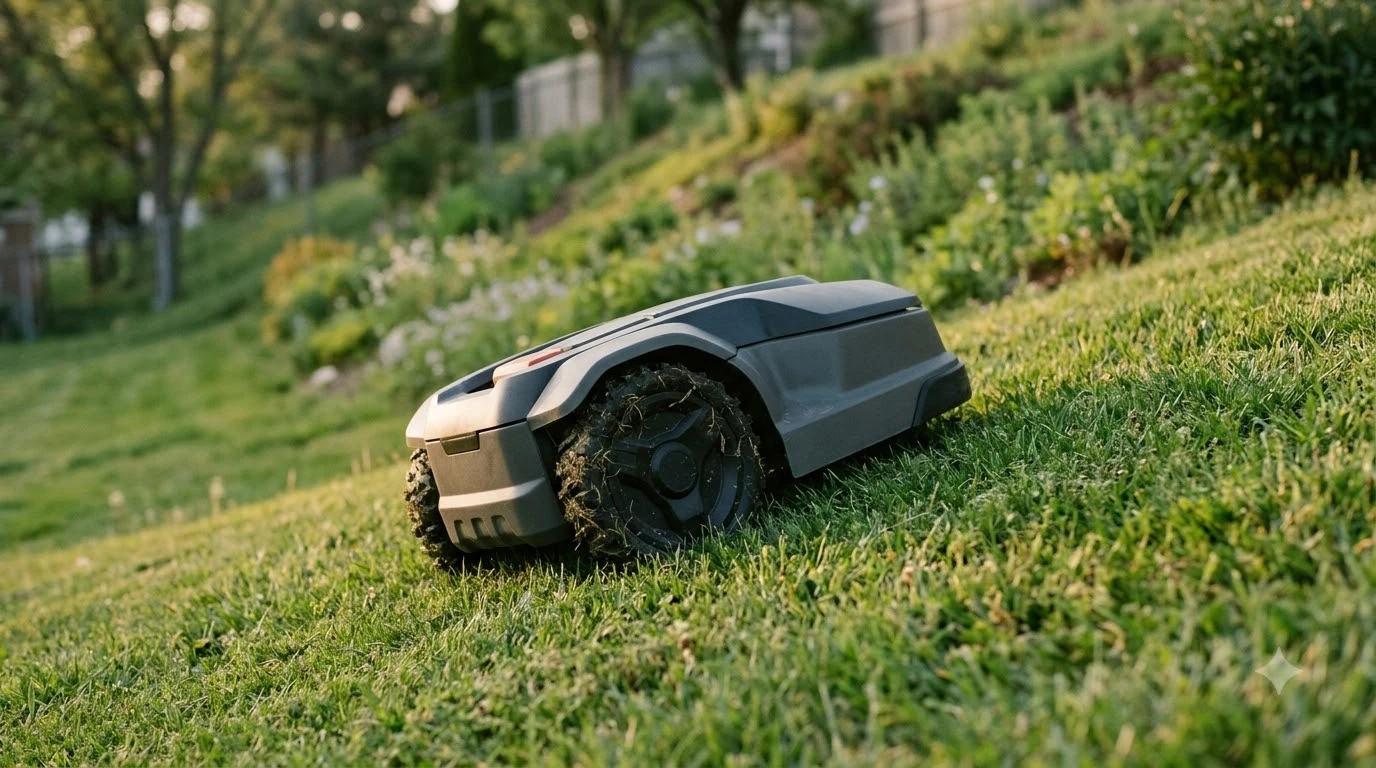

How steep a slope can a robot mower handle? Most standard models are rated for about 25 to 50 percent grade, which is roughly 14 to 26 degrees, and some all-wheel-drive models reach 70 percent (35 degrees). Those figures come from one manufacturer’s published limits, and other brands use different scales. The safe approach is to measure your steepest section, compare it with the rating in the same unit, and leave a margin for wet grass.
The short answer
- Typical standard model: 25 to 50 percent grade (about 14 to 26 degrees), depending on the model.
- All-wheel-drive models: up to 70 percent (about 35 degrees) on some hillside designs.
- Boundary wire limits are lower than the work-area limit, in some models as low as 10 percent.
- Margin: rate the mower above your steepest section, not at it, especially when grass is wet.
Percent grade and degrees are not the same number
Slope is written two ways, and mixing them causes most of the confusion. A percent grade is the vertical rise divided by the horizontal run, times 100. A 15 cm rise over 100 cm is 15 percent. Degrees measure the actual angle. Because the tangent of the angle is the ratio, 40 percent works out to about 21.8 degrees, not a round 18 or 22 degrees as some listings claim. Always convert both figures to the same unit before comparing a mower with your lawn. Published limits vary, so compare them with how models handle slopes in a single tested roundup before you decide.
Some manufacturers publish only percent, others only degrees, and some show both. Two listings for the same model can disagree, so take the number from the manufacturer manual when you can.
How steep a slope can a robot mower handle? The published limits
Husqvarna’s support documentation gives a useful picture of how limits differ by model. Its standard models run from 25 to 50 percent (14 to 26 degrees), with the lower end on entry models such as the Aspire R4 and the 50 percent end on higher-spec NERA versions. The 435X AWD and 435X AWD NERA are listed at up to 70 percent (35 degrees). That spread shows why a single answer to “how steep” does not exist across the category. The drivetrain often decides whether a stated grade is realistic, as 2WD versus AWD traction on hills explains in detail. Which axle pulls also matters on wet grades, and front versus rear wheel drive on slopes covers that trade-off.
Keep in mind that the work-area limit is not the only number. The same documentation lists boundary-wire limits that are lower than the work-area figures, from 10 percent on the entry model to 50 percent on the AWD model. A slope that the mower can climb may still be too steep to sit beside the wire.

How to measure your own slope
You do not need a surveyor’s level to check your lawn. Lay a straight board or a long level across the slope, then measure the height difference at the far end with a tape. Divide the rise by the run and multiply by 100 to get percent. Measure the steepest strip you plan to mow, not the average across the whole yard, because the mower is limited by its toughest section.
Check wet conditions too. Grass that is soaked or slick can cause slipping on a slope that is within the rating when dry. Many owners set a more conservative boundary for rainy seasons and rely on a stay-out zone on the steepest bank.
Installing a robot mower on a steep lawn
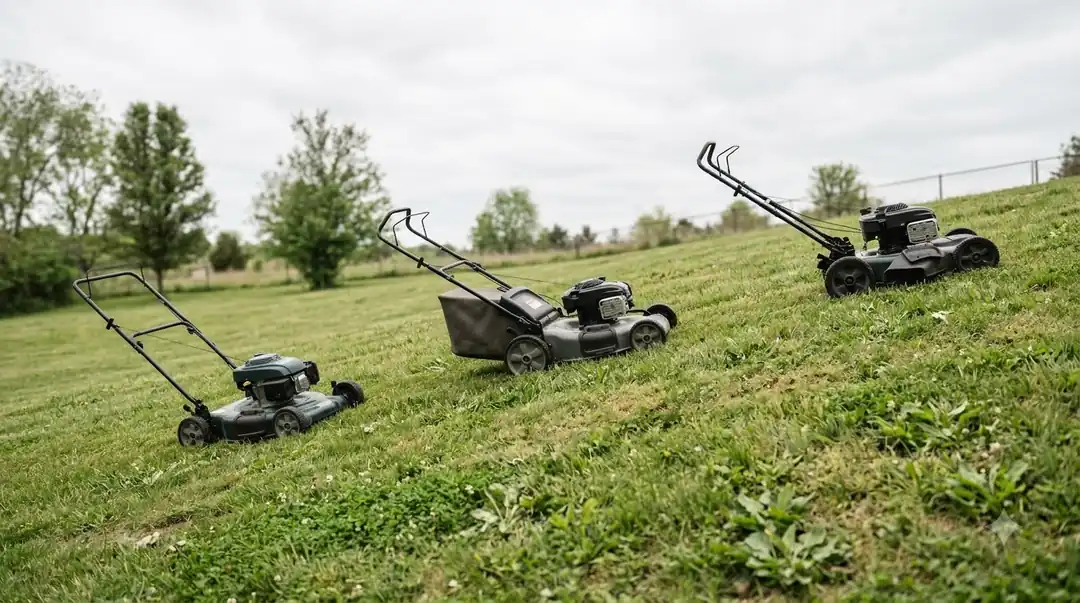
The manufacturer guidance is consistent about installation. Keep the steep areas inside the model’s limit and exclude anything steeper with a stay-out zone or a boundary island. If a slope borders a public road, install a barrier along its outer edge. Where the outer edge is too steep, move the boundary inward onto flat ground before the slope begins. Slopes shorten runtime, so look at battery size and runtime on slopes when planning how much of the lawn one charge covers.
Route the transport paths straight or diagonally across the slope rather than up it, and set the mowing pattern to run up the slope where possible. Obstacles such as trees or rockeries force sharp turns, and turns on a grade increase the chance of slipping, so use irregular patterns in complex areas or exclude the awkward patch.
Heads up
Keep wheels free of clippings with a soft brush or hose. Clumped grass on the drive wheels is a common cause of slipping, and it reduces grip even on a slope that is well within the rating.
Where height and slope meet
Slope and cutting height interact. On a steep bank, a low cut exposes soil and makes wheel slip more likely, so keeping the grass a little taller on slopes often helps. Clemson Cooperative Extension advises removing no more than one-third of the grass height at any one mowing, and a robot mower that cuts often in small amounts is well suited to that rule. Set the height for your grass type first, then check the slope limit. Climbing demands torque from the drive motors, and motor type and climbing power are explained in a short comparison of motor designs.
Is a robot mower right for a steep yard?
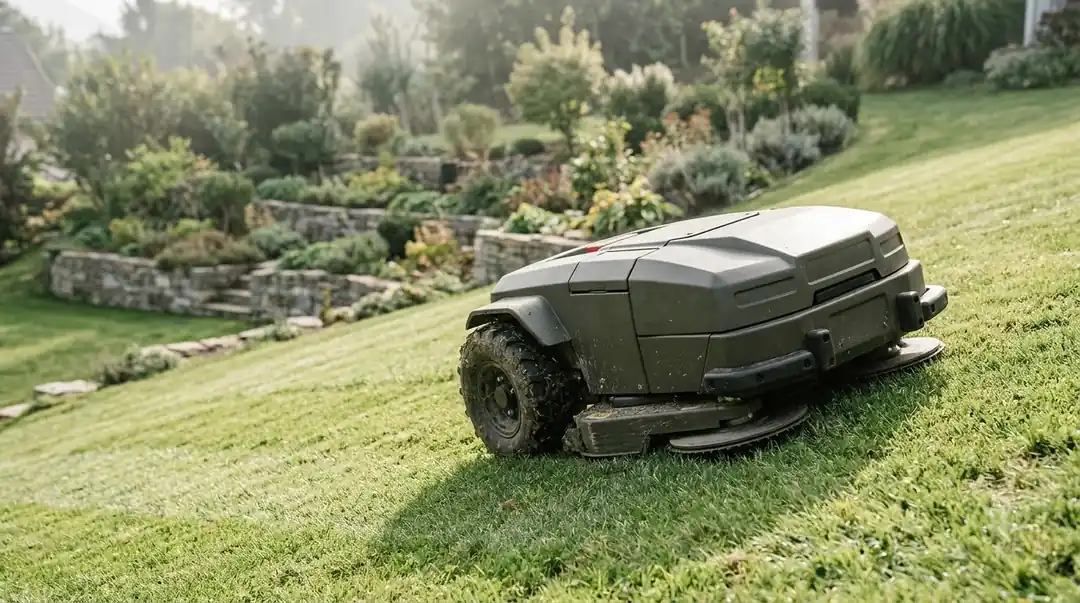
A steep yard is a reasonable fit when the steepest section sits clearly under the rating, the lawn is open enough for reliable navigation, and you can exclude any bank that is too steep. It is a poor fit when the steepest slope is already at the limit, when the grass is often wet, or when a steep edge runs along a road or drop-off. In those cases, a smaller mower sized for flat ground, or a manual cut on the bank, may be the safer choice. One model-level example of a limit that can fall short is Lidax Ultra 2000 slope limit gaps against its spec sheet. On steep ground the choice of drive matters, and the Ecovacs GOAT O1000 vs Mammotion LUBA 3 comparison weighs two models side by side.
Our reading is that a margin of 5 to 10 degrees above your steepest section is a sensible target. That margin covers wet grass, dips in the ground, and the difference between a rated figure and real conditions.
Frequently asked questions
How steep a slope can a robot mower handle in degrees?
Standard models are commonly rated around 14 to 26 degrees. Some all-wheel-drive designs reach about 35 degrees. Check the manual for the exact model you buy.
Is 40 percent slope the same as 40 degrees?
No. A 40 percent grade is about 21.8 degrees. Forty degrees is far steeper, roughly 84 percent grade.
Can a robot mower climb a slope when the grass is wet?
It may slip even within the rated limit. Keep a margin below the rating and clean the wheels, and consider a stay-out zone for the steepest bank when conditions are poor.
Why is the boundary wire limit lower than the work area limit?
The wire is placed along the edge of the mowing area, and the manufacturer documentation lists a lower limit there for several models. Keep steep edges within that smaller figure.
Sources
- Husqvarna, optimising an Automower installation for steep slopes (manufacturer): standard limits of 25 to 50 percent, the 70 percent AWD rating, boundary wire limits and installation advice.
- Clemson Cooperative Extension, mowing lawns (university): removing no more than one-third of grass height per mowing.
 Up next8 min readReviews & CompareWhich Robot Mower Handles Slopes Best Tested? Specs ExplainedUpdated Nov 12, 2026
 7 min readReviews & CompareIs the Mammotion LUBA 2 AWD Worth It? Slopes, Height and LimitsUpdated Nov 17, 2026
 7 min readReviews & CompareIs the Navimow i210 AWD Worth It? Slopes, Area and LimitsUpdated Nov 17, 2026
 6 min readReviews & CompareAnthbot M5 Slope Limit: What 45 Percent Means on Your LawnUpdated Nov 14, 2026
 8 min readReviews & CompareMOVA LiDAX Ultra 1000 Review: Specs, Slope and LimitsUpdated Nov 16, 2026
 8 min readReviews & CompareMOVA LiDAX Ultra 3000 AWD Review: Specs and Slope LimitsUpdated Nov 16, 2026