
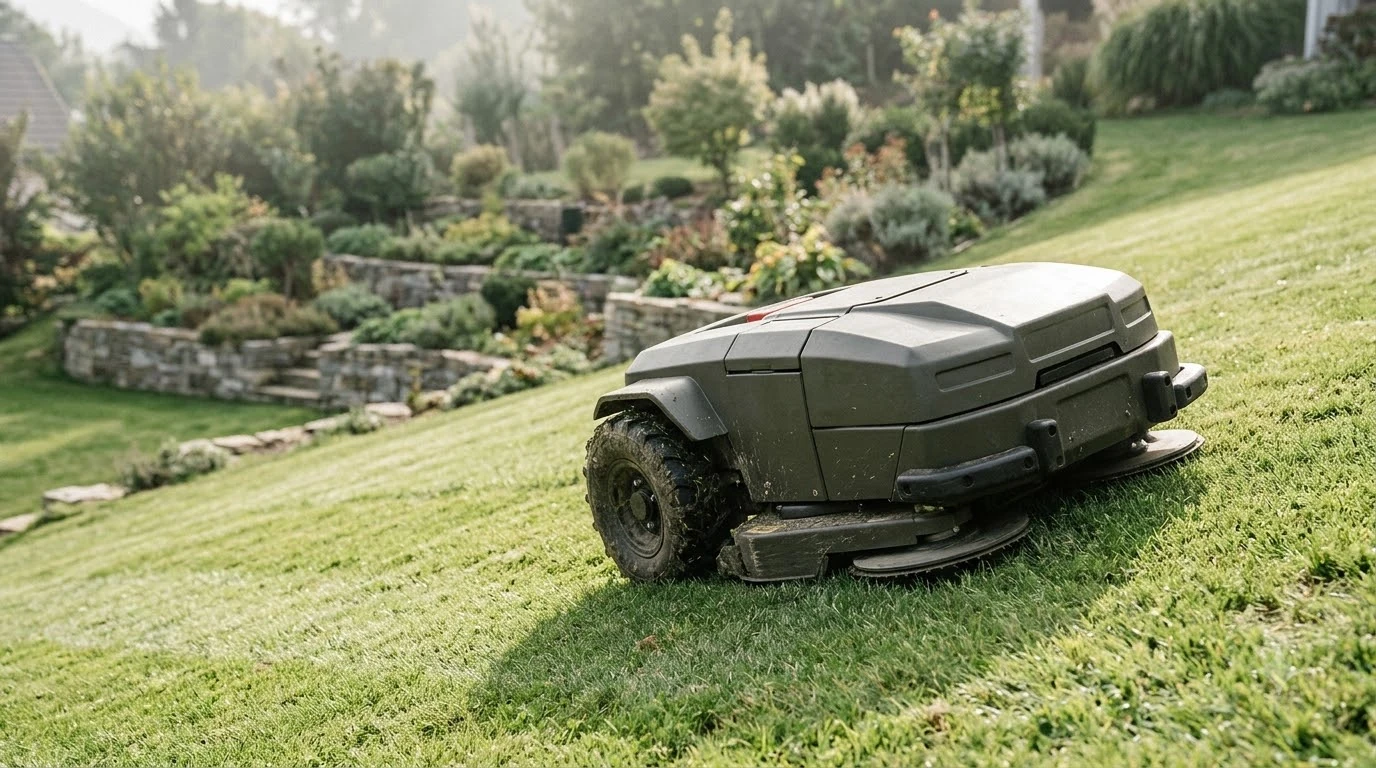

A robot mower for a lawn with a sunken patio works best when the patio edge is treated as a drop-off, not as a path. A mower that rolls over the edge can tip, get stuck below the lawn line, or damage its wheels and housing. The fix is a boundary set back from the edge, a clear no-go area, and a lawn edge that is level with the patio rim before the mower runs unattended.
The short answer
- Treat the rim as a drop: keep the boundary wire or virtual boundary inside the lawn, not on the patio edge.
- Set back from the edge: Robomow uses about 35 cm of distance for obstacles that could let the robot fall in, such as ponds.
- Fill dips: Eufy advises filling soil dips deeper than about 3 cm, or using a virtual boundary.
- Test by hand first: walk the edge and check for any gap the wheels could drop into.
- Read your model’s rule: the closest wire distance applies only in certain conditions, so use the manual’s number.
Why a sunken patio is a drop-off
A sunken patio sits below the lawn. From the mower’s point of view, the edge is not a bump it can climb but a step down into empty space. Robot mowers handle low spots and small dips in the lawn, but a surface several centimeters below the turf gives the wheels nothing to grip on the way down, and the mower can end up tilted or wedged against the wall. A sunken patio is one of several hardscape features, and the mower guidance for paths and fixtures covers the others. A drop behaves like a bank edge, and drop-off bank buffers explain how much flat margin to keep.
Sloped or sunken edges also cause a second problem. Once the wheels are over the edge, the robot may keep trying to drive forward, which can pull the body into the hole and leave it stuck until someone rescues it. For this reason, the question is not only whether the mower can cut the grass near the patio, but whether it can stop before the edge.
Robot mower for a lawn with a sunken patio: set the boundary back
The practical answer is to keep the boundary wire a safe distance from the drop. Robomow’s guidance for hazards like ponds uses about 35 cm of distance, plus any obstacle that stops the robot from falling in. A sunken patio is a similar hazard, so a wider setback is a reasonable first choice until you test your own edge. A level patio is simpler, and patio edge boundary handling shows the baseline before you add the drop.
Robomow also gives a closer distance for paved surfaces, around 10 cm, but only when the surface is at ground level or lower than the lawn. That exception is the reason to read the manual carefully. A sunken patio is lower than the lawn, so the closer distance should not be used as a shortcut without checking the rules for your model.
Heads up
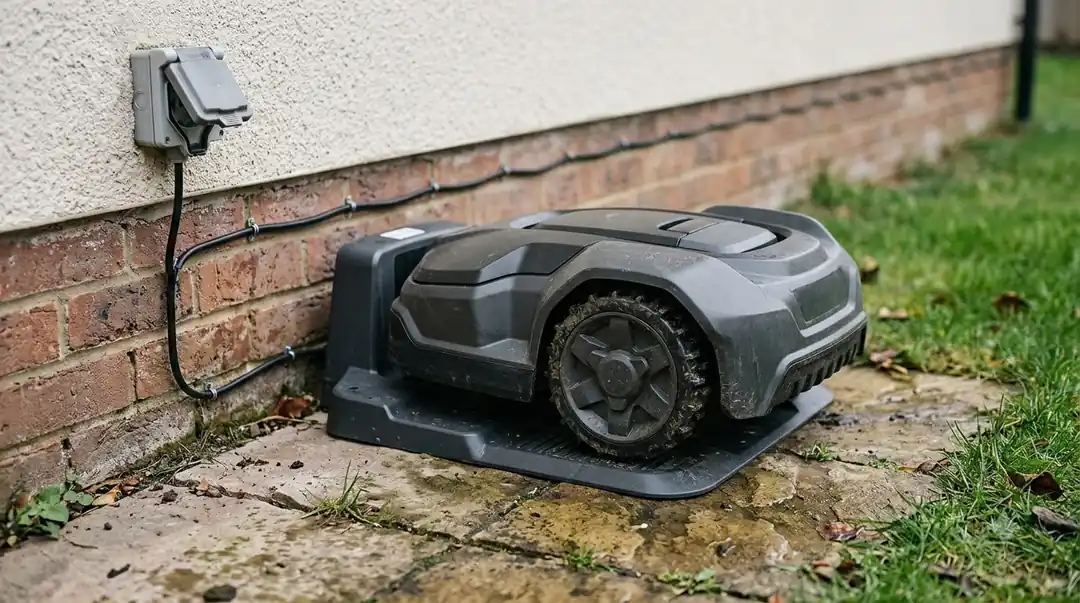
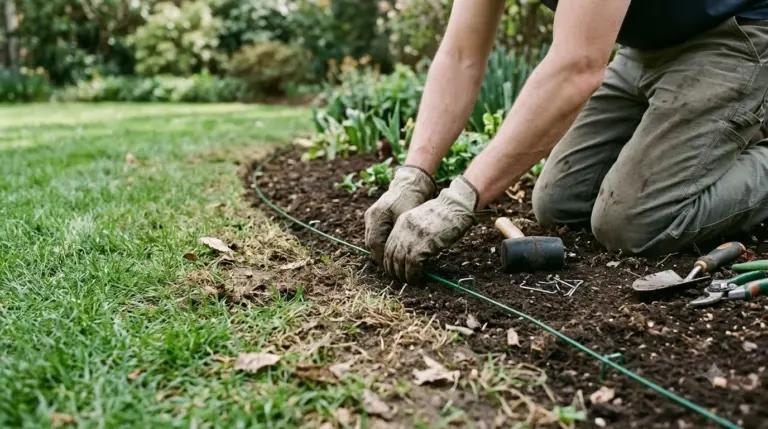
Do not rely on the wire alone at a sunken edge. Wire can be damaged by edging work or frost heave, so inspect the run every season.
Fill the lip and dips before you set the wire
A lawn that runs down to the patio often has a dip just before the rim, where soil has settled or been cut away. Eufy’s slope guidance describes soil dips deeper than about 3 cm as something to fill or handle with a virtual boundary. The same logic applies here. If the grass drops away near the patio, bring the soil up to the patio’s height so the mower meets a level edge rather than a sudden step. Smoothing the lip is similar to repairing other uneven spots, as filling holes and dips explains.
Filling is also the better long-term option. A level transition means fewer scrapes on the blades, less chance of wheel slip, and a boundary that does not have to sit unusually close to the edge.
Use a no-go zone where the wire cannot go
Some patio edges are too awkward for wire, such as a short retaining step or a curved wall. In those spots, a no-go zone or a physical barrier can keep the mower from approaching the drop. Some wire-free systems let you draw the no-go area on a map instead of running wire along the edge, which can be easier to adjust later. Mapped zones are the usual fix, and a no-go zone mapping example shows how to draw one.
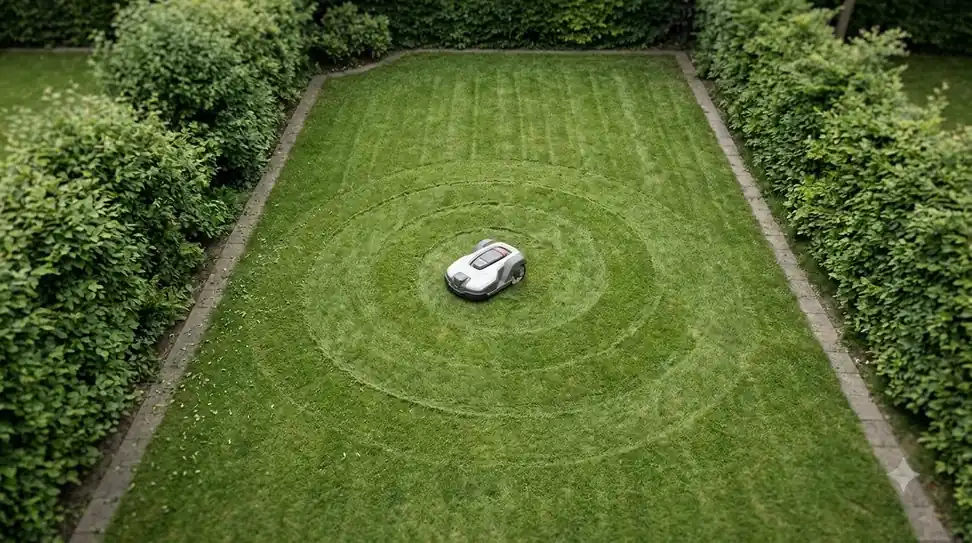
Whatever you choose, plan for the mower to reach the patio’s edge in normal use. If it can get close and then turn away, the zone is working. If it keeps pushing against the same spot, the boundary is too close or the edge needs filling.
A quick check before you run the mower unattended
- Measure the drop. Find the height difference between the lawn and the patio rim, and note any spot where it is larger.
- Set the boundary back. Place the wire or virtual boundary inside the lawn, with a margin from the rim that matches your model’s manual.
- Fill the dips. Bring soil up where the lawn falls toward the patio, especially any dip deeper than about 3 cm.
- Test by hand. Walk the edge and confirm there is no gap the wheels could drop into.
- Supervise the first runs. Watch the mower near the patio for at least a few cycles and stop it if the wheels spin or the body tilts.
Expect some maintenance. Patio edges collect leaves, washed-in soil, and clippings, and these can change the height of the lawn edge over time. Check the setup after heavy rain or a season of edging work. Hard edges at grade are covered in the brick walkway edge check.
Related reads: A covered slab with an exposed edge is another case worth reading, and slab edges under a gazebo cover it. Raised decks create a similar hard edge beside the lawn, which is covered in more detail in raised deck edges.
Frequently asked questions
Can a robot mower drive onto a sunken patio?
It should not be allowed to. A surface below the lawn is a drop, and a mower that rolls over the edge can tip or get stuck. Keep the boundary inside the lawn and treat the rim as a hard stop.
How far should the wire be from a sunken patio edge?
Robomow uses about 35 cm for hazards like ponds, and a closer 10 cm only for certain paved surfaces at ground level or lower than the lawn. Use the number in your model’s installation guide, and start with a wider setback if you are unsure.
What if the lawn slopes down toward the patio?
Fill the dip so the lawn meets the patio at a level edge, and check that the slope itself is within your model’s limit. A steep drop near the patio needs a wider setback than a flat edge.
Can I use a virtual boundary instead of wire near the patio?
Some wire-free systems can mark the edge on a map, which helps for awkward shapes. Test the boundary by hand and watch the first runs, because map accuracy near a drop matters more than in open lawn.
Sources
- Laying the lawn boundary wire (Robomow): wire distances from ponds, paths and walls, and the rule for paved surfaces at or below lawn level.
- Robot lawn mower slope limits (Eufy): soil dips deeper than 3 cm need filling or a virtual boundary; sharp drops trap mowers.
- Can robotic lawn mowers handle slopes? (Sunseeker): natural hazards such as roots, rocks and sudden drops on sloped ground.
 Up next7 min readBy YardChoosing a Robot Mower for a Yard with a Sloped Walkout Basement PatioUpdated Nov 19, 2026
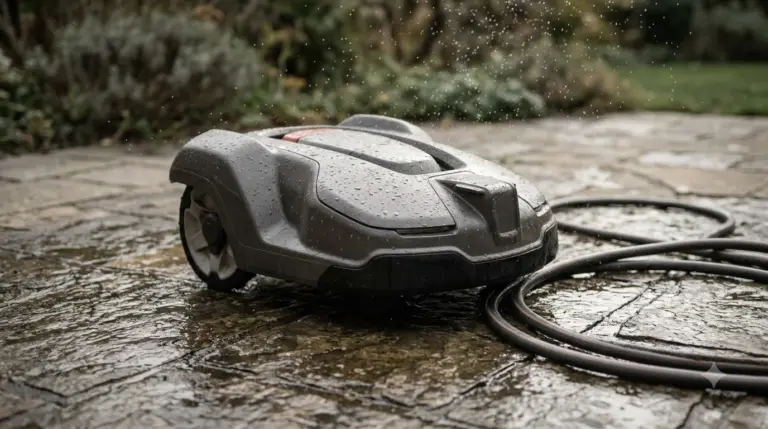 8 min readBy YardHow Does a Robot Mower Handle a Patio? Wire and Edge RulesUpdated Nov 12, 2026
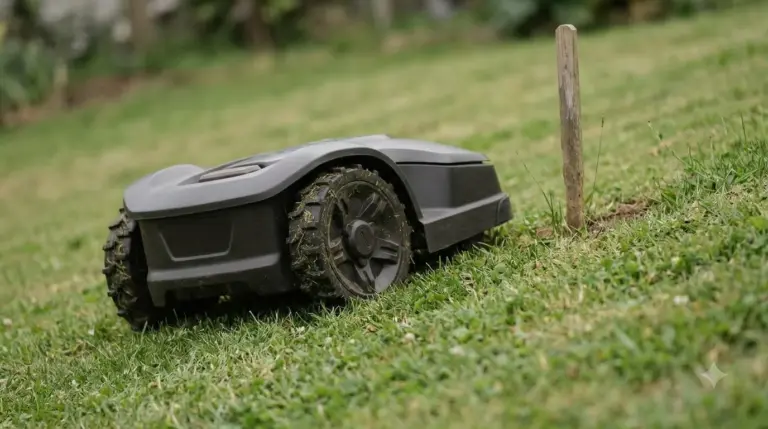 7 min readBy YardRobot Mower for a Lawn With a Sloped Ditch: Where to Set the BoundaryUpdated Nov 14, 2026
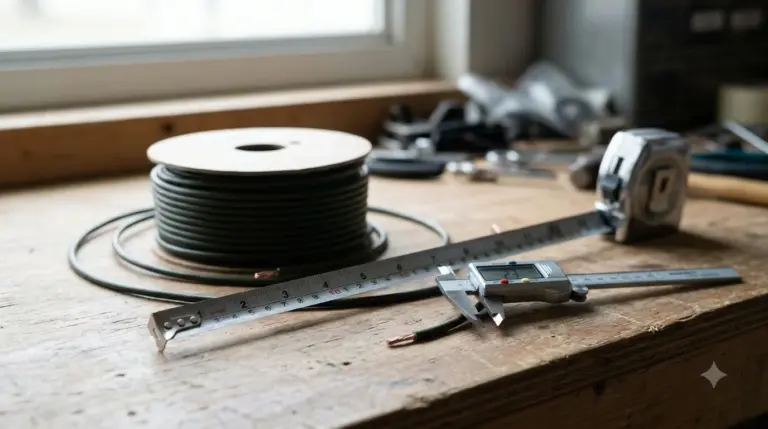 8 min readBy YardHow Much Boundary Wire Do You Need for a Robot Mower?Updated Nov 11, 2026
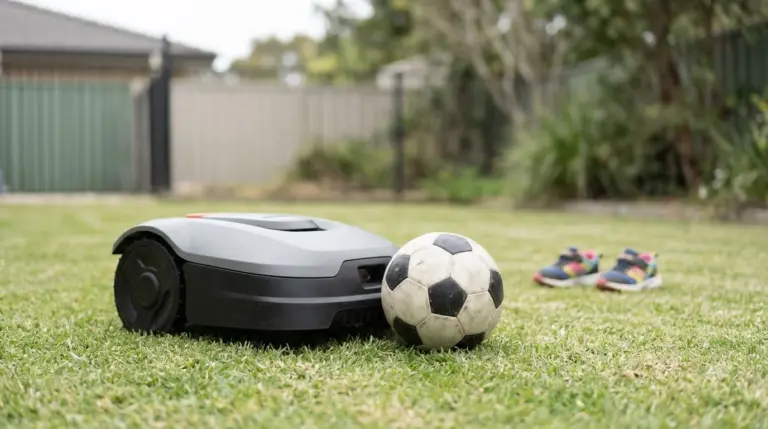 9 min readBy YardHow to Lay Boundary Wire Around Trees and ObstaclesUpdated Nov 11, 2026
 8 min readBy YardShould You Bury or Peg Robot Mower Boundary Wire?Updated Nov 11, 2026