
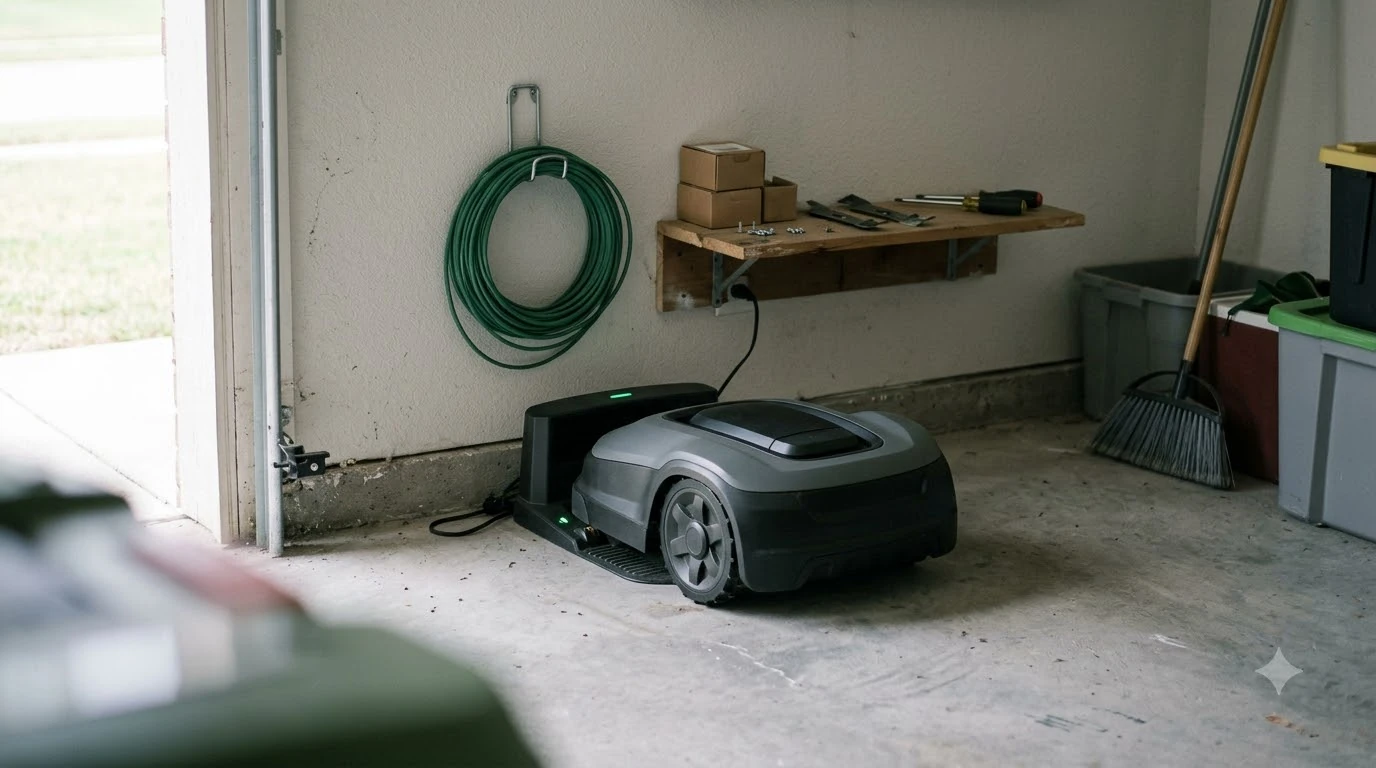

Robot mower for a lawn with a shed in the middle works well when the shed is wired as an island. The mower cuts the grass around the building, and a boundary loop keeps it from driving into the walls, the door threshold, or the shed’s base. The setup is straightforward, but the wire has to be laid carefully so the island closes correctly.
The short answer
- Wire the shed as an island: a loop of boundary wire around the building keeps the mower out of that footprint.
- Keep the wires close: the two wire runs on the way back must sit together, or the island will not be recognized.
- Plan the access paths: leave clear grass on each side so the mower can cut behind the shed.
- Test before scheduling: run a supervised cycle to check the turns around the shed.
Why a shed in the middle is a good island candidate
A shed is a fixed obstacle with hard walls and a raised base. A robot mower should not hit it, and the walls can scuff the body or confuse the sensors if the mower corners too tightly. An island wire tells the mower that the whole footprint is off limits, so it turns before it reaches the building. A shed is a common outbuilding, and the garden shed yard mower overview covers picks and checks for it. Other raised structures behave in a similar way near the building, as wooden deck obstacle edges show in more detail for this case.
Our reading is that a shed in the middle of a lawn is simpler to handle than a shed at the edge, because the mower can cut all the way around it. The trade-off is that the grass behind the shed takes more time to reach, so the schedule should allow for the extra passes.
Robot mower for a lawn with a shed in the middle: island setup
The island method for a robot mower is a loop that starts and ends at the main boundary wire. Husqvarna’s guide to creating islands in a boundary wire describes the basic sequence. The wire runs from the boundary to the obstacle, goes around it, and returns along the same path, with the two returning wires placed close together so they cancel the signal. A glass structure takes a similar approach, and the greenhouse island and wire spacing guide adds the spacing detail.
- Mark the footprint. Outline the shed with stakes or spray paint, and add a margin so the mower stays a short distance from the walls.
- Run the wire out. Lay the wire from the main boundary to the shed, keeping it off the paving or concrete if the shed has a slab.
- Loop the shed. Go all the way around the footprint without crossing the wire.
- Close the loop. Bring the two return wires back together along the same path, so they sit close and do not cross.
The margin is a judgment call. Manuals often give a model-specific clearance around an obstacle, so use that figure if your mower publishes one. If it does not, test with a short run and adjust.
Heads up
Do not let the wire cross itself or run across the shed door path. A crossed wire can stop the mower from recognizing the island, and a wire on a walkway can get cut.
Access and cutting behind the shed
One of the most common questions is whether the mower can cut the grass behind a shed. It can, as long as the island is set with enough room for the mower to pass. Keep a gap of grass on each side of the building, and avoid a narrow strip that is too tight for the mower to turn in. If a bin sits behind the shed, the compost bin access path explains how to keep the route open. Small lots leave little room to cut behind a shed, which is where robot mowers for a postage stamp lawn need careful choices.
Grass directly against the walls will usually stay uncut, since the mower stays outside the island. Plan to trim that strip by hand or with a string trimmer every few weeks. A small patch of uncut grass against the walls is normal and is easier than wiring a tighter loop that risks contact.
Keep the shed door and paths clear
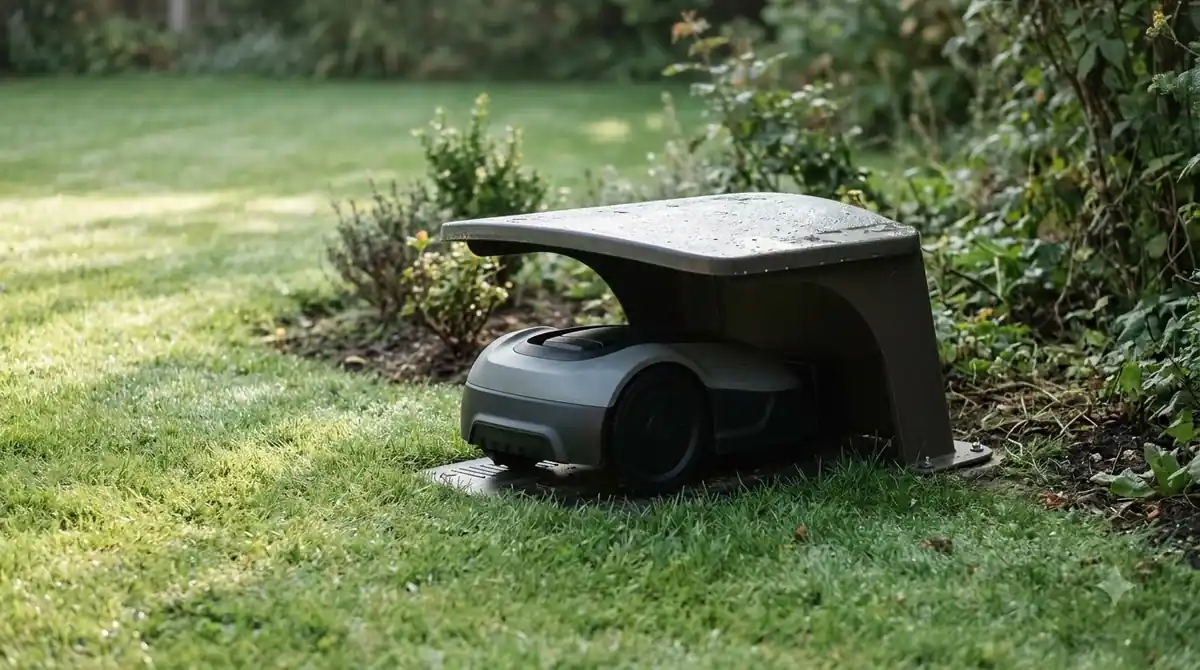
A shed door often opens onto a path, a patio, or a gravel strip. Keep that path out of the working area or give it a stay-out zone in the app. Husqvarna’s documentation on creating stay-out zones explains how zones are drawn on the map. A zone is useful for a flexible path, but it does not replace a physical wire near a drop or a hard surface. Paved transitions beside the door can be tricky, and patio and path edges explain how to treat them.
Also check the approach to the shed. If a path runs toward the building, the mower may try to follow it. A wire that keeps the mower on the grass side of the path is the more reliable stop.
Maintenance over the season
Wire can shift when the soil settles, and grass can creep over a buried line. Walk the island once a month and check that the wire is still at the right depth and the loop is closed. After heavy rain or frost, look at the loop again, since the ground can move and expose or dislodge the wire. Seasonal debris collects against walls, so a fall leaf cleanup routine keeps the cut clean.
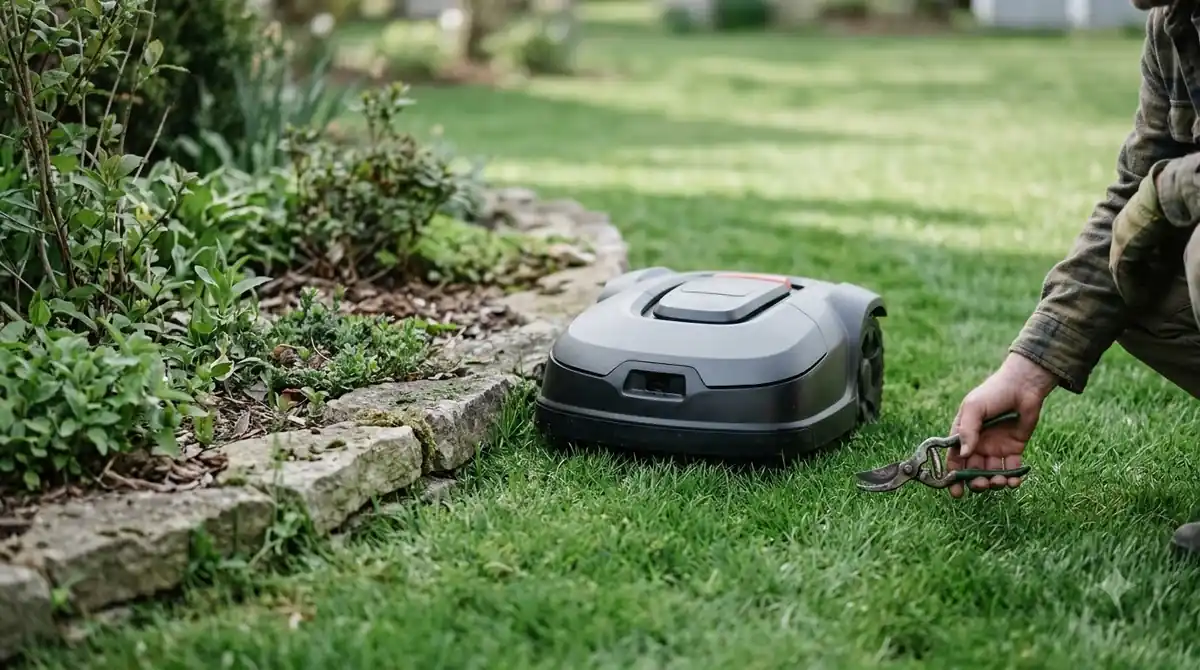
Keep clutter away from the island. Rocks, sticks, and garden tools left near the shed can damage the wire or block the mower’s path. Clear them before each season begins.
Related reads: Another covered space on the property is discussed in the carport parking spot guide.
Frequently asked questions
Can a robot mower cut a lawn with a shed in the middle?
Yes. The usual approach is to wire the shed as an island so the mower cuts around the building and stays out of its footprint.
Why do the two island wires need to sit together?
The wires carry opposite signals, and placing them close together cancels the field so the mower can pass over them. If they cross or spread apart, the mower may not recognize the island and can stop.
Will the mower cut the grass right against the shed walls?
Usually not. The island keeps the mower a short distance from the walls, so a narrow strip stays uncut. Trim that strip by hand or with a string trimmer.
Can I use a stay-out zone instead of an island?
A stay-out zone works on a map for flexible areas, but it is not a physical barrier. For a shed with walls and a raised base, a boundary wire island is the more reliable choice.
Sources
- How to create islands in a boundary wire installation (Husqvarna): the loop sequence and the rule that the wires must not cross.
- Creating stay-out zones with AIM technology (Husqvarna): how zones are drawn and their limits.
 Up next9 min readBy YardHow to Choose a Robot Mower for a Yard With a Garden ShedUpdated Nov 16, 2026
 7 min readBy YardRobot Mower for a Lawn With a Sloped Ditch: Where to Set the BoundaryUpdated Nov 14, 2026
 6 min readBy YardRobot Mower Concrete Basketball Pad Edge: Set the Wire RightUpdated Nov 14, 2026
 7 min readBy YardRobot Mower for a Lawn With a Gravel Driveway: Keep It Off the DriveUpdated Nov 14, 2026
 7 min readBy YardRobot Mower for a Lawn With a Narrow Side Gate: Width RulesUpdated Nov 14, 2026
 6 min readBy YardRobot Mower for a Lawn With a Compost Bin: Zone and Route SetupUpdated Nov 14, 2026