
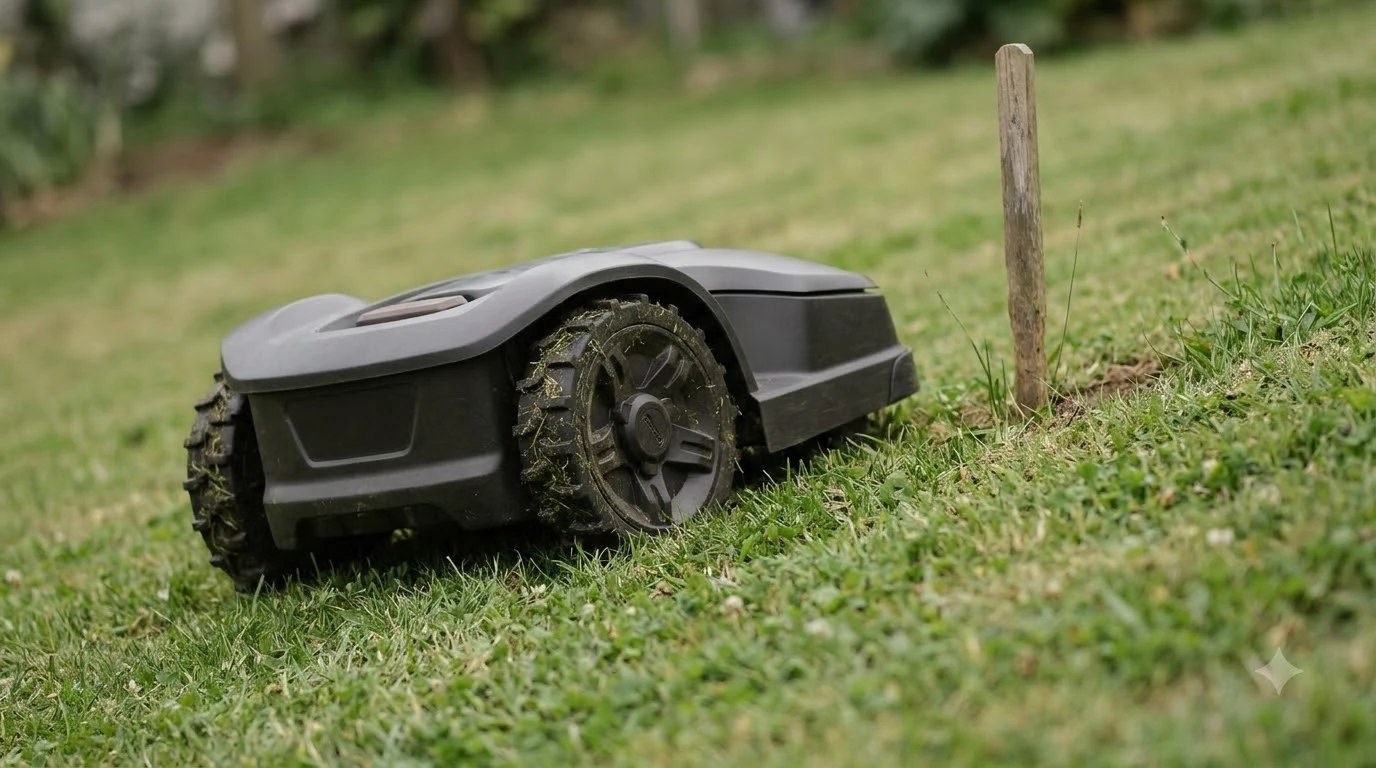

A robot mower for a lawn with a sloped ditch needs the boundary set back from the top of the bank, because the ditch is a drop-off and the slope beside it can exceed what the mower can climb safely. The mower can cut the flat lawn above the ditch, but it should stop well before the slope starts. The right setup depends on the grade of the bank, the distance to the edge, and the slope rating in your model’s manual.
The short answer
- Stop before the slope: Husqvarna advises positioning the boundary further in on flat ground, before the slope begins.
- Leave flat ground: Husqvarna recommends at least 50 cm of level ground between the flat lawn and the steep part.
- Keep a wide margin on steep banks: for all-wheel-drive models on steeper slopes, Husqvarna gives 1.5 m from the bottom of the slope to the wire.
- Treat the ditch lip as a hard edge: Eufy lists steep embankments as no-go areas and notes that sharp drops trap mowers easily.
- Check the rating: the slope figure in the manual is a limit, not a daily target.
What a sloped ditch does to a robot mower
A sloped ditch combines two hazards. The bank tilts the mower sideways and forward, and the ditch at the bottom is a drop. A mower that crests the bank can tip, slide, or roll into the channel, and once it is in the ditch the wheels often have no grip to climb back out. Even a shallow ditch can strand a mower if the lawn beside it is soft or wet. A sloped ditch is one form of a side slope, and the guidance for side slopes and ditches covers the broader pattern. The main hazard at a bank edge is rolling, which the tip-over risk on hills explains in more detail.
The bank is also where grass is hardest to cut evenly. The mower may lose traction on the slope and leave uneven stripes or bare patches, which makes the lawn look worse even when the mower stays safe.
Robot mower for a lawn with a sloped ditch: find the grade first
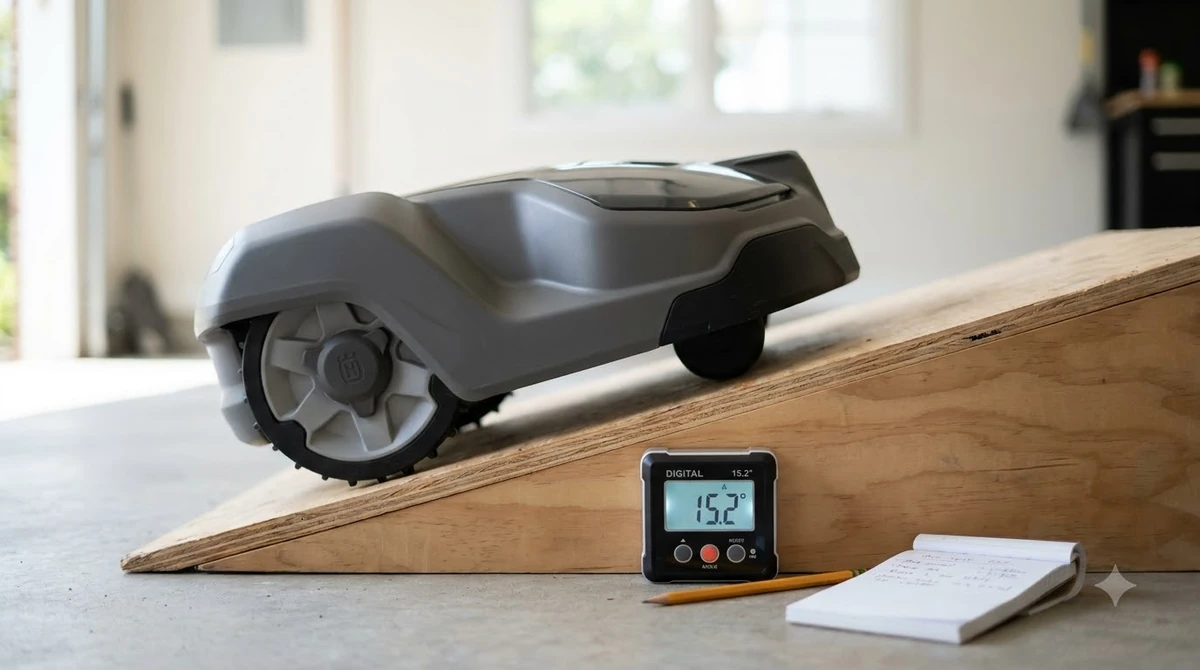
Before setting the boundary, measure the bank. Iowa State Extension gives a simple reference: slope is rise over run, a 1:5 grade (20%) is steep, and grades near 30% (1:3) are too steep to mow with ordinary equipment. Robot mower ratings are a separate figure, so use the number from your model’s manual to decide, and keep the extension figure as a general warning. Finding the grade first is the same step as in the hillside lawn layout, where it is applied to a whole slope. If the grade is steep enough to affect your choice of model, the hill-capable mower picks and ratings give a starting point.
Eufy’s rating guidance adds an important point: a slope rating is an absolute limit, not a target for everyday mowing. A mower rated for 25 percent should not be asked to work at its limit on a wet bank beside a ditch. Use the lower end of the rating for banks next to any drop.
Heads up
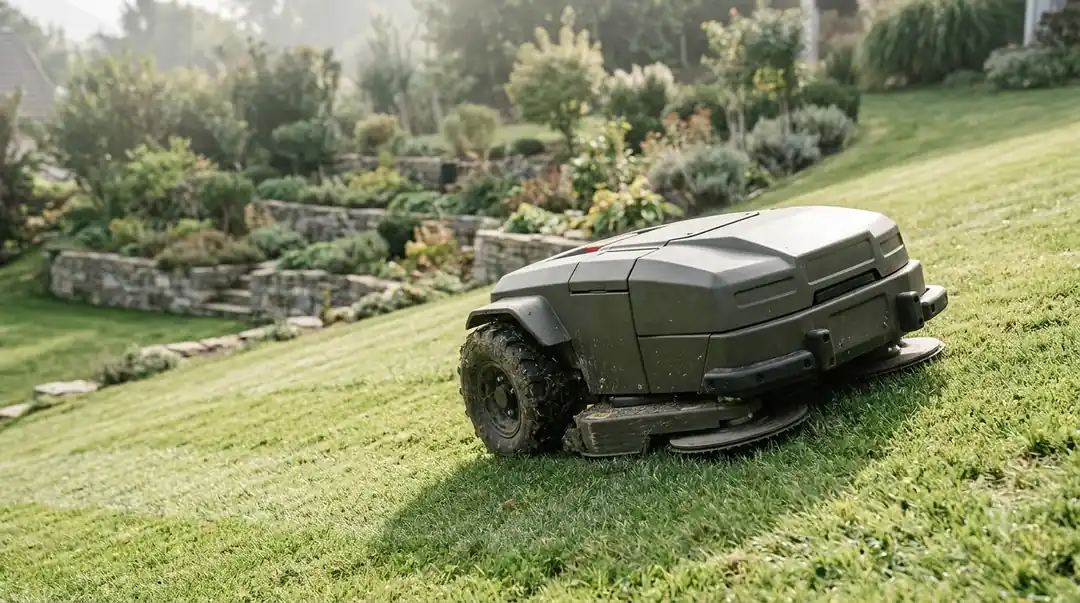
Eufy warns that deep holes, thick tree roots, and sharp retaining drops trap mowers easily. A ditch with roots or a crumbling lip needs a wider setback than a clean, grassy bank.
Set the boundary before the slope starts
The main rule is simple: put the wire where the flat lawn ends, not at the top of the bank. Husqvarna’s steep-slope guidance says to position the boundary further in on flat ground before the slope begins. That keeps the mower on level turf while it turns, and it gives the wheels a margin if the bank edge is soft. Where the ditch also carries water, the drainage ditch mowing limits explain how that changes the boundary.
For steeper banks, Husqvarna’s all-wheel-drive guidance keeps the boundary about 1.5 m from the bottom of the slope, and suggests running the guide wire diagonally across the slope rather than straight up and down. A diagonal layout helps the mower approach the slope at an angle it can handle, and it avoids forcing the robot to turn on the steepest part.
Keep a flat buffer between the lawn and the bank
A flat buffer is the cheapest protection. Husqvarna recommends at least 50 cm of level ground between the flat lawn and the steep section, which gives the mower a place to straighten out before it reaches the grade. If the lawn runs straight into the bank, consider a strip of flat grass to create that buffer, or move the boundary further back. A wall at the edge of the bank needs a similar margin, and the retaining wall buffer distance gives typical figures.
Fill low spots along the top of the bank. Eufy’s slope guidance describes soil dips deeper than about 3 cm as something to fill or handle with a virtual boundary. A dip at the lip can tip the mower forward as it reaches the edge.
A quick check before the first unattended run
- Measure the bank. Find the rise and run, then convert the grade into a percentage and compare it with the rating in your manual.
- Find the flat edge. Mark where the level lawn ends, then place the boundary further in from that point.
- Add a buffer. Leave at least 50 cm of level ground before the steep part, and more on steep banks.
- Fill the dips. Level any soft spot near the lip, especially a dip deeper than about 3 cm.
- Watch the first runs. Stop the mower if it slides, spins at the top of the bank, or stops with its front wheels over the edge.
Recheck the setup after heavy rain, mowing that removes soil from the bank, or any erosion that moves the lip. A ditch edge changes faster than a flat lawn edge. Before the first unattended run, the slope cutting direction check helps you pick a safe pattern.
Related reads: Properties with both a bank and flat ground may prefer the sloped front yard and flat backyard plan.
Frequently asked questions
Can a robot mower cut a lawn that slopes into a ditch?
It can cut the flat part of the lawn, but the bank and the ditch should stay outside the mowing area. Keep the boundary back from the top of the slope, leave a flat buffer, and do not let the mower work on the steepest part.
How steep is too steep for a robot mower next to a ditch?
Use the rating in your model’s manual, and remember it is a limit, not a target. Iowa State Extension calls grades of 20 percent steep and grades near 30 percent too steep to mow. Next to a ditch, use the lower end of the rating.
How far back should the boundary be from the top of a ditch bank?
Husqvarna advises placing the boundary on flat ground before the slope begins, with at least 50 cm of level ground between the flat lawn and the steep part. On steeper banks, its all-wheel-drive guidance uses about 1.5 m from the bottom of the slope.
What if the mower gets stuck in the ditch?
Power it off, lift it carefully with help, and check the wheels and blades for damage. Then move the boundary back and fill the lip. Repeated trips into the same ditch mean the setback is too small.
Sources
- Optimise an Automower installation for steep slopes (Husqvarna UK): boundary before the slope, 50 cm of level ground, 1.5 m margin for AWD models on steep slopes.
- Robot lawn mower slope limits (Eufy): ratings as absolute limits, steep embankments as no-go areas, soil dips deeper than 3 cm.
- Gardening on slopes and hillsides (Iowa State University Extension): slope as rise over run, 20 percent as steep, about 30 percent as too steep to mow.
 Up next8 min readBy YardChoosing and Setting Up a Robot Mower for a Lawn with Steep Culvert Ditch BanksUpdated Nov 19, 2026
 8 min readBy YardWhere to Place RTK Antenna in a Yard With TreesUpdated Nov 11, 2026
 8 min readBy YardCan a Robot Mower Mow a Drainage Ditch?Updated Nov 11, 2026
 9 min readBy YardWhere to Put a Robot Mower Charging Station (Placement Rules)Updated Nov 11, 2026
 6 min readBy YardRobot Mower Concrete Basketball Pad Edge: Set the Wire RightUpdated Nov 14, 2026
 6 min readBy YardRobot Mower and Wood Chips Under a Swing Set: Keep It Off the ChipsUpdated Nov 14, 2026