
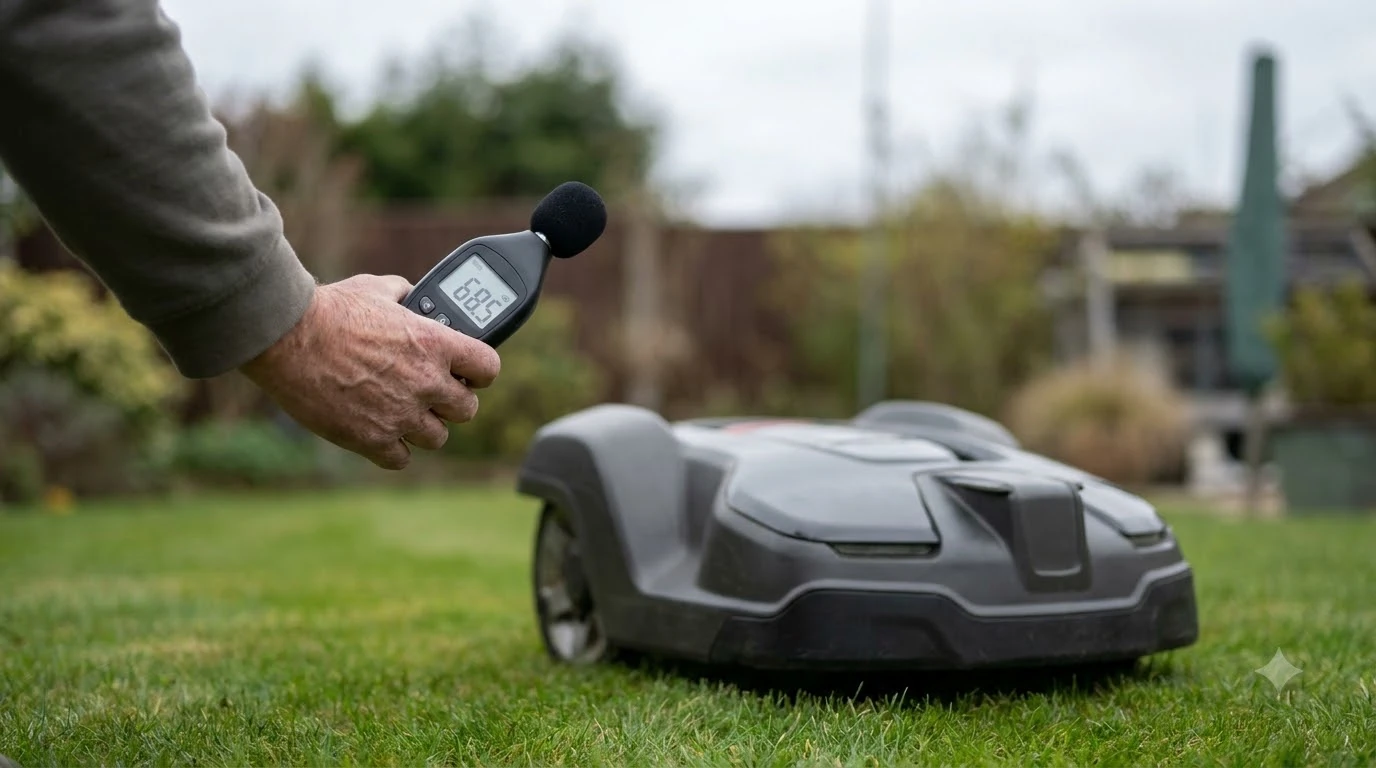

A robot mower noise level comparison is only useful when you know the distance behind each dB figure. Most models in the published lists fall between about 57 and 65 dB, with some rated higher. Robolever’s list gives Husqvarna Automower models around 58 to 63 dB and Worx Landroid models around 63 dB, while Robomow’s RS series is listed at 74 dB. Neither list states how or where the readings were taken, so use the numbers to rank models roughly, not to judge a specific yard.
The short answer
- Quieter group: several Husqvarna Automower, McCulloch ROB and Honda Miimo models are listed at 57 to 59 dB.
- Middle group: Worx Landroid and some Husqvarna models sit around 60 to 63 dB.
- Louder group: Robomow RS612, RS622 and RS630 are listed at 74 dB, the highest figure in the list we read.
- Distance matters: sound drops by about 6 dB each time you double the distance from the mower.
Robot mower noise level comparison: the published figures
Robolever’s extensive list gives a single dB value for each model, with no distance or weighting stated. The results are easier to read when grouped by range. Husqvarna’s Automower 310, 430X, 450X and 430XH sit at 58 dB, while the 315, 315X and 550 are listed at 60 and 61 dB, and the 550H at 63 dB. McCulloch’s ROB S400 and S600 are at 57 dB, and Honda’s Miimo HRM310 and HRM520 are at 58 dB. If you only need a shortlist, the quietest robot mower picks by measured noise rank models using the same published decibel figures.
Worx Landroid models in the same list are at 63 dB, and Ambrogio and Redback Power units are at 65 dB. Robomow’s RS612, RS622 and RS630 are at 74 dB, and RX20 at 69 dB, which places them at the top of the list. Those differences are real on paper, but the list does not say whether each figure was measured under the same conditions.
| Brand and model (as listed) | Stated dB |
|---|---|
| McCulloch ROB S400 / S600 | 57 |
| Husqvarna Automower 310 / 430X / 450X | 58 |
| Honda Miimo HRM310 / HRM520 | 58 |
| Husqvarna Automower 550 | 61 |
| Husqvarna Automower 550H | 63 |
| Worx Landroid M / L (20V) | 63 |
| Robomow RX20 | 69 |
| Robomow RS612 / RS622 / RS630 | 74 |

Why the numbers are hard to compare
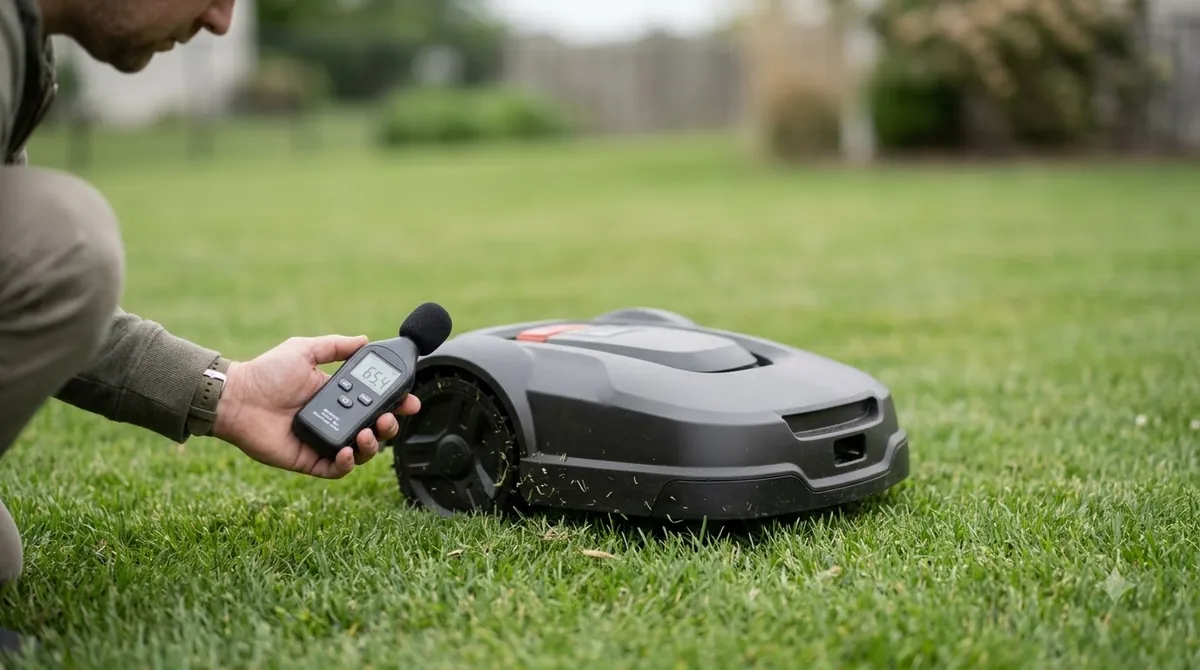
A robot mower noise level comparison built from these lists has one big gap: the distance. The biggest problem is distance. Robolever notes that manufacturers often do not give the distance at which the volume was measured, and it says the figures come from a single third-party article rather than from independent tests. A 60 dB reading taken at 2 metres and one taken at 5 metres are not the same test. Noise ratings sit next to other specs on the market, and the coverage, slope and noise spec comparison shows how each model’s figures line up. Published figures only tell part of the story, so also read about robot mower brands owners avoid and the reliability reports behind that.
Robomow’s own explainer shows how much distance matters. It gives a worked example of a robot rated at 60 dB at 5 metres, which drops to about 54 dB at 10 metres. Because sound falls by about 6 dB each time the distance doubles, the same mower can sound much quieter from the far side of a large lawn than from the fence line next to a neighbour.
The scale is logarithmic too. Robomow says a 10 dB increase is what makes a sound seem about twice as loud, so a 5 dB gap between two mowers is more noticeable than the numbers suggest.
Reference points for everyday sound
Robomow’s scale places 60 dB near a TV or music played at normal volume, and 70 dB near a vacuum cleaner or blender. Those are useful anchors, though they describe ordinary sources rather than the mower itself. The page also says robot mowers are substantially quieter than electric or gasoline mowers, but it does not give a gas-mower figure to compare against, so the size of that gap cannot be measured from this source. A side-by-side robot mower spec chart is useful when you need decibel ratings in the same table as runtime and cutting width.
Heads up
Robolever cautions that mowers can get louder over time, for example when clippings build up or an engine develops a fault. A quoted figure describes a new or well-maintained unit, so keep the blades sharp and the underside clean.
What this means for a noisy neighbourhood
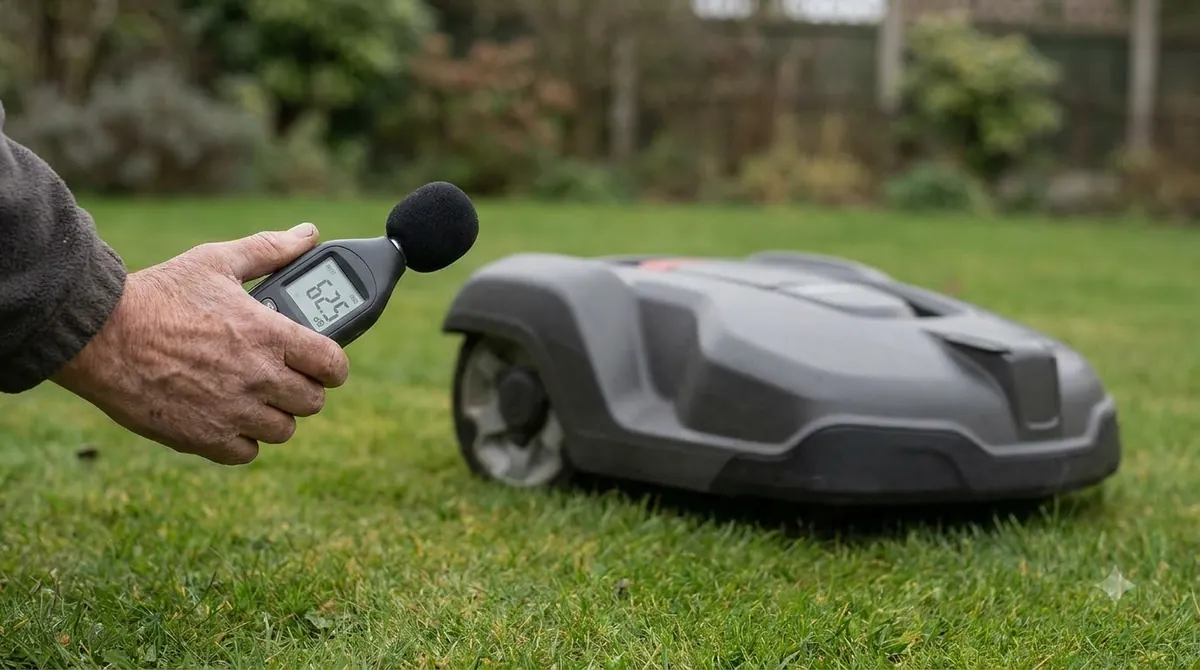
Noise rules, where they apply, are usually measured at the property boundary, not at the mower, according to Robomow. That means the level at a neighbour’s fence matters more than the number on the spec sheet. Robomow also suggests asking neighbours and scheduling mowing for daytime, even when the mower is rated quiet. Garden size, the layout of the lawn, and how close the mower runs to shared fences all change how loud it sounds to the people next door. Noise is only one part of ownership, and the brand durability and reliability rankings show which makers have held up over several seasons.
Our reading is that a model in the 57 to 60 dB group will usually be less disruptive than one at 74 dB, but only if both are tested under the same distance. If you are choosing between two models, ask the seller for the measuring distance and the test method, and compare those figures instead of the headline number.
Who should prioritise a quiet model
A quieter model suits a small suburban lawn with close neighbours, a home office facing the yard, or a schedule that runs in the early evening. A louder model in the 60 to 65 dB range can still be a reasonable choice on a large, open property where the nearest neighbour is far away. A model at the top of the list is a poor fit for a shared boundary, however much the cut quality appeals. Long-term owner feedback after two years of use often mentions how loud a mower sounds once the novelty wears off, which helps put the lab figures in context. For one specific model with its own noise discussion, the Navimow i210 AWD verdict including noise puts the decibel claim next to slope and battery notes.
Related reads: The Sunseeker Elite X5 verdict covering noise is a model-level companion to this page, with the same caveats about how manufacturers state sound levels.
Frequently asked questions
How loud is a typical robot mower?
The lists we read put most robot mowers between about 57 and 65 dB, with some models higher. Robolever notes the figures do not always state the measuring distance, so treat them as rough guides.
Is 60 dB quiet for a lawn mower?
Robomow places 60 dB near a TV or music at normal volume. It is quieter than a vacuum cleaner at about 70 dB, but the exact impression depends on distance and the other sounds around it.
Does distance change the dB rating?
Yes. Robomow gives a worked example of 60 dB at 5 metres falling to about 54 dB at 10 metres, and says sound drops by about 6 dB each time the distance doubles.
Can a robot mower get louder over time?
Robolever says it can, for example because of clippings buildup, worn blades or an engine fault. Regular cleaning and blade care keep the sound closer to the rated figure.
Sources
- Robolever, “How Loud Are Robotic Mowers? An Extensive List” (third-party list): stated dB figures by model and caveats on measurement.
- Robomow, “How Loud Is a Robotic Mower” (vendor blog): distance effects, dB scale and noise-rule basis.
 Up next9 min readReviews & CompareRobot Mower Spec Comparison: Coverage, Slope and NoiseUpdated Nov 11, 2026
 7 min readReviews & CompareRobot Mower 2025 Model vs 2026 Model What ChangedUpdated Nov 18, 2026
 7 min readReviews & CompareMammotion LUBA 2 AWD Lawn Size: Which Model Fits Your YardUpdated Nov 17, 2026
 7 min readReviews & CompareMammotion Yuka Mini Review: 2 Models, Limits, VerdictUpdated Nov 17, 2026
 8 min readReviews & CompareHusqvarna Automower 450X NERA Pros and Cons: 5,000 m² ModelUpdated Nov 18, 2026
 8 min readReviews & CompareNavimow i206 AWD vs i210 AWD: Which Model Fits Your YardUpdated Nov 16, 2026