
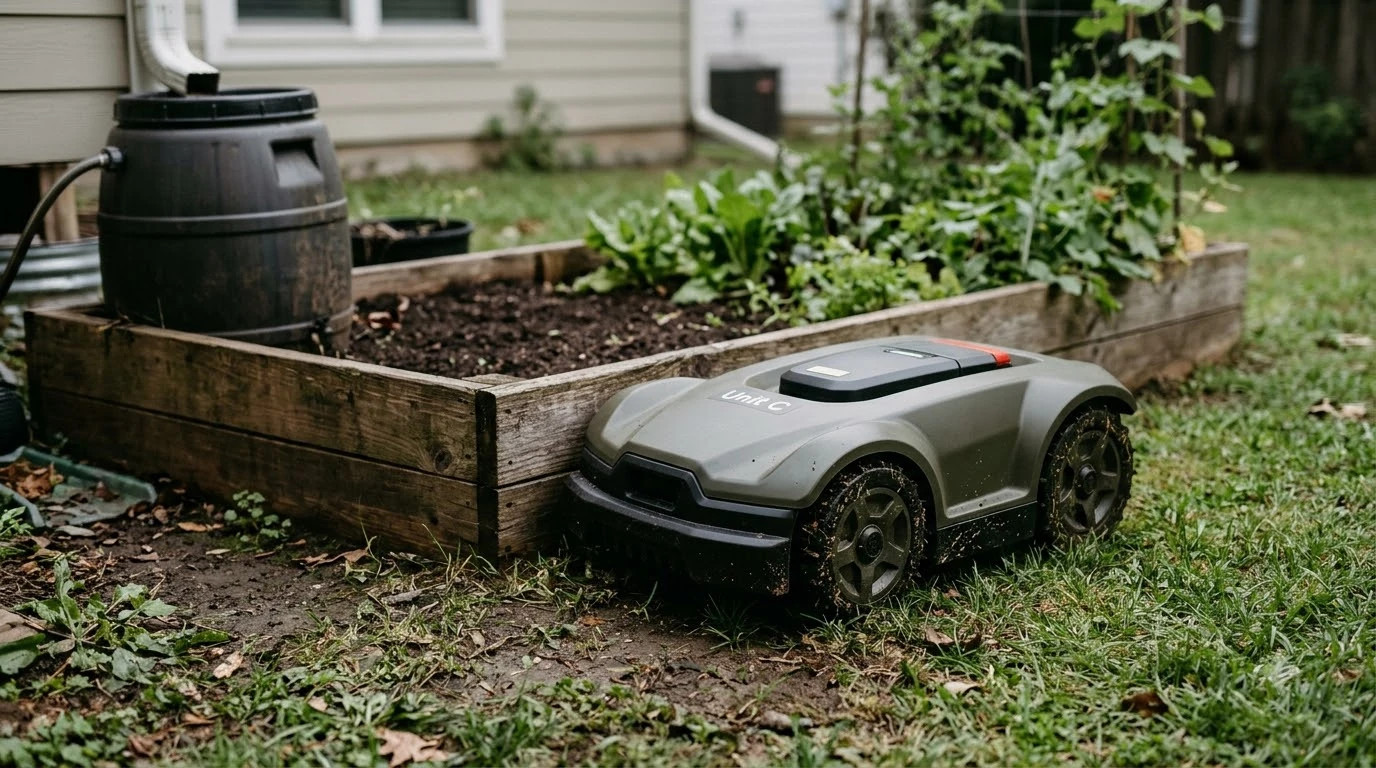

A robot mower for a lawn with a rain barrel can work well if the barrel, its hose, and the overflow stay out of the mowing path and sit on level ground. The barrel itself is heavy and fixed, so the real job is planning the boundary and the hose route. Rutgers University’s rain barrel guide explains where to place the barrel and where the overflow should go, and those two choices decide how much the mower has to work around.
The short answer
- Put the barrel on level, stable ground under the downspout, and keep the mowing boundary clear of its base.
- Route the overflow deliberately. Rutgers prefers a pervious area such as a lawn or mulched bed, but the hose should not sit where the mower drives.
- Keep the hose flush with the grade or put it on the far side of the boundary, so a hose cannot catch the mower.
- Use the boundary wire to leave a clear strip around the barrel rather than relying on the mower to notice it.
Robot mower for a lawn with a rain barrel: where the barrel sits
Rutgers’ guide says the barrel goes under a downspout next to a house, shed, or other outdoor structure. It also says the ground should be level, and if it is not, you should add crushed stone or gravel under the barrel and raise it on a stable platform. A full 55-gallon barrel weighs about 460 pounds, so the base must hold that weight without shifting. A barrel is a small water fixture, and the mower picks for ponds and water features show how larger setups are handled. Like a planted basin, a barrel on a stand is a fixed object, and rain garden fixture handling shows how a mower avoids one.
For a robot mower, that base is the first thing to plan. A barrel on a sloped or uneven patch creates a dip or a step near the wall, and the mower can get stuck or tip there. Our reading is that the barrel belongs inside the boundary’s excluded zone, with a few inches of clearance around the base, rather than in the open lawn.
Routing the overflow and the hose
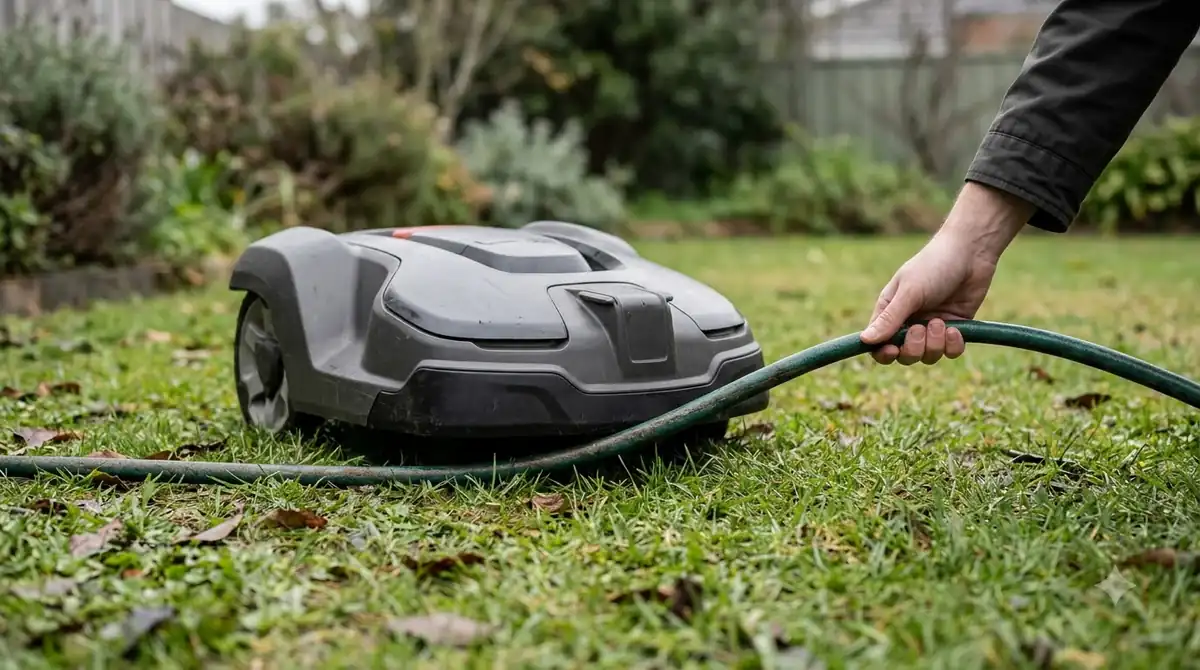
Rutgers says to decide in advance where the overflow will go. It prefers a pervious area, such as a lawn, garden, or mulched bed, where water can soak in. The guide keeps the overflow at least six feet from a house with a basement, and two feet from a house with a crawl space. An overflow hose lying across the grass can tangle a mower, so hose and sprinkler head handling is a useful companion read.
That preference puts the hose on the lawn, and the mower is the problem. A hose lying across the grass can be pulled, cut, or tangled, and a robot mower has no way to know a hose is a cable it should avoid. Our reading is that the overflow hose should run along the edge of the mowing area, outside the boundary wire, or it should discharge into a planted bed the mower never enters.
- Hose to a bed: the cleanest option, because the mower’s path does not cross the bed.
- Hose along the boundary: keep it outside the wire, and check it after each storm.
- Hose on the open lawn: avoid this, or stake it flat and move it before the mower’s scheduled runs.
Downspout connections near the mowing path
Rutgers describes two approaches: buy a commercial diverter kit, or modify the downspout yourself. For a DIY connection, the guide says to mark the downspout about two inches below the top of the elbow, cut along that line, and reattach the elbow to the cut end with downspout screws. A flexible plastic downspout up to 4.5 feet long can replace the aluminum elbow, and the guide says to use screws so it does not dislodge in heavy wind. Downspouts often feed a buried line, and the French drain soft-ground cautions explain what a mower may sink into.
Those choices matter for the mower because the downspout sits at the wall, where the mower often turns. A low, flush connection is safer than a tall one that the mower can hit. Some vendors sell downspout extensions and say their products are safe for lawn equipment. We could not verify those claims in the sources we read, so check the mower’s manual and test the route before relying on it.
Mowing around the barrel without a collision
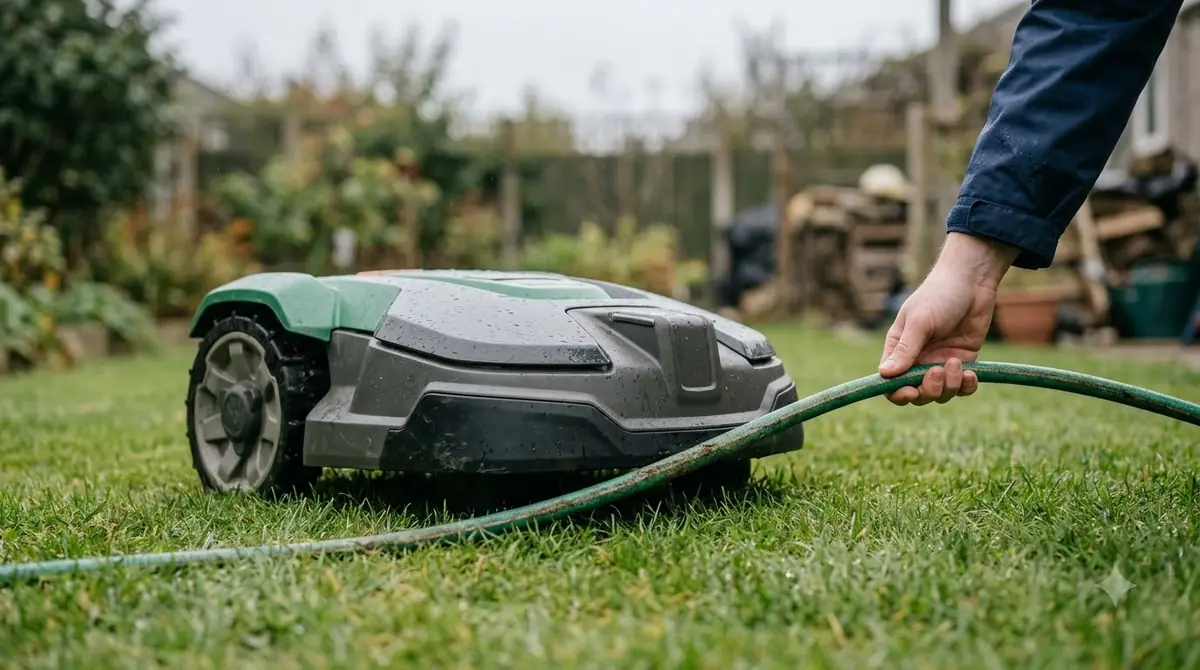
Once the barrel and hose are placed, set the boundary so the mower turns before it reaches the base. Husqvarna’s guidance for steep-slope installations explains that boundary placement near edges and roads changes how the mower moves, so the same logic applies to a barrel. Leave a wider turn near the barrel, because a mower that clips a corner can push the barrel off its platform. Anything with plumbing attached is mowed around in the same way, as hot tub equipment obstacle zones demonstrate in practice.
Watch the wet season, too. A full barrel can overflow onto the lawn during rain, which softens the soil near the base and can change the ground the mower crosses. Our reading is that a rain-soaked strip near the barrel is a reason to add a wider buffer or to schedule the mower away from the storm.
What to check at setup
Before you put the mower on schedule, walk the route once. Look at the barrel base, the overflow hose, and the downspout connection. Make sure nothing sits in the mowing path, and that the boundary wire keeps the mower a safe distance from the barrel. Where overflow is directed into a rock channel, dry creek bed overflow channels explain how to keep the mower off it.
Rutgers also advises that in winter you drain the barrel and disconnect it from both the downspout and the garden hose. Remove the hose from the lawn at the same time, so the mower does not meet a loose hose in the off season.
Related reads: Overflow can leave the ground wet near the barrel, so the stuck risk on a soggy lawn is worth a look.
Frequently asked questions
Can a robot mower drive around a rain barrel?
Yes, if the barrel is on level, stable ground and the boundary keeps the mower a safe distance from its base. Plan the clearance during setup rather than hoping the mower will avoid it.
Where should a rain barrel overflow hose go with a mower?
Rutgers prefers a pervious area such as a lawn, garden, or mulched bed. With a robot mower, our reading is that a planted bed or a spot outside the boundary wire is safer than the open mowing area.
How far should a rain barrel overflow be from the house?
Rutgers says to keep it at least six feet from a house with a basement, and at least two feet from a house with a crawl space.
Should I drain a rain barrel before winter?
Yes. Rutgers says to drain the barrel and disconnect it from the downspout and the garden hose in winter, which also takes the hose off the lawn.
Sources
- FS1118: Rain Barrels Part II: Installation and Use (Rutgers NJAES): barrel placement, overflow distance, downspout connection, winter drain.
- Husqvarna support: optimising an Automower installation for steep slopes (Husqvarna): boundary placement near edges and obstacles.
 Up next9 min readBy YardWhere to Put a Robot Mower Charging Station (Placement Rules)Updated Nov 11, 2026
 6 min readBy YardWhat Does a Robot Mower Rain Delay Setting Do?Updated Nov 14, 2026
 8 min readBy YardCan a Robot Mower Work Around a Rain Garden?Updated Nov 12, 2026
 7 min readBy YardRobot Mower for a Lawn With a Dog Run: Safe SetupUpdated Nov 14, 2026
 7 min readBy YardRobot Mower with Chicken Manure on the Lawn: Cleanup and SetupUpdated Nov 14, 2026
 6 min readBy YardRobot Mower for a Lawn With a Compost Bin: Zone and Route SetupUpdated Nov 14, 2026