


For a lawn with a koi pond, the robot mower has to keep a firm margin from the water and stay away from the pond’s edge stones, pump cables and filter area, and that setback matters more than any feature on the spec sheet. Koi ponds usually have a raised or stone edge, and the mower’s boundary must treat that edge as the hard stop. The points below come from manufacturer guides we read, plus our reading of what changes when the pond holds fish, as of November 2026.
The short answer
- Set a wide margin. Robomow’s guide gives about 35 cm between the wire and a pond, with extra obstacles to stop the robot falling in.
- Account for the edge. Worx says to keep the wire 26 cm from a step or gravel edge, against 10 cm from a plain edge.
- Treat the pond as a no-go zone. Robomow describes the wire as acting like a stop sign, which helps keep the robot from “accidentally landing in a garden pond.”
- Protect the cables and pump. Our reading is that pump lines and power cables near the edge need to be routed away from the mower’s path.
Why a koi pond needs a wider margin than a plain pond
A koi pond usually has a built-up edge, with stones, a shelf or a raised lip, and the grass often runs right up to it. That changes the boundary problem. Worx’s installation guide for its Landroid mower gives one distance for a plain edge and a larger one for a step or gravel edge. It says that if there is no step, keep the wire 10 cm from the edge, but if there is a step or gravel at the edge, keep the wire 26 cm away. A koi pond is a special case of a pond, and the broader robot mower picks for pond yards give the wider context. For a plain garden pond, pond edge behavior for robot mowers explains why the margin can be smaller than with fish.
Our reading is that a stone or raised koi edge should be treated as the second case, even when it looks flat. A mower that drops off a stone edge into water can be lost, damaged or stuck, and the fish are exposed to the same risk. The safer plan is to measure from the water’s edge, not from the lawn’s edge.

Robomow’s guide to laying boundary wire gives a larger figure for ponds. It says the distance to a pond should be approximately 35 cm, with additional obstacles to prevent the robot from falling in. That is a useful minimum for a koi pond, and our reading is that you should add a physical barrier where the margin is tight, rather than stretching the wire closer to the water.
Wire depth and the signal near the water
The boundary wire has to work where the grass is wet and the pond is close. Robomow says a laying depth of 4 to 5 cm is optimal, and that the robot can still detect the signal at a depth of up to 7 cm. Those are general figures for the wire, not for the pond, so use them to set up the wire correctly and then apply the pond distance on top. Buried lids and tanks can sit near the same cable route, so wire placement near buried covers is a helpful reference.
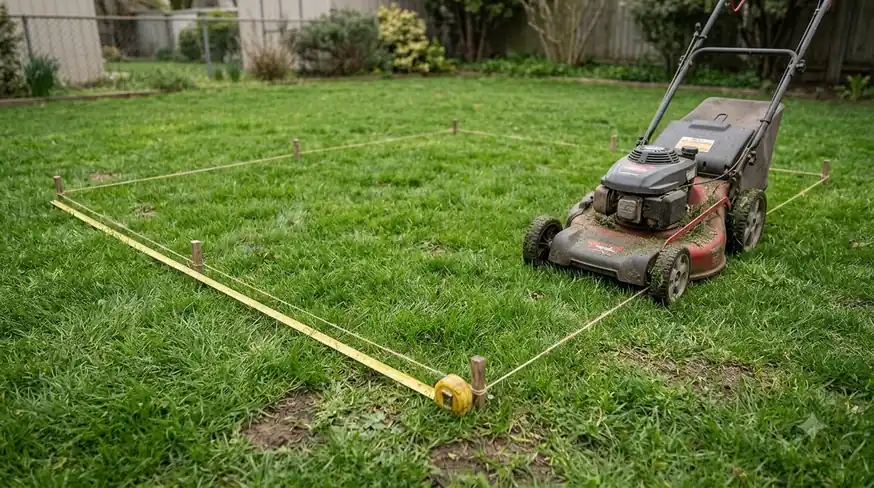
Our reading is that a koi pond often sits in a damp corner, where the soil is soft and the grass stays wet. In that spot, a deeper or loose wire can be pulled out of place by the mower, so check the wire after the first few runs and re-stake it wherever it has lifted near the water.
Pump cables, filters and the edge stones
Koi ponds bring equipment that a plain pond does not. Pump lines, power cables and filter boxes sit near the water, and a mower can catch a cable or knock a fitting. Our reading is that the cable route should be planned before the wire goes down, so the wire and the mower’s path stay well clear of the equipment. Keep cables in conduit, and run the boundary wire so that the mower never has to drive over a cable to reach the dock. If a pump and spray head share the bank, the fountain no-go zone setup shows how to fence both.
Edge stones are another hazard. A loose stone or a raised lip can tip a wheel, and a mower on a tilted edge can slip toward the water. Robomow’s wire guidance gives a useful rule for paths and slabs: about 10 cm from the wire, provided the surface is at ground level or lower than the lawn. That rule covers surfaces at or below lawn level. A raised edge falls outside it, so our reading is that it needs a larger margin, and the edge height should be checked before the wire is fixed.
Fish, noise and the mowing schedule
We did not find a source that measures how a robot mower affects fish, so we do not claim a number. Our reading is simple: a mower that runs close to the pond on a regular schedule adds vibration and movement at the edge, and a mower that goes into the water can harm both the machine and the pond. Our reading is to run the mower on a schedule that lets someone check the pond edge after the first few runs, so any slip or wire problem is seen early.
Wet grass near a pond is also a slip risk. Eufy’s wet-grass guidance says that wet turf reduces wheel grip, and that a mower that slips on a slope can slide into a garden bed or a pond. Our reading is to avoid mowing the bank right after rain and to check the mower’s position after any slip.
What to check before you buy for a koi pond
- Margin figure. Confirm the minimum distance from water in the manual, and add a buffer for stone or raised edges.
- Edge handling. Ask how the mower treats a step, gravel or stone edge, and whether a physical barrier is needed.
- Cable routing. Plan the route for pump lines and power cables before the wire goes down.
- Traction on the bank. Check the slope rating and wet-grass performance for the bank beside the pond.
The best robot mower for a lawn with a koi pond is the one you can keep a firm margin with, on a route that keeps cables and edge stones well clear of the mower. Pool edges raise a similar safety margin, and the pool-side mower picks compare what works near open water. Raised equipment pads next to the water follow the same no-go logic, as hot tub and equipment zones explain.
Related reads: Readers comparing water features may also want to see swimming pool edge handling for a larger body of water.
Frequently asked questions
How far should the boundary wire be from a koi pond?
Robomow gives about 35 cm from a pond, with extra obstacles to prevent the robot falling in. Worx gives 26 cm for a step or gravel edge. Check the figure for your own model’s manual, and add a physical barrier where the margin is tight.
Does a stone edge change the setback?
Yes. Worx says to keep the wire 26 cm from a step or gravel edge, compared with 10 cm from a plain edge. Our reading is that a stone or raised koi edge should use the larger figure.
Can a robot mower go into the pond?
It should not be allowed to. Robomow says the wire acts like a stop sign and helps keep the robot from accidentally landing in a garden pond. Our reading is that a fenced or barrier-protected edge is the safer choice when the margin is small.
How deep should the wire be laid near the pond?
Robomow says a laying depth of 4 to 5 cm is optimal and that the robot can detect the signal at up to 7 cm. Lay the wire to that depth, then apply the pond distance on top.
Sources
- Robomow, laying the lawn boundary wire (manufacturer): pond distance, wire depth and the stop-sign effect.
- Worx, Landroid installation boundary wire (manufacturer): setback from plain and stepped or gravel edges.
 Up next7 min readBy YardBest Robot Mower for a Yard With a Pond: 35 cm Margin CheckUpdated Nov 11, 2026
 8 min readBy YardHow Does a Robot Mower Handle a Pond?Updated Nov 11, 2026
 7 min readBy YardRobot Mower for a Lawn With Ground Cover Plants: Zones and EdgesUpdated Nov 14, 2026
 6 min readBy YardRobot Mower Concrete Basketball Pad Edge: Set the Wire RightUpdated Nov 14, 2026
 8 min readBy YardHow Does a Robot Mower Handle a Patio? Wire and Edge RulesUpdated Nov 12, 2026
 9 min readBy YardRobot Mower for a Sloped Front Yard: Limits, Edges and SetupUpdated Nov 11, 2026