
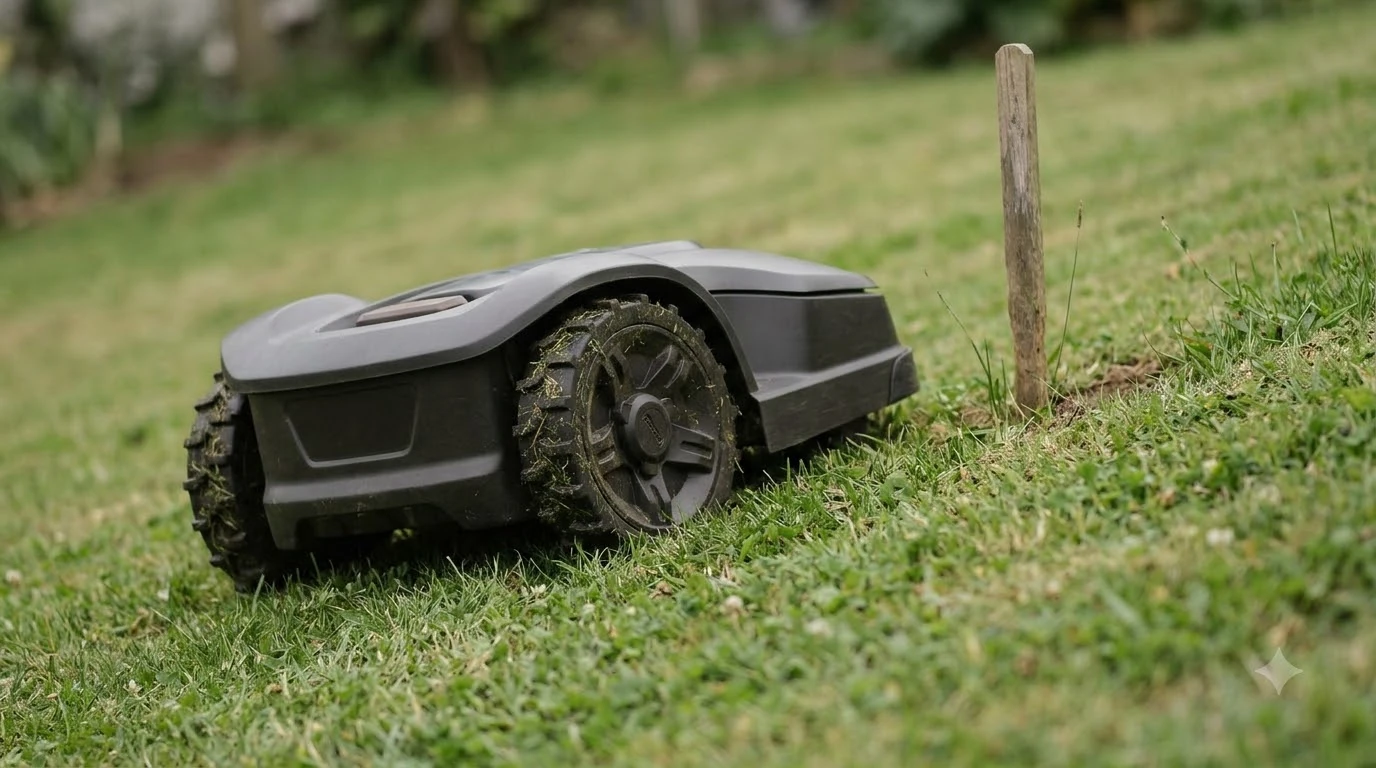

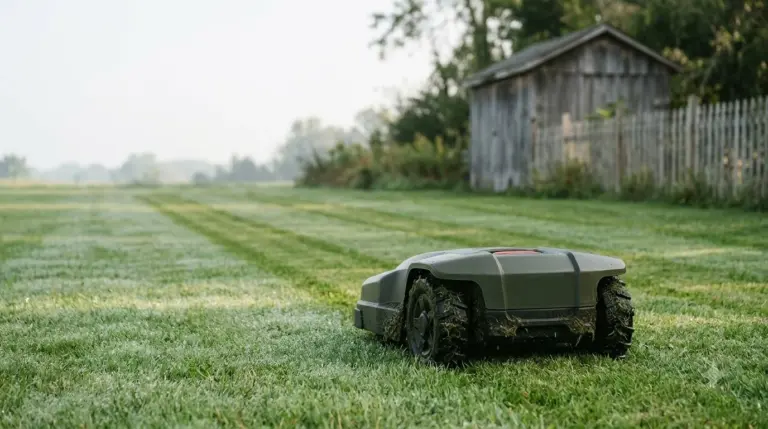
Why does my robot mower wheels slip on grass? Usually because the grass is wet, the slope is too steep for the model, or the drive wheels are packed with clippings. Damp blades cut friction, and turning on a slope makes the problem worse. Most cases can be fixed by cleaning the wheels, changing the mowing direction, and checking the slope rating.
The short answer
- Wet grass: damp blades reduce grip, and Husqvarna says the slipping risk is greatest in damp weather.
- Clogged wheels: grass wrapped around the drive wheels stops the tread from reaching the soil.
- Steep slopes and turns: the more the mower turns on an incline, the more likely it is to slide.
- Fix: clean the wheels, mow up the slope where possible, and add heavy wheels or wheel brushes if slipping continues.
Why does my robot mower wheels slip on grass when it is wet
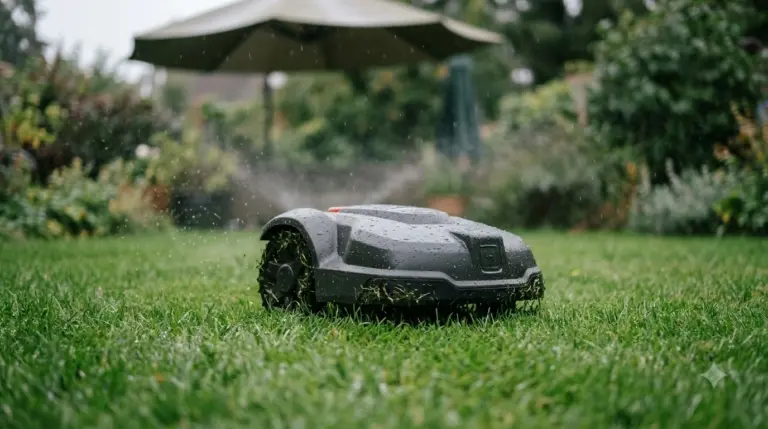
Drive wheels grip by friction against the soil and the blades underneath. Water on the grass lets the tread skate instead of bite, so a mower that climbs easily on dry lawn can lose traction on the same slope after rain or heavy dew. Husqvarna’s steep-slope guidance says the risk is greatest in damp weather for this reason. Early-morning dew is often enough to cause it, so a mower that runs fine at noon can slip at 7 a.m. Slipping is one of many causes for a stalled mower, and robot mower problems and fixes cover the rest of the usual suspects. Wet turf is the main trigger for slipping, and when to run a mower after rain gives practical waiting guidelines.
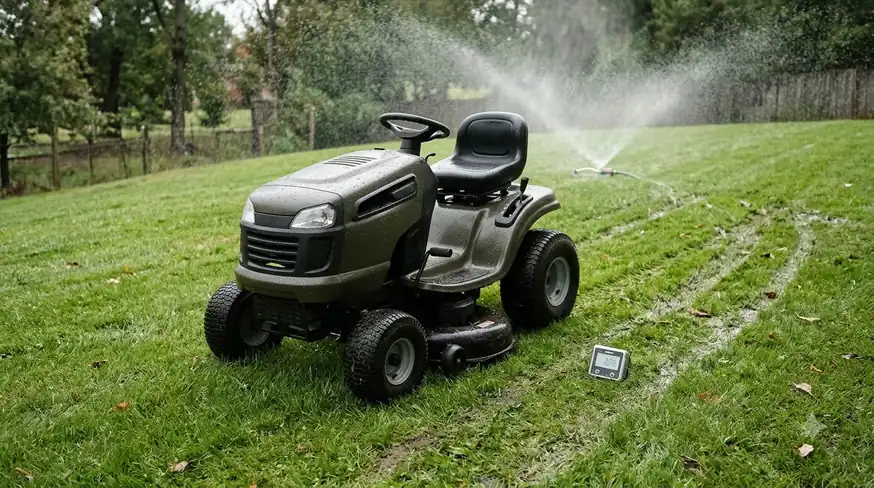
Our reading is that wet-grass slipping is the easiest cause to avoid. Scheduling mowing for the afternoon, after dew has dried, often solves it without changing any hardware. If the mower must run in wet weather, expect more slips on the steepest parts of the lawn and keep those areas out of the schedule until they dry.
How slopes and turns add to the problem
On a slope, weight shifts toward the downhill wheels, so the uphill drive wheel carries less load and has less grip. Husqvarna notes that obstacles such as trees or rockeries force the mower to turn on the incline, which raises slipping risk, especially on wet grass. Each turn can also dig the wheels in and wear the grass where the mower pivots. On a turn the drive wheels carry the whole load, so circling caused by poor grip is a closely related symptom. Drive layout changes how much a mower can pull on a slope, as 2WD and AWD traction compared explains with examples.
Slope is measured as vertical rise divided by horizontal run, multiplied by 100. A 15 cm rise over a 100 cm run is 15 percent. The Husqvarna steep-slope guide lists roughly 25 to 50 percent for its standard models, depending on the model. Its limits can also be lower near the boundary wire than in the middle of the work area, so check the rating in your own manual rather than a general figure.
Clogged wheels and grass buildup
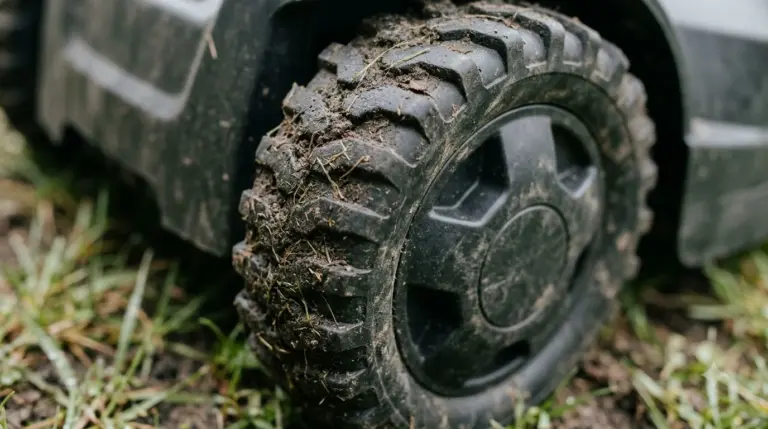
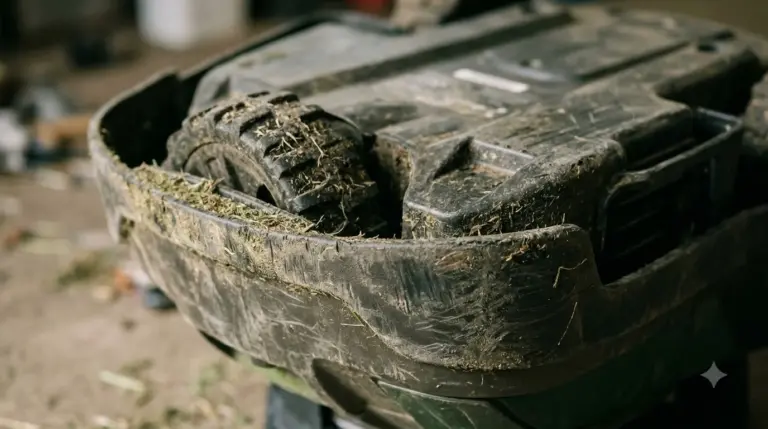
Grass wraps around the drive wheels as the mower runs, especially long grass or wet clippings. Husqvarna’s FAQ says a mower with large amounts of grass buildup will not perform as well on slopes. Its fault guidance also notes that grass can twist around a drive wheel. Once the wheel is packed, the tread no longer touches soil properly, and the mower can slip even on dry grass. Clogged tread can leave a mower hanging on a kerb, and getting caught on lawn edges is a typical result.
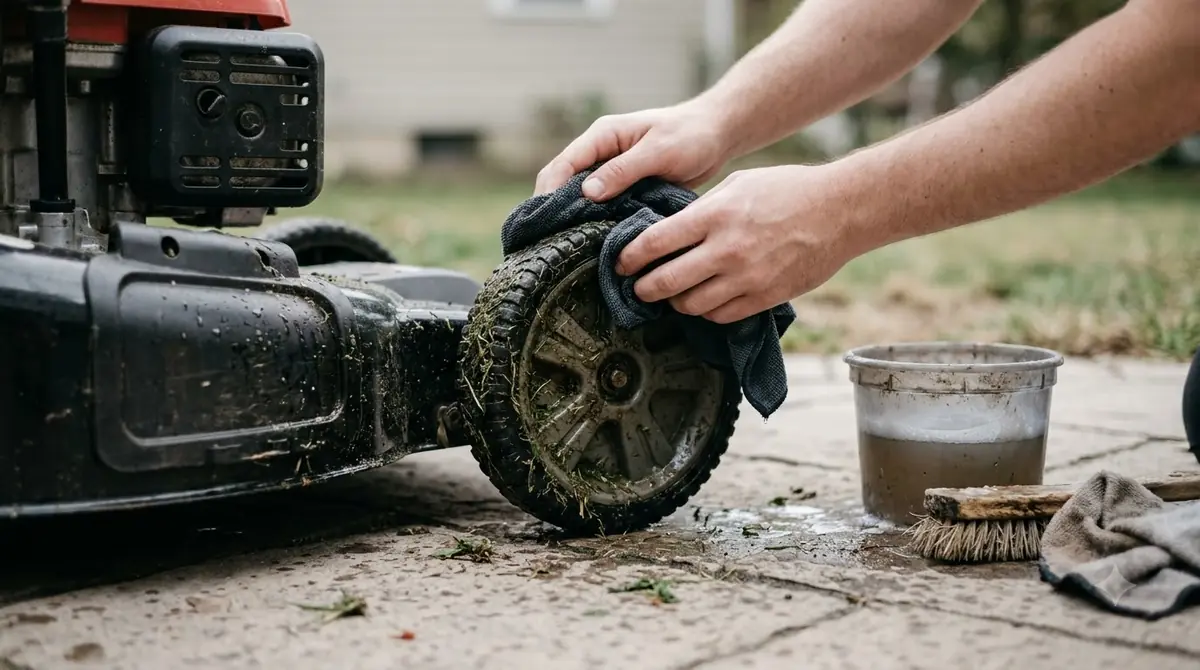
Grass can also build up on the wheel hubs and under the body, which changes how the wheel sits on the ground. Before a slope session, check that each wheel turns freely by hand and that no clump of clippings is caught behind the wheel arch.
Clean the wheels with a soft brush or a hose, and look for grass twisted around the axle. Check them regularly, and always after mowing wet grass, before the next session. A quick check takes less time than a stuck mower on a slope.
Fixes that improve grip
If the mower still slips after cleaning, match the fix to the cause. Each one addresses a different problem. A noise that changes with load can mean a worn gearbox, and clicking from the drive wheels describes what to inspect.
| Cause | What to change | Where it comes from |
|---|---|---|
| Wet grass | Mow later in the day, after dew dries | Husqvarna steep-slope guidance |
| Clogged wheels | Clean with a soft brush or hose | Husqvarna steep-slope guidance and FAQ |
| Slope and turns | Set mowing lines straight up the slope where possible; keep the steepest areas out of the zone | Husqvarna steep-slope guidance |
| Worn traction | Heavy rear wheels or wheel brushes, if the model offers a terrain kit | Husqvarna steep-slope guidance |
Husqvarna describes its optional Terrain Kit, with heavy rear wheels and wheel brushes, as a grip upgrade for sloping lawns. Not every model has one, so confirm the kit exists for your mower before buying. The same guidance recommends leaving at least 50 cm of level ground between a steep slope and flat lawn, which gives the mower room to stabilize before it reaches the incline.
What to check before you blame the mower
When someone asks why does my robot mower wheels slip on grass, the answer is often not the wheels. Slipping is not always a wheel problem. A boundary wire laid across a steep slope can make the mower struggle to turn. A slope steeper than the model’s rating will slip no matter how clean the wheels are. Walk the problem area, measure the slope, and compare it with the manual before changing hardware or buying accessories. Note the weather, the time of day, and the spot where the slip happens. A pattern such as slips only after dew or only at the same turn points to a cause you can change without spending money. Check for stored faults before you blame the grass, since error codes that signal traction trouble may already point to the wheel motor.
Frequently asked questions
Is it normal for a robot mower to slip on wet grass?
Some slipping is expected on wet grass, because damp blades reduce friction. Husqvarna says the risk is greatest in damp weather. If the mower slips often on dry grass, look for clogged wheels, a slope above the model’s rating, or worn tread instead.
Should I mow up or across a slope?
Where possible, set mowing patterns straight up the slope. Husqvarna says this gives better traction and less grass wear. Its guidance also suggests irregular patterns in complex areas with trees or obstacles.
Will heavy wheels stop the slipping?
Heavy rear wheels can improve grip on sloping lawns, according to Husqvarna’s description of its terrain kit. They do not fix clogged wheels or a slope that is above the model’s limit, so clean the wheels and check the slope first.
Does a slip error always mean the mower needs repair?
Not always. Clean the wheels and check the slope and mowing direction first. If the error keeps appearing on a slope within the rating, contact the manufacturer. Husqvarna advises swapping to terrain wheels for repeated slipped errors on its iQ-series models.
Sources
- Optimising an Automower installation for steep slopes (Husqvarna): wet-grass slipping risk, slope ratings, mowing direction up the slope, wheel cleaning, Terrain Kit.
- FAQ for Automower robotic lawn mowers (Husqvarna): grass buildup on slopes, drive wheel obstruction fault.
 Up next9 min readLearnWhy Does My Robot Mower Spin Its Wheels When Turning?Updated Nov 19, 2026
 7 min readLearnWhy Does My Robot Mower Leave Clumps of Grass?Updated Nov 13, 2026
 8 min readLearnHow to Prevent Grass Buildup Inside Robot Mower Wheel WellsUpdated Nov 19, 2026
 7 min readLearnRobot Mower Wheels Slipping on Grass: Causes and FixesUpdated Nov 11, 2026
 7 min readLearnWhy Does My Robot Mower Take So Long to Finish?Updated Nov 13, 2026
 8 min readLearnWhy Does My Robot Mower App Say Offline?Updated Nov 13, 2026