
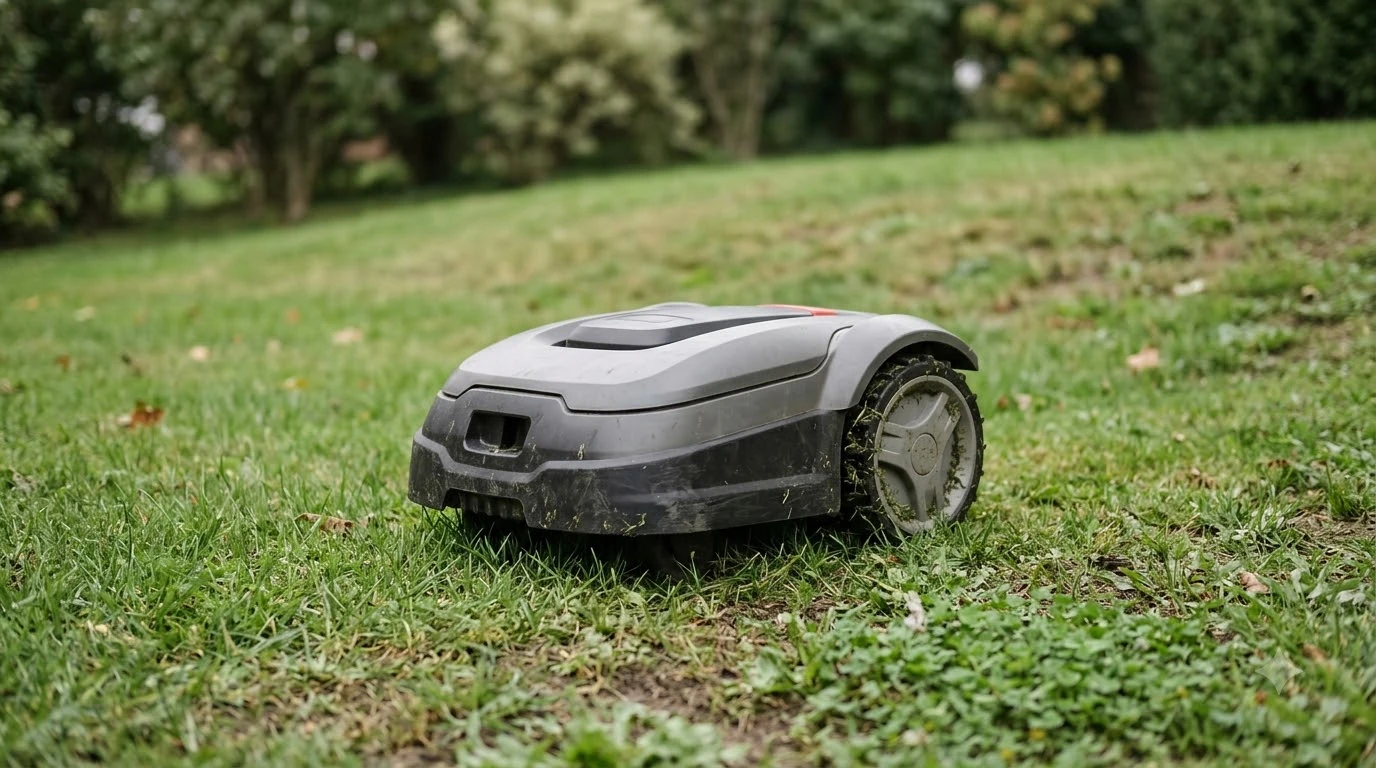

The best robot lawn mower 2027 is the one that fits your yard, not the one with the newest year on the box. Manufacturers do not agree on a single ranking, so the practical test is whether a mower’s rated area, slope rating and navigation method match your grass, your slope and your trees. Model-year labels vary by brand, so read the spec sheet before you decide on the best robot lawn mower 2027 has to offer for your yard.
The short answer
- Size it by real grass. Measure the lawn you mow and choose a rating well above that area.
- Read the slope in percent. Manufacturers usually rate climbing ability as a percentage, and steep yards need all-wheel drive.
- Match navigation to your sky view. RTK needs open sky, while vision and LiDAR suit yards with trees or poor satellite signal.
- Compare specs, not years. A 2027 label does not tell you rated area, slope or warranty terms.
Start with the mowing area, not the lot size
Buy for the grass you actually mow, because manufacturers exclude driveways, patios, decks and garden beds when they describe coverage. Mammotion’s buying guide groups lawns into four bands: up to 500 m2, 500 to 1,000 m2, 1,000 to 2,000 m2, and over 2,000 m2. It also tells buyers to measure the actual lawn area rather than the whole property.
Most buyers overestimate how much they mow. Dreame’s guide says homeowners often overestimate their mowing area by 20 to 40 percent. Its example is useful: a mower rated for 0.5 acre realistically covers 0.35 to 0.4 acre in a typical suburban setting. Dreame advises sizing up by at least 30 to 50 percent for reliable coverage in one run. For a worked example, see what size robot mower you need for a half acre.
Undersizing has a visible cost. Mammotion warns that a significantly undersized mower can mean longer mowing times and more frequent charging. Oversizing also has a cost. The same guide says the largest model is not always the best choice for a small lawn. Our reading is that a margin of 20 to 30 percent above your measured area is a reasonable middle ground, which matches the checklist threshold in Dreame’s guide.
Check the slope rating in percent
Manufacturers usually express climbing ability as a percentage, not degrees, so compare the same unit across models. If your yard is near the middle of these bands, our guide to a robot lawn mower for a 35 percent slope goes into the limits. Mammotion’s bands run up to 20 percent (about 11 degrees), 20 to 35 percent (about 11 to 19 degrees), 35 to 50 percent (about 19 to 27 degrees), and over 50 percent (about 27 degrees or more).
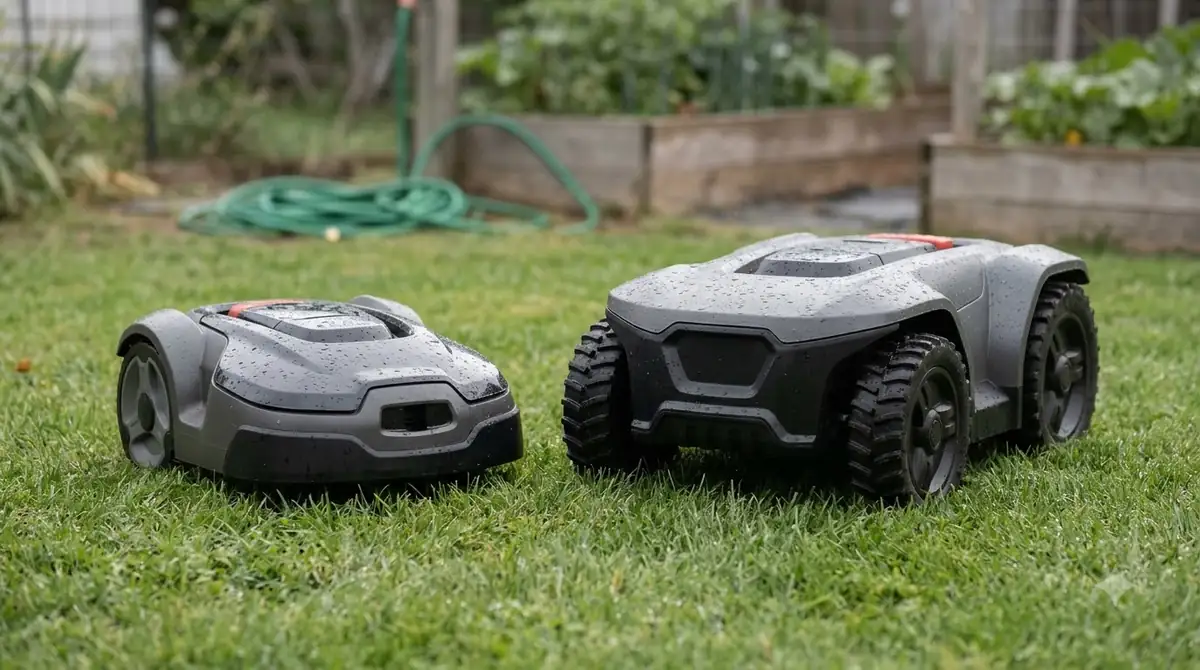
- Under 35 percent: Dreame’s guide calls for all-wheel drive only above about 35 percent, so a lower rating should still be checked against your own slope.
- Over 50 percent: Mammotion says only certain all-wheel-drive models are designed to operate reliably on these lawns.
- Wet grass: Dreame notes that two-wheel-drive models can slip on wet grass once slopes get steeper than about 35 percent.
To measure a slope, Mammotion suggests checking the landscaping plans or using a smartphone inclinometer app. Our reading is that a rough estimate is enough to pick a rating band, but a steep or uneven yard deserves a closer look before you buy.
Match navigation to your sky view and trees
Boundary wire, RTK, vision and LiDAR each struggle in different yards, so sky view and tree cover should decide the choice. Navigation is where the best robot lawn mower 2027 shoppers pick differs most from yard to yard. The table below uses setup times and weak spots from Dreame’s guide, and the navigation types match those in Mammotion’s guide.
| Navigation | Setup time (Dreame figures) | Where it struggles |
|---|---|---|
| Boundary wire | 2 to 3 hours of trenching, plus about an hour for dock placement and app pairing | Layout changes mean re-burying the wire |
| RTK | 30 to 60 minutes with a clear sky view | Tree cover, tall buildings and poor satellite visibility |
| Vision | 20 to 45 minutes | Low light, and open boundaries |
| LiDAR | 15 to 30 minutes | Needs no GPS or buried wire, and the guides name no specific weak spot |
RTK gives centimeter-level accuracy in open sky, according to Mammotion, but tree cover, buildings and poor satellite visibility can all affect it. Hybrid designs try to cover those gaps by combining RTK with vision or LiDAR, and our comparison of wire-free vs boundary wire robot mowers shows how the setups differ. Our reading is that a hybrid suits a yard with both open lawn and shade, while a plain RTK model suits a yard with a clear sky.
Look at cutting width and edge cutting
Cutting width changes how long the job takes. Dreame says decks below 30 cm (12 in) can take hours to finish a 2,000 m2 lawn, so a narrow deck is a time cost, not just a size difference. Edge cutting matters too. Dreame advises looking for mowers that cut within 3.8 cm (1.5 in) of the boundary, which keeps edges tidy without hand trimming; see what edge cutting on a robot mower means.
Passage width is the other half of the check. Dreame warns that passages narrower than 82 cm (32 in) may be impassable for some models. Measure the narrowest gap between your beds, fences and trees before you buy, and compare it with the mower’s stated width.
Check the battery against mowing area and warranty
Mammotion advises looking at the manufacturer’s recommended mowing area rather than battery size alone. When you shortlist the best robot lawn mower 2027 offers, a bigger battery number does not guarantee more coverage if the mower’s rated area is smaller than your lawn.
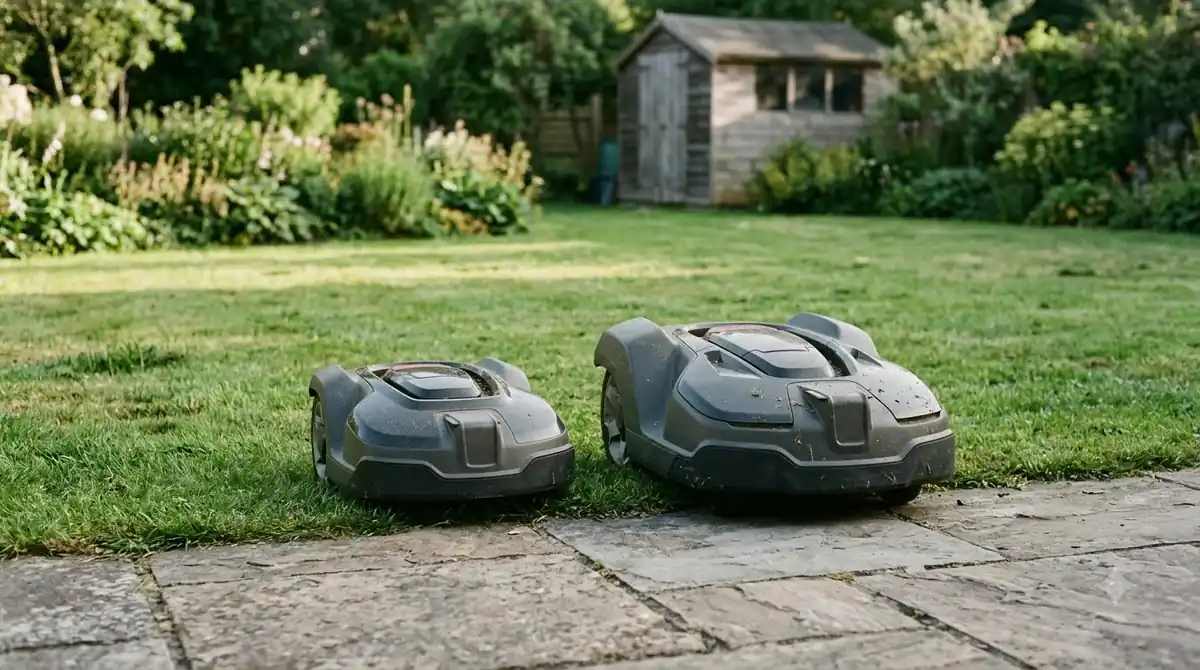
Charge-and-resume is worth checking. Dreame describes it as letting the mower recharge and continue where it stopped instead of restarting the whole lawn. Dreame also notes that batteries are commonly replaced every 3 to 5 years, and its checklist suggests a battery warranty of at least 3 years. Read the warranty terms on the manufacturer’s page, because wording varies by brand; our robot mower warranty guide lists what to look for.
- Recommended mowing area, not battery size alone
- Charge-and-resume so a recharge does not restart the lawn
- Battery warranty of at least 3 years
How to choose the best robot lawn mower 2027
Before you buy the best robot lawn mower 2027 for your yard, work through the same short list for every candidate. This keeps the comparison focused on your yard rather than on launch marketing.
- Mowing area. Measure the grass you mow, leave out beds and patios, and confirm the rating sits above that figure.
- Slope. Find your slope in percent and check the rating against it.
- Navigation. Compare your sky view and trees with the setup and weak-spot notes above.
- Cutting width and passages. Check the deck width, edge-cut distance and your narrowest passage.
- Battery and warranty. Compare recommended mowing area and read the warranty terms.

Frequently asked questions
Is there one best robot lawn mower for 2027?
No single model fits every yard. The right choice depends on your measured mowing area, slope in percent, navigation fit and cutting width. A mower that is ideal for a flat, open lawn may be a poor fit for a sloped yard under heavy tree cover.
Does the model year matter when buying the best robot lawn mower 2027?
Model-year labels vary by brand, so the year alone does not tell you much. Compare the rated mowing area, slope rating, navigation type and warranty terms on the manufacturer’s spec sheet. Those numbers are what affect your results.
How big a robot mower do I need?
Measure the grass you actually mow, excluding driveways, patios, decks and beds. Dreame recommends sizing up by at least 30 to 50 percent so the mower can finish in one run. Mammotion warns that an undersized model can mean longer mowing times and more frequent charging.
Is RTK always the most accurate option?
RTK gives centimeter-level accuracy when it has a clear view of the sky. Tree cover, tall buildings and poor satellite visibility can reduce that accuracy. For a yard with heavy shade, vision or LiDAR, or a hybrid design, may suit better.
Sources
- How to choose a robot lawn mower (Mammotion): lawn size bands, slope bands in percent, navigation types, battery guidance.
- How to Choose a Robot Lawn Mower for Your Yard (Dreame): mowing area overestimate, sizing margin, navigation setup times, cutting width, passage width, battery warranty.
 Up next9 min readBest Robot MowersRobot Mower Emergency Stop Button: What to Check Before You BuyUpdated Nov 12, 2026
 8 min readBest Robot MowersBest Virtual Boundary Robot Lawn Mower 2026: What to Check Before You BuyUpdated Nov 14, 2026
 8 min readBest Robot MowersBest Robot Lawn Mower Under $5000: What to Check Before You BuyUpdated Nov 12, 2026
 9 min readBest Robot MowersBest Robot Lawn Mower Under $700: What to Check Before You BuyUpdated Nov 12, 2026
 7 min readBest Robot MowersBest Robot Lawn Mower Under $3000: What to Check Before You BuyUpdated Nov 14, 2026
 10 min readBest Robot MowersBest Robot Lawn Mower Under $1000: What to Check Before You BuyUpdated Nov 12, 2026