
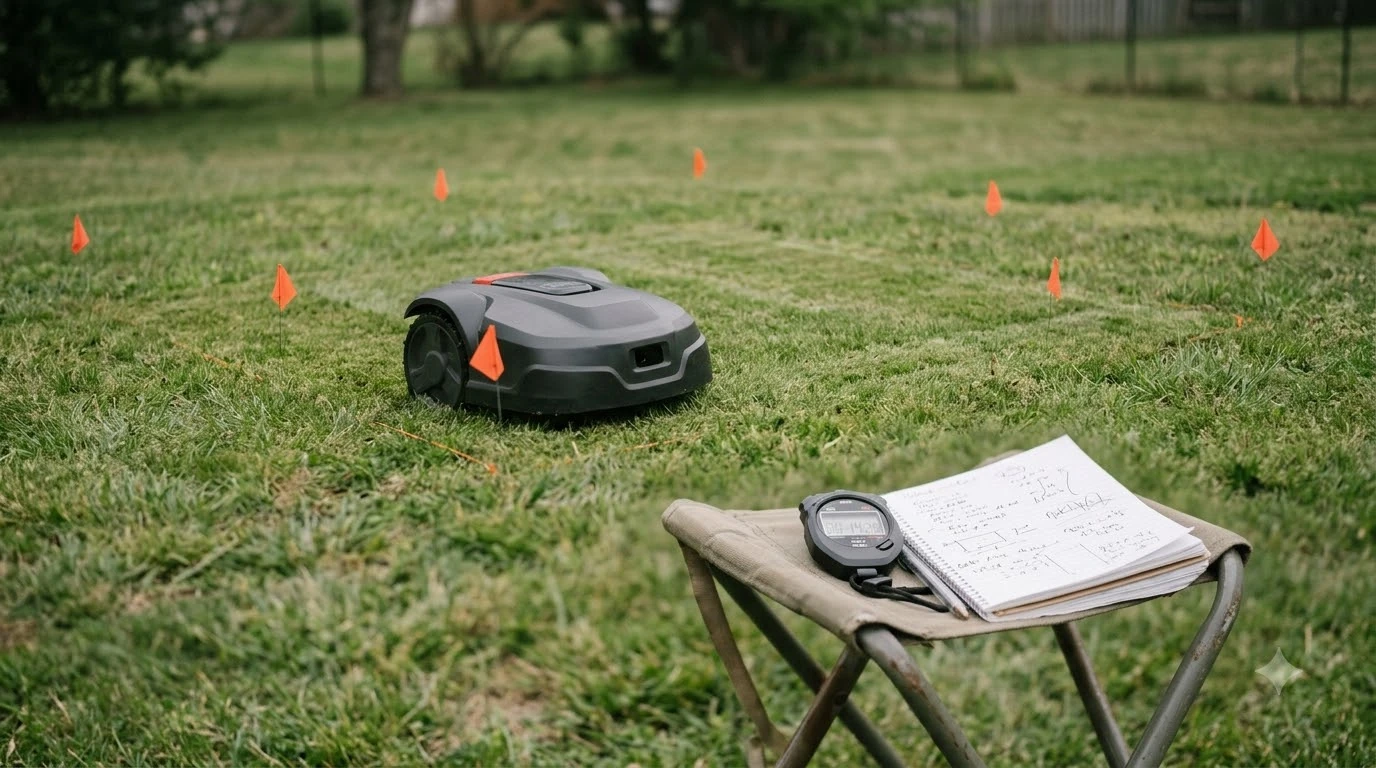

There is no single best wire-free robot mower under $1200 for every yard, but the spec sheets point to a clear shortlist method. Under this budget you are usually buying a LiDAR or vision-navigated mower with no perimeter wire, and its rated area, slope limit and dock space matter more than the brand name. This guide shows what to check, using manufacturer and review figures as of Nov 2026.
The short answer
- Size it with headroom: one guide advises at least 20 to 30 percent more rated area than your mowing area.
- Check slope twice: a working-area rating and a boundary rating are listed separately by some makers.
- Plan for the dock: one hands-on review of a sub-$1,500 LiDAR model needed about 6.6 ft clear in front of the dock and 1.6 ft on each side.
- Budget the running costs: blades, batteries and any app subscription add up over the first three to five years.
What wire-free means at this price
A wire-free robot mower does not need a buried boundary wire. Most models in this band use either LiDAR, which builds a map with laser pulses, or a camera with AI vision, sometimes combined with a satellite positioning module. Ecovacs describes LiDAR as a method that can be affected by fog and heavy rain, because the laser beams can scatter or be absorbed. That is worth remembering if your region has long wet seasons. For background on the technology, read the guide to mowing without a perimeter wire. To see what a lower budget still covers, read wire-free robot mowers under $800 and compare the rated areas. If the price changes what wire-free means, see how robot mowers without a perimeter wire compare across budgets.
The setup difference is large. A Dreame buying guide puts LiDAR mapping at 15 to 30 minutes and boundary-wire installation at two to three hours of digging. For many owners that time saving is the main reason to stay under $1,200 for a wire-free model instead of a cheaper wired one.
Match the rated area to your real lawn
Start with the lawn size you actually mow, not the total property. Subtract flower beds, the deck footprint and any tree areas the mower will never enter, then add headroom. Dreame says real coverage can drop by 20 to 30 percent near trees, slopes and boundaries, and that homeowners often overestimate their own yard by 20 to 40 percent. Sunseeker recommends at least 20 percent above the calculated area.
A rated area that exactly matches your lawn leaves no room for those losses, and that is the first filter for any best wire-free robot mower under $1200 you consider. Our reading is that a mower rated for about 20 to 30 percent more than your measured lawn is the safer target at this price.

Read the slope ratings carefully
Slope is where many budget buyers get caught out. Some makers list two numbers: how steep the mower can go inside the working area, and how steep the boundary can be. The Dreame guide suggests ruling out a two-wheel-drive model if any section of the lawn is steeper than about 35 percent. Sunseeker suggests all-wheel drive above about 30 percent. Both are vendor guides, so compare them with the figures printed on the spec sheet you are looking at. Slope ratings relate to ground shape, so see mowers that cope with uneven ground.
Heads up
Some budget LiDAR models list a 45 percent slope rating for the work area but a much lower virtual boundary slope. Check both before you assume the mower can cover a bank.
Dock space and cutting height
Dock space is easy to forget. The PCWorld hands-on review of the Navimow i215 LiDAR, a model in a similar price band, measured the dock at about 6.6 feet of clear space in front and 1.6 feet on each side. Cutting height ranges are also worth comparing: the same review band reported 2 to 4 inches for that model, while other budget mowers go lower or higher. Pick a height your grass type can take, and do not cut more than about one-third of the blade length in one pass. Dock space also decides where the mower sleeps, so compare a garage for the dock and mower before settling on a layout.
| Spec to check | Why it matters | Where to find it |
|---|---|---|
| Rated area | Sets the lawn size with headroom | Maker spec page |
| Work-area slope | Decides if hills are reachable | Spec sheet, sometimes listed as a percent |
| Boundary slope | Limits edge work on banks | Spec sheet, often a separate figure |
| Dock clearance | Decides where the dock fits | User manual or review |
| Warranty | Covers the battery and motors | Maker terms, sometimes missing |
Running costs and subscriptions
The purchase price is only part of the cost. The Dreame guide lists blades at $20 to $40 per season, batteries at $100 to $300 after three to five years, and electricity at $15 to $25 per year. Some wire-free mowers also sell a cellular connection plan. One review of a Navimow model reported a first year free and then $32.90 per year, but plans change, so confirm the current terms before you buy. Running costs and subscriptions change the real cost of a wire-free model, so a guide on how to judge robot mower value is worth reading alongside this one.

Best wire-free robot mower under $1200: what to check before you buy
Before you order, write down four numbers: your measured lawn area, your steepest slope, the dock space you can give up, and the maximum you will pay for the first two years of running costs. Then compare only mowers whose rated area, slope and dock needs fit those numbers. Check the warranty length in writing, and look for reviews from owners in a climate like yours, because LiDAR and vision systems behave differently in fog, shade and tall grass. If your budget can stretch one tier higher, compare the options in wire-free mowers under $1500 before you decide.

Frequently asked questions
Can a wire-free robot mower work under trees?
Some LiDAR and vision models are marketed for shaded areas, but independent comparisons under tree canopy are limited. Expect lower real coverage near trees, and check the maker’s notes on overhead branches before you rely on it.
How long does setup take without a boundary wire?
A Dreame guide estimates about 15 to 30 minutes for LiDAR mapping, compared with two to three hours for installing a boundary wire. Actual time depends on lawn size and how many passes the mapping needs.
Is a subscription required?
Not always. Some makers offer optional connectivity plans, and some features are free. Check whether remote control and mapping updates need a paid plan before you buy.
Is a wire-free mower worth it under $1,200?
It depends on your lawn. If the lawn is simple, flat and easy to fence, a wired model may cost less to run. If you want a quicker setup and expect to move the boundary later, the wire-free premium can be worth paying.
Sources
- Dreame robot lawn mower buying guide (manufacturer): used for rated-area headroom, slope threshold, setup time and running costs.
- Sunseeker robotic mower buying guide (manufacturer): used for the two slope ratings and the 20 percent area headroom.
- Ecovacs, LiDAR vs RTK robot lawn mowers (manufacturer): used for the fog and heavy rain limit of LiDAR.
- PCWorld, Navimow i215 review (review): used for the dock clearance and the hands-on lawn test.
 Up next6 min readBest Robot MowersBest Wire-Free Robot Mower Under $1000: Fit Before PriceUpdated Nov 14, 2026
 6 min readBest Robot MowersBest Wire-Free Robot Mower Under $800: What the Price BuysUpdated Nov 14, 2026
 7 min readBest Robot MowersBest Wire-Free Robot Mower Under $3000: What the Premium Price BuysUpdated Nov 17, 2026
 8 min readBest Robot MowersBest Wire-Free Robot Mower Under $5000: What to CheckUpdated Nov 17, 2026
 6 min readBest Robot MowersBest Robot Lawn Mower Under $1200: What the Extra Budget BuysUpdated Nov 14, 2026
 6 min readBest Robot MowersBest Wire-Free Robot Mower Under $1500: What the Spec Sheets ShowUpdated Nov 14, 2026