
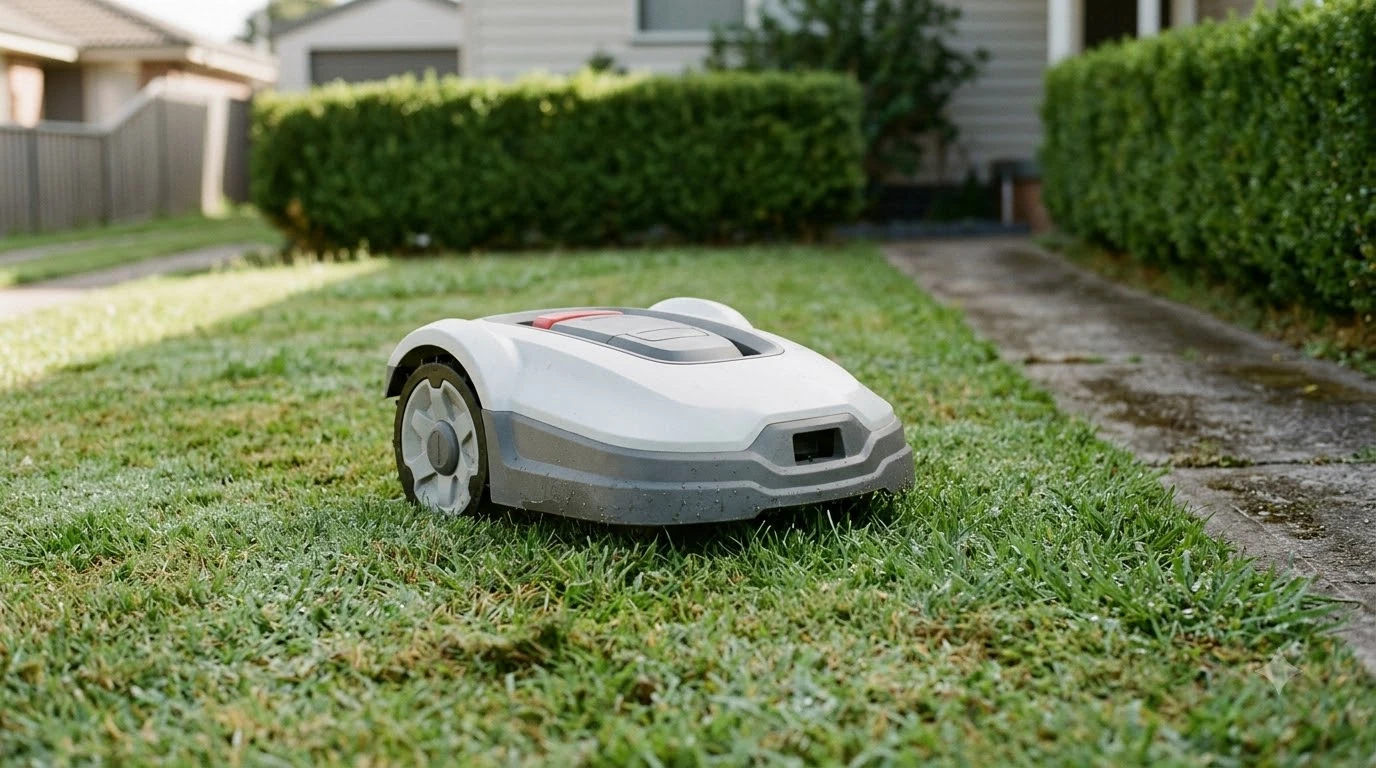

How close can a robot mower get to a property line? It stops at its boundary setting, not at the lot line, so most models leave a margin you set yourself. Robomow places the boundary wire about 35 cm from walls and about 10 cm from beds, while Husqvarna recommends a work-area border at least 1.5 m outside the lawn. The model manual has the final say for every setup.
The short answer
- Wire near walls: about 35 cm, per Robomow’s installation guidance.
- Wire near beds and hedges: about 10 cm at lawn level.
- Border-based systems: Husqvarna recommends at least 1.5 m (5 ft) outside the lawn.
- Edge strip: a centered-blade mower commonly leaves about 10 to 20 cm uncut along the border.
- Legal setbacks: none were found in the sources read here, so check your deed, survey, or local rules.
How close can a robot mower get to a property line?
So how close can a robot mower get to a property line in practice? The boundary wire, or the virtual border in a wire-free system, tells the mower where to turn around. The cut edge is therefore the boundary setting, not the fence, hedge, or lot line you can see, so the answer to how close a robot mower can get depends on that setting.
A mower with a wire set 35 cm from a wall will not cut right up to that wall, even if the wall sits on your property line. Robomow states that the required distances depend on the specific model. Its guidance says to refer to the installation instructions of your robot model before you lay the wire, so treat the figures in this article as typical values rather than settings for every machine.
Why border settings sit outside the lawn
Husqvarna’s guidance for AIM-based border settings is to place the work-area border outside the lawn, with a minimum distance of 1.5 m (5 ft). The mower then cuts the grass all the way up to the boundary wire instead of stopping early.
Positioning is not exact. Husqvarna gives the accuracy of AIM Technology as approximately 1 m (3.3 ft), so the point where the mower stops and turns can vary by about that amount. Leave room for that variation near a fence or property edge.
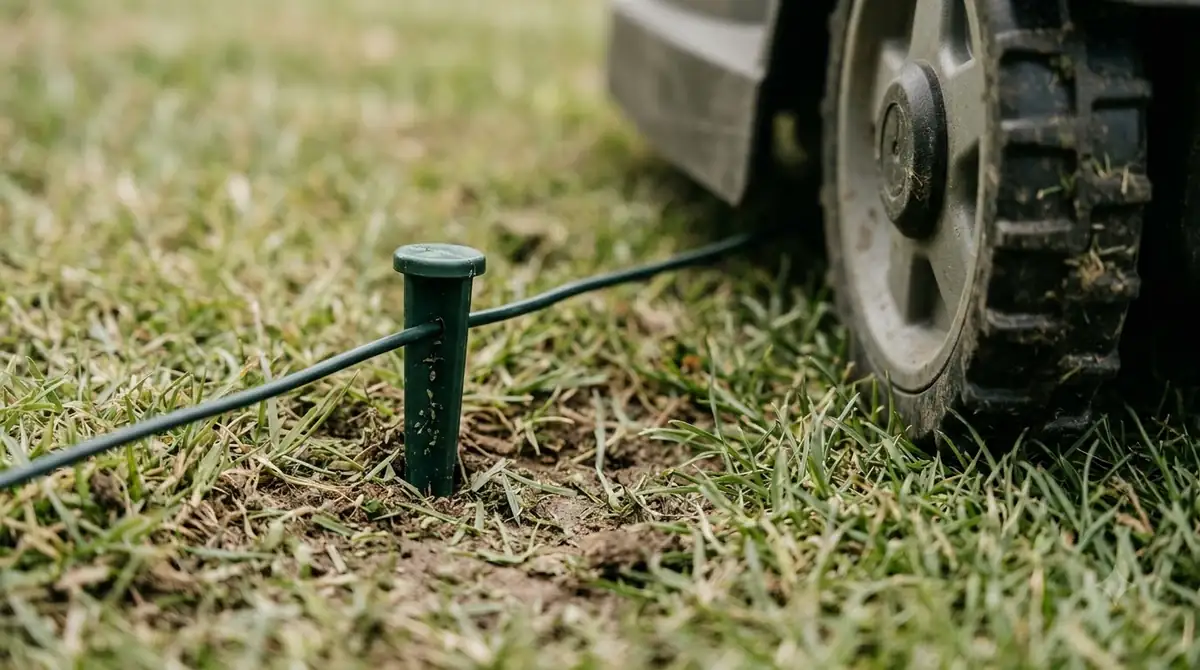
Wire distances from walls, beds, and paths
Robomow’s guidance gives different distances for each kind of edge, which is the most useful way to plan a perimeter. The table below lists the values from its installation page.
| Obstacle or edge | Boundary wire distance (Robomow) |
|---|---|
| Wall or tall stone | Approximately 35 cm |
| Bed or hedge | Approximately 10 cm |
| Slab or path at ground level, or lower than the lawn | Approximately 10 cm |
Our reading is that a fence line counts as a wall for planning. A fence that stands on the property line therefore leaves a strip of ground that the mower will not cut, and that strip is what the next section covers.
Heads up
The table gives approximate values from one manufacturer. Your model may use a different setting, so confirm the figure in its manual before you stake the wire.
The uncut strip along the border
If you search “how close can a robot mower get to a property line,” the uncut strip is the part many guides skip. A robot mower with a centered blade usually leaves an uncut strip of about 10 to 20 cm along the border. Robomow describes this as the normal limit of a centered-blade design, so the grass close to the edge may need a hand trim.
Edge-cut models reduce the strip but do not remove it. Robomow notes that they cannot reach vegetation right against walls and fences, so a narrow band along a fence usually still needs trimming.
When the property edge is a slope or a road
If the edge of your lot is steep, the boundary should move inward. Husqvarna’s guidance for steep installations says that if the outer edge of the work area is steeper than the mower’s limit, you should position the boundary further in on flat ground before the slope begins. Areas too steep for the model should be excluded from the installation altogether.
The same guidance covers roads: where a slope borders a public road, Husqvarna advises a protective barrier such as a wall or fence of at least 15 cm (6 in) along the outer edge. Check slope limits in your model’s manual, and see how to measure yard slope in percent and degrees before you place the wire near a steep edge.
What the sources do not cover: legal setbacks
No manufacturer page or guide read for this article sets a legal distance between a robot mower and a property line. Local ordinances, HOA rules, and easements can all apply, and they vary by city and county.
If you need a legal answer to how close a robot mower can get to a property line, check your deed or survey first, then ask your city or HOA whether it limits equipment or noise near the boundary. Those records, not a mower manual, decide the legal limit on your lot.
Checklist before you set the perimeter
Before you decide how close a robot mower can get to a property line on your lot, start from the model manual, then add margin wherever the property line is shared with a neighbor or an obstacle. The list below covers the checks that the sources support.
- Manual first: use the model’s own distances for wire, walls, and beds.
- Walls and fences: plan for about 35 cm of wire clearance, per Robomow’s guidance.
- Border offset: with border-based systems, set the border at least 1.5 m outside the lawn.
- Edge strip: expect a 10 to 20 cm uncut band and plan a hand trim.
- Property records: confirm the line on a survey before you rely on any setting.
Frequently asked questions
Can a robot mower cut right up to a fence?
Usually not to the fence itself. The boundary wire sits about 35 cm from walls according to Robomow, and centered-blade mowers leave a strip of about 10 to 20 cm uncut. A narrow band along the fence will likely need trimming by hand.
Does a wire-free robot mower need the same margin?
Plan for a margin as well. Husqvarna gives AIM Technology an accuracy of approximately 1 m (3.3 ft), so the point where the mower stops can vary. Set the border at least 1.5 m outside the lawn, as Husqvarna recommends.
Is there a legal setback for robot mowers from a property line?
The sources read for this article do not give a legal distance. Check your deed, survey, city ordinance, and HOA rules, since these can set limits that differ from the mower’s own settings.
Why does the mower leave a strip of grass uncut?
A centered-blade design cannot reach the edge of the lawn, so it leaves a band of about 10 to 20 cm. Robomow describes this as typical for that design. Edge-cut models reduce the strip, but they cannot reach grass right against walls and fences.
For the wire work itself, our guide to setting up no-go zones on a robot mower and the overview of robot mower coverage ratings cover what happens around obstacles and edges. If a neighbor shares the line, a garden fence for a robot mower no-go zone keeps the machine on your side.
Sources
- AIM Technology: Preventing uncut grass along boundary wire (Husqvarna): border set at least 1.5 m outside the lawn, and accuracy of about 1 m.
- Laying the lawn boundary wire (Robomow): wire distances to walls, beds, and slabs, and the note to check the model manual.
- Optimising an Automower installation for steep slopes (Husqvarna UK): boundary moved inward before a steep edge, and a 15 cm barrier where a slope borders a road.
- How cleanly does a robotic mower cut the lawn edge (Robomow): the uncut strip of about 10 to 20 cm for centered-blade mowers.
 Up next6 min readBy YardBest Robot Mower for a 1 Acre Property with a Horse PaddockUpdated Nov 17, 2026
 7 min readBy YardBest Robot Mower for a 1 Acre Rural PropertyUpdated Nov 13, 2026
 7 min readBy YardWill a Robot Mower Get Stuck on a Lawn With Tree Roots?Updated Nov 13, 2026
 7 min readBy YardWill a Robot Mower Get Stuck on a Lawn With Low Spots That Flood?Updated Nov 13, 2026
 8 min readBy YardWill a Robot Mower Get Stuck on a Newly Seeded Lawn?Updated Nov 11, 2026
 8 min readBy YardWill a Robot Mower Get Stuck on a Lawn With Gravel Edges?Updated Nov 11, 2026