
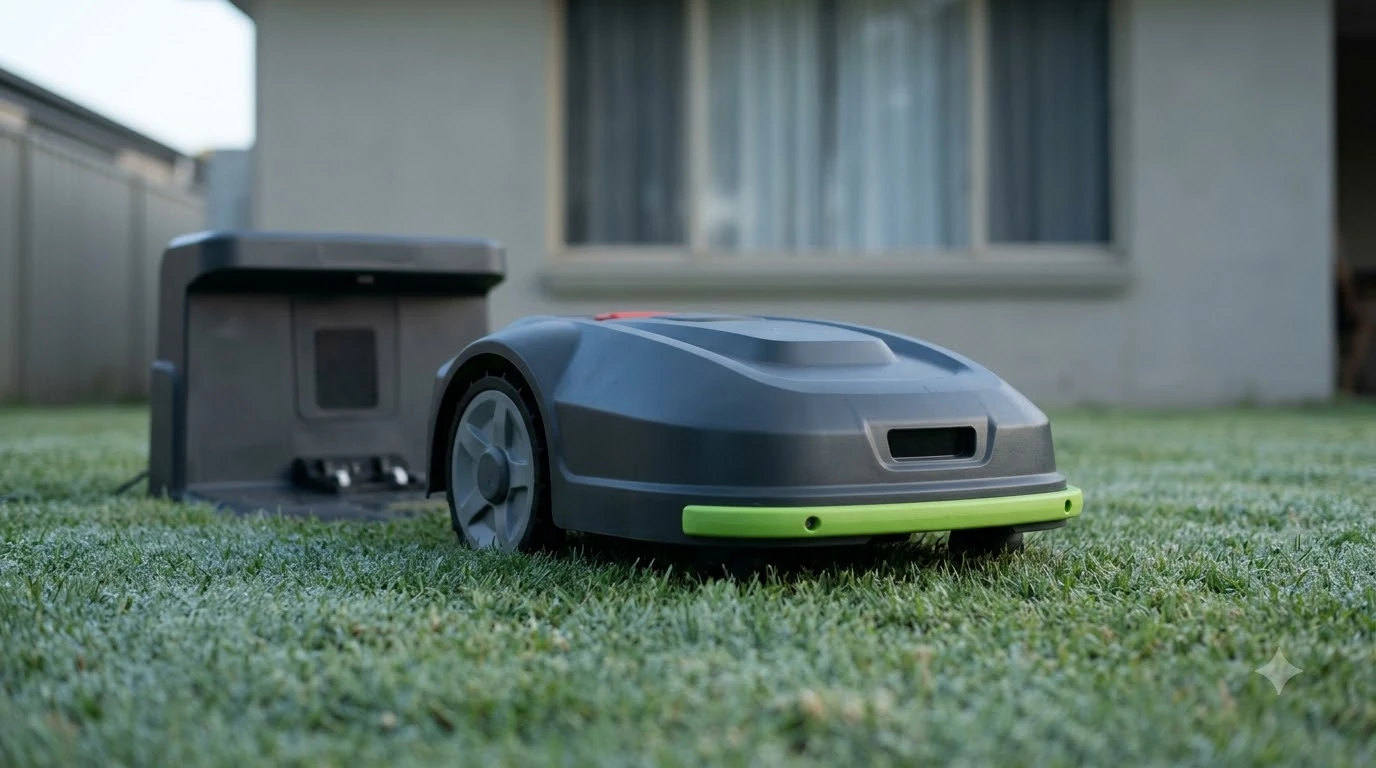

Why does my robot mower leave tire marks on the dock area? Mostly because it enters and leaves the dock along the same line, so the same two wheel tracks are pressed into the same soil every day. Turning on the dock pad and mowing when the ground is wet make the marks deeper. Varying the approach and keeping the area firm usually reduces them.
The short answer
- Same path: the mower drives in and out along one line, so its tires repeat the same track.
- Pivot turns: it spins on the pad to line up with the charging contacts, which scuffs the turf.
- Wet soil: ground softened by rain or irrigation takes a rut more easily.
- Fix: vary the approach, keep the area firm and covered, and avoid mowing the approach when it is wet.
Why does my robot mower leave tire marks on the dock area from one route
A robot mower returns to its dock along a set route after most sessions, and that route is usually the shortest path from the lawn. LSU AgCenter notes that mowing the same easiest route each time leaves repeated tire tracks in turf. The dock is a fixed destination, so the same tires cross the same few feet of lawn every time, which is why the marks show up in one place rather than across the whole yard. Marks form where the route never changes, as why mowers repeat the same route explains for typical mowing patterns. Frequent returns add to the wear near the base, as robot mower returning to the charger repeatedly explains.
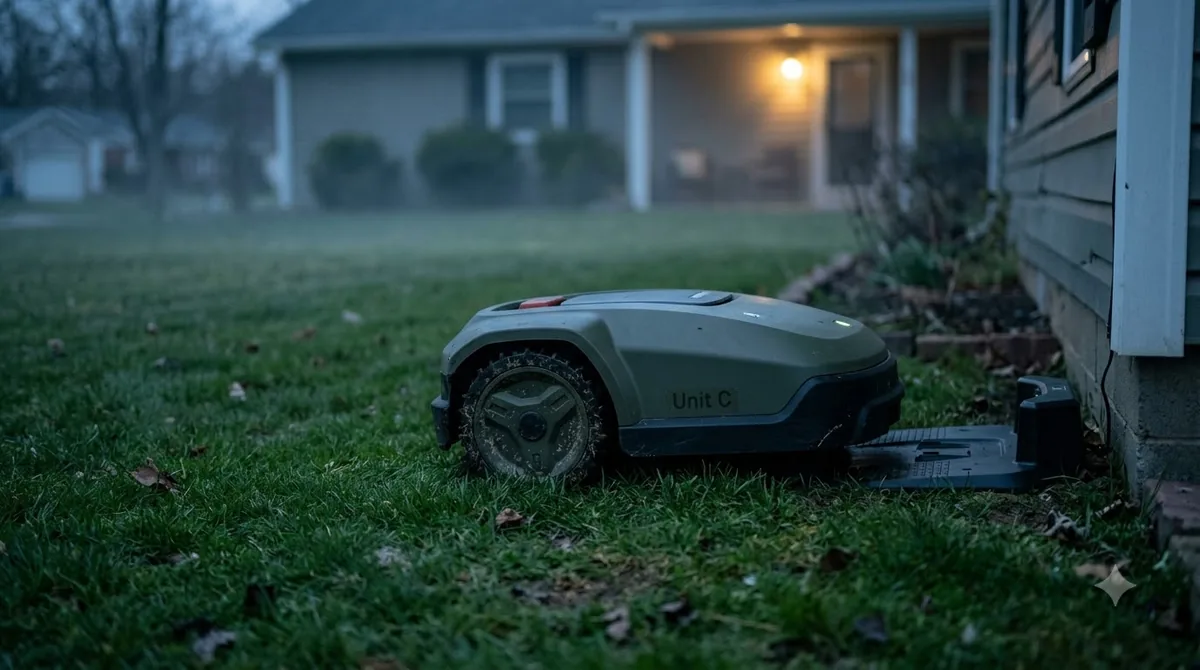
Our reading is that the marks come from route repetition more than from the mower’s weight. Many robot mowers are light, so a single pass rarely leaves a visible rut. Weeks of identical entries are what turn a faint track into a bare line.
Why turning on the dock pad leaves scuff marks
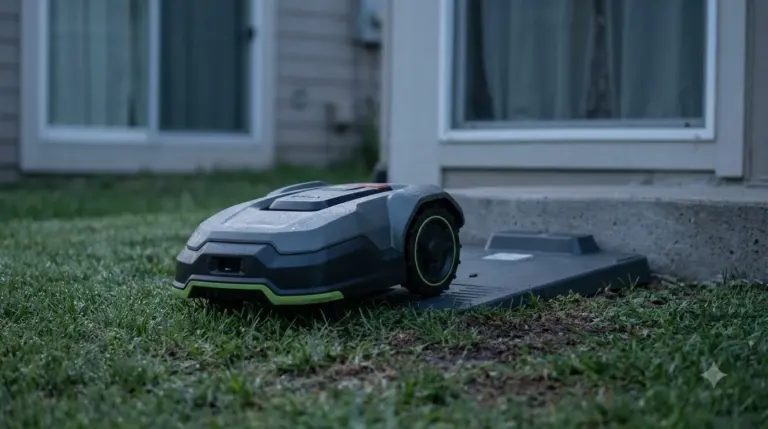
Docking needs alignment. The mower often makes small turns on the pad until its contacts meet the charger. Each pivot drags the wheels across the same patch of turf, and the grass is pushed sideways instead of standing up. Repeated across many sessions, the spot can thin out before the tire track itself becomes obvious. Trouble on the approach can leave scuffs behind, and a mower struggling to return to base lists the checks.
We do not have a measured count of how many turns a typical docking run needs, so treat this as a qualitative cause. If the dock’s pad is raised or sits on a slight slope, the mower may need more correction, which adds more scuffing.
How wet soil makes the marks deeper
Traffic is the main driver of soil compaction, and soil is more prone to compaction when it is wet, according to Colorado State University Extension. The same risk applies to a robot mower. Husqvarna’s wet-grass guidance notes that wet soil is softer and more vulnerable to mower weight, so the marks at the dock can deepen after rain or heavy watering even when they were shallow on dry days. Wet soil deepens scuffs on the pad, and the same moisture sits behind the longer paths covered in preventing lawn tracks from robot mowers.
LSU AgCenter also warns that mowing when the ground is wet can create ruts where the mower always runs. The dock approach is exactly that kind of spot, so the simplest habit to change is when you run the mower, not how.
How to reduce the marks
You can often cut the marks without moving the dock. Start with the cheap changes and keep the dock where it is unless the marks keep coming back.
- Vary the mowing pattern. Alternate the direction of cuts so the mower does not always leave along the same edge. LSU recommends rotating among four patterns on larger lawns.
- Mow the approach when it is dry. Schedule sessions for drier hours, especially after rain or watering.
- Keep the approach covered. Healthy turf recovers faster than thin grass. Feed and water the area lightly if the grass around the dock is weak.
- Check the dock’s ground. The pad and its approach should be firm and level so the mower does not need extra turns.
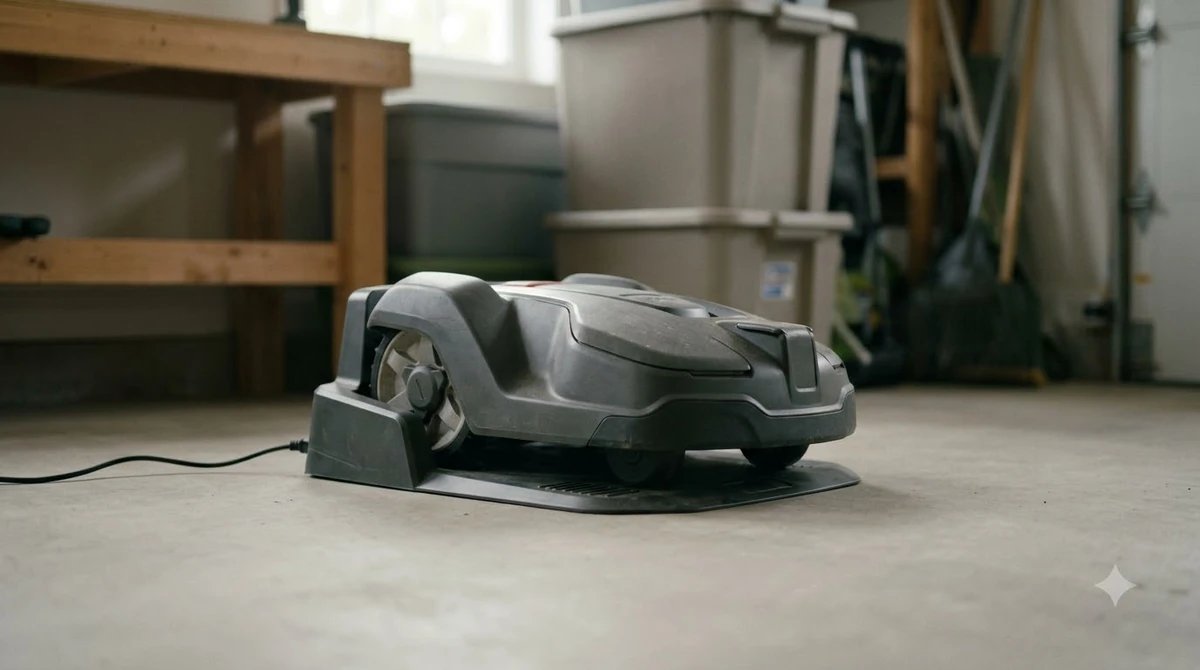
Expect recovery to be slow. Grass that is already stressed by heat or drought may take longer to fill a worn line, so keep the approach watered on the same schedule as the rest of the lawn. Avoid aggressive dethatching or heavy scalping near the dock, since that can expose more bare soil right where the mower already pivots.
If the marks still appear after these changes, a different entry angle may help. A dock placed where the mower can approach from a new direction spreads the wheel contact over more turf. Check the manufacturer’s dock placement guidance before moving it, since the contacts and boundary wire must still line up.
When the marks point to a bigger problem
Light tire marks usually fade once traffic stops and the grass regrows. Some signs suggest more than a route issue. Standing water at the dock, ruts deeper than the tire tread, or bare patches that stay after the mower has moved to another route all point to drainage or compaction. Our reading is that these cases need a closer look at the soil, not just a change in the mowing schedule.
Frequently asked questions
Are tire marks near the dock harmful to the lawn?
Light marks usually recover once the grass regrows. Repeated tracks on the same line can thin turf and compact the soil, because traffic is a major contributor to compaction.
Can mowing the dock approach when it is wet cause ruts?
Yes. LSU AgCenter says mowing when the ground is wet can create ruts where the mower always runs, so keep the approach to dry hours when possible.
Should I move the dock to stop the marks?
It can help, because a new entry angle spreads wheel contact across more turf. First try varying the pattern, keeping the approach firm, and mowing when it is dry. Confirm the new position with the manufacturer’s guidance so the contacts and boundary wire still work.
How long do the marks take to fade?
Once traffic stops, light marks often fade as the grass regrows. This timing depends on the season, the grass type, and how deep the track is, so it varies from lawn to lawn. Deep ruts or standing water usually need a soil fix rather than waiting.
Sources
- Mow Like a Pro (LSU AgCenter): repeated tire tracks from the same route, rotating mowing patterns, ruts from mowing wet ground.
- Soil compaction (Colorado State University Extension): traffic as the main driver of compaction, and wet soil being more prone to it.
- Can you mow wet grass? (Husqvarna): wet soil is softer and more vulnerable to mower weight.
 Up next8 min readLearnWhy Does My Robot Mower Skip Shaded Areas of the Lawn?Updated Nov 19, 2026
 6 min readLearnWhy Does My Robot Mower Keep Going Back to the Dock?Updated Nov 14, 2026
 9 min readLearnWhy Does My Robot Mower Beep Three Times on the Dock?Updated Nov 19, 2026
 7 min readLearnWhy Does My Robot Mower Leave Stripes in the Lawn?Updated Nov 13, 2026
 7 min readLearnWhy Does My Robot Mower Leave Clumps of Grass?Updated Nov 13, 2026
 8 min readLearnWhy Does My Robot Mower Leave Unmowed Circles Around Trees?Updated Nov 19, 2026