
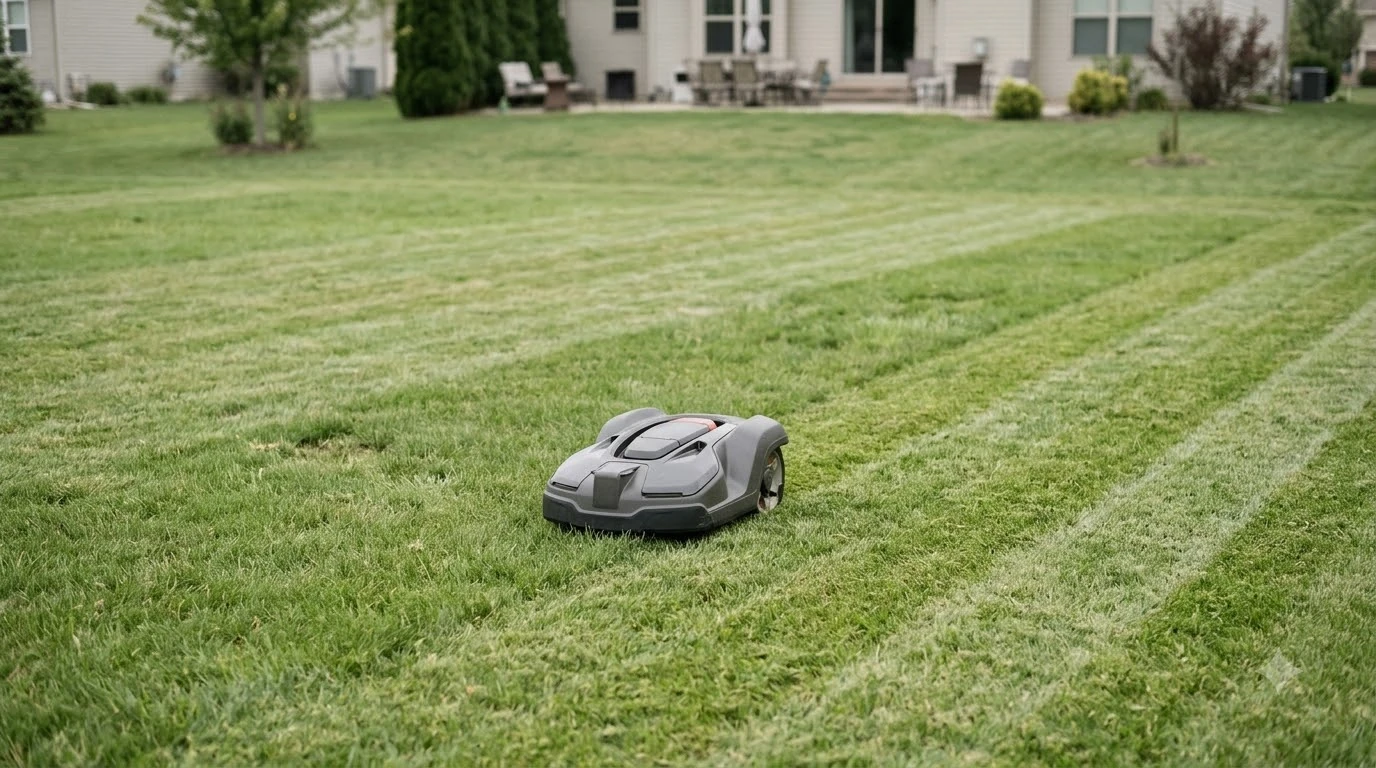

Do robot mowers cause lawn tracks? Yes, a robot mower can leave visible tracks, but the cause is usually repeated travel over the same strip of turf. Tracks form most often on the route to the charging station, in narrow passages, and where the soil is wet and soft. Most manufacturers build in ways to spread the wheel path, and a few settings and yard changes can usually stop the marks from becoming permanent.
The short answer
- Where: the same line to the dock, gates, and narrow gaps between beds.
- Why: the wheels press the same grass on the same path, many times a day.
- When it is worse: after rain or irrigation, when clay soil stays soft.
- What helps: spreading the path, not mowing wet ground, and fixing low spots early.
Do robot mowers cause lawn tracks on the same path?
So, do robot mowers cause lawn tracks on a healthy yard? Usually only where they repeat a path. Tracks are a wear problem, not a sign the mower is faulty. A robot mower follows the boundary wire and returns to its dock many times a week, so any stretch it uses often gets pressed down again and again. The grass there thins, the soil compacts, and the wheel marks stay visible even when the rest of the lawn looks fine. Tracks form where the route repeats, as paths that mowers repeat explains for common mowing patterns.
Repeated paths are the main pattern. A robot mower that always drives the same strip beside the wire will wear that strip, even on a healthy lawn. Our reading is that the fix starts with the path, then with the ground.
Where tracks usually form
The route to the charging station is the most common trouble spot, because the mower passes over it every time it charges. Narrow passages between a fence and a flowerbed are the second hot spot, since the mower has less room to vary its line. Edges along a wire that runs straight across open turf can also show a faint band over time. Changing the mowing pattern spreads the load, as mowing patterns that vary the path explains for different lawns. Tracks and stripes both come from repeated paths, so it is worth reading about stripes left by a robot mower in the same context.
Husqvarna describes this directly in its Automower guidance. The mower travels at a variable distance from the wire when it follows the boundary or guide wire to and from the charging station, or through a passage. The stated purpose is to reduce the risk of tracks forming on the lawn. The same article explains that the corridor width setting is only relevant to installations with a physical boundary wire.
Wet soil makes tracks into ruts
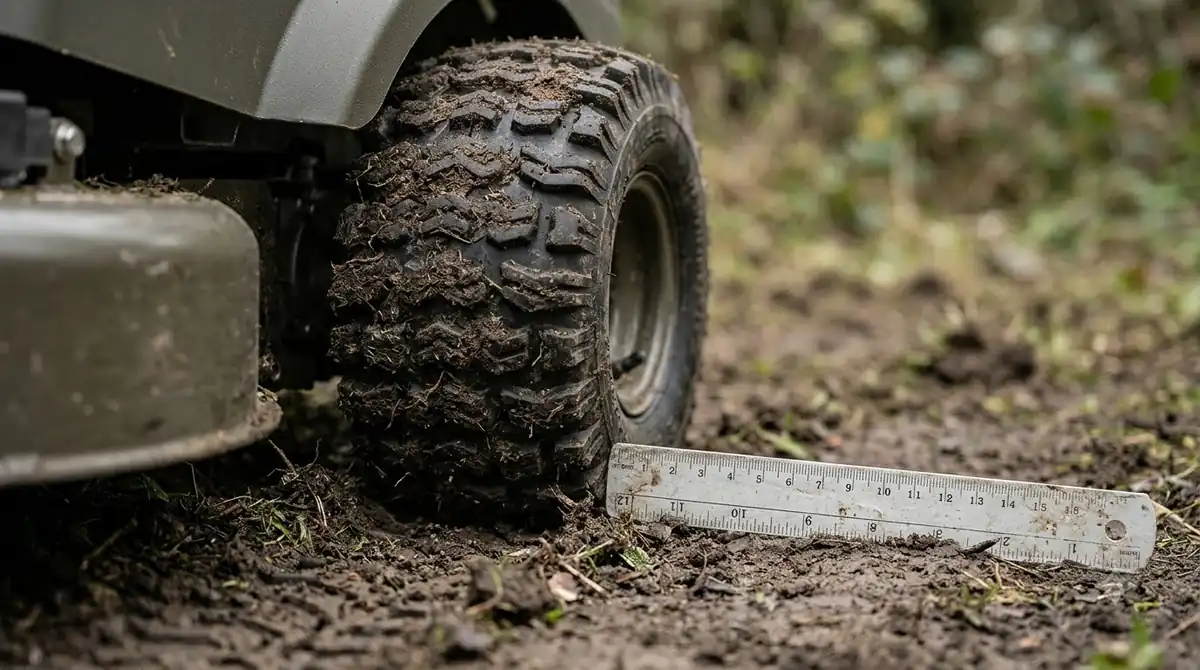
Tracks turn into ruts when the ground is soft. Eufy’s guidance on stuck robot mowers says that clay soil after a summer storm, or a lawn that gets regular sprinkler use, can let a wheel sink and leave a rut. Its advice is to let the area dry before running the mower again, then repair the surface. Tracks that deepen over time turn into ruts, which how to stop wheel ruts explains how to prevent and repair.
The same page points to repeat muddy spots near downspouts and irrigation outlets. These are places where water collects, so they are worth checking after every heavy rain. Ruts are usually a sign that the mower is running on ground that is too wet, not that the mower is damaging a healthy lawn.
Heads up
Do not keep running the mower on a lawn that is soaked through. Pressing a wet strip again and again deepens the rut faster than the grass can recover.
How to reduce tracks on your lawn
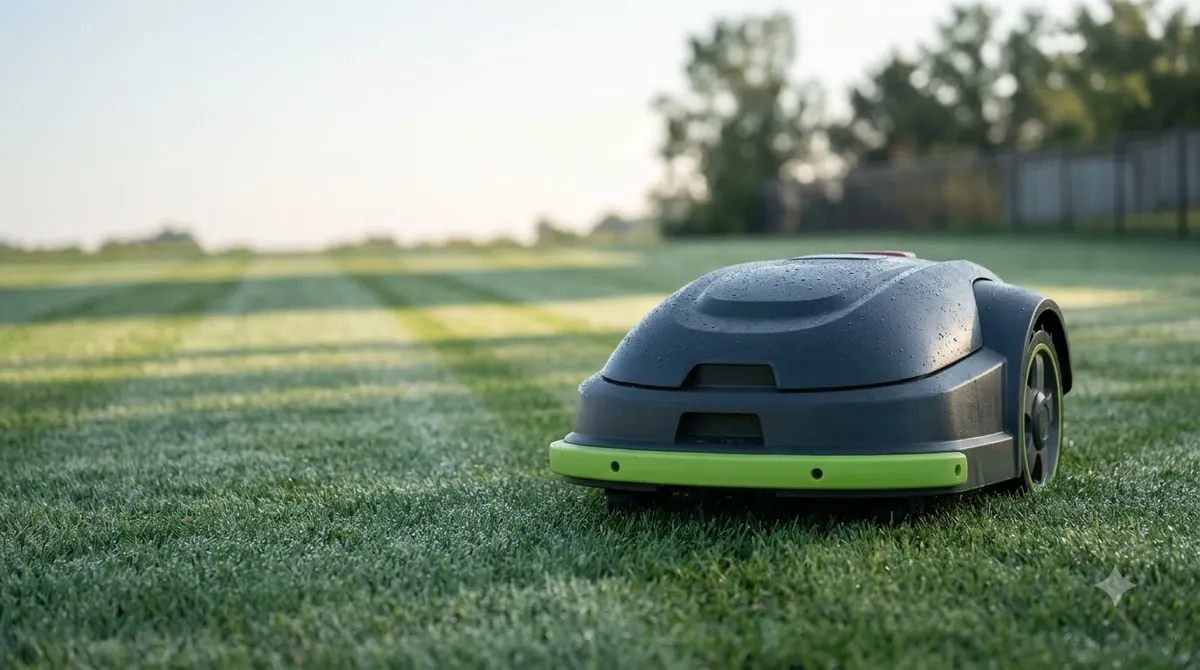
Start with the mower’s own settings. If your model lets you adjust the corridor width, a wider setting asks the mower to vary its distance from the wire more. Husqvarna lists a range from 1 to 9 for the corridor width, with 6 as the factory setting for a boundary wire. Check your model’s manual before you change it, because the right value depends on the installation.
Before changing anything, it helps to tell a track from a problem. A faint line of slightly flatter grass that disappears after a few days is normal wear. A band of bare, shiny soil, or a dip that holds water, is worth fixing. Walking the lawn in the morning, when dew shows the flattened lines clearly, is a simple way to map where the mower travels most.
Next, look at the ground. Fixing the soil is often what stops robot mowers from causing lawn tracks for good. Eufy’s advice is to fill shallow holes and compact loose soil, and to add a No-Go Zone around sections without stable turf. The same page suggests levelling a spot the mower keeps dropping into, or marking it as a No-Go Zone so the mower stays away until the grass recovers.
- Check the route. Walk the path to the dock and note any strip that looks thin.
- Adjust the corridor. If the model allows it, widen the corridor on the dock route and passages.
- Fill and firm. Add a little soil to shallow dips, then press it down.
- Pause after rain. Let wet ground dry before the next cut.
Frequently asked questions
Will the tracks go away on their own?
Light marks often fade as the grass regrows, especially if the mower moves to a different line. Deep ruts in wet clay usually need the ground to dry and a little soil and seed or sod before they recover.
Do robot mowers cause lawn tracks on a healthy lawn?
A healthy lawn that gets regular rest usually shows only faint marks, so robot mowers cause lawn tracks mainly where the path never changes. Wear appears when the mower repeats the same path on thin or wet grass, so the path and the soil condition matter more than the mower alone.
Should I move the boundary wire to stop tracks?
Moving the wire is a larger job and can leave gaps. Our reading is to try the corridor setting and No-Go Zones first, then consider moving the wire only if the path still wears the same strip after those changes.
Can I stop tracks by mowing less often?
Running the mower less often can reduce wear, since the grass has more time to recover between passes. It is not a complete fix for a route that the mower must cross every day, so pair it with the path and soil checks above.
Sources
- How to adjust the corridor width in an Automower installation (Husqvarna): variable distance from the wire to reduce tracks, corridor width range 1 to 9, factory settings, and the boundary-wire-only note.
- Robot lawn mower stuck: causes and fixes (Eufy): soft clay after storms, sinking wheels, filling and compacting, and No-Go Zones.
 Up next7 min readLearnRobot Mower Error No Loop Signal Meaning: Causes and FixesUpdated Nov 14, 2026
 6 min readLearnWhy Does My Robot Mower Spin in Circles? Causes and FixesUpdated Nov 14, 2026
 7 min readLearnRobot Lawn Mower Problems: Causes and FixesUpdated Nov 13, 2026
 6 min readLearnRobot Mower Making Loud Noise? Causes and FixesUpdated Nov 13, 2026
 9 min readLearnRobot mower wifi keeps disconnecting: causes and fixesUpdated Nov 12, 2026
 8 min readLearnWhat Do Robot Mower Error Codes Mean? Causes and First FixesUpdated Nov 12, 2026