
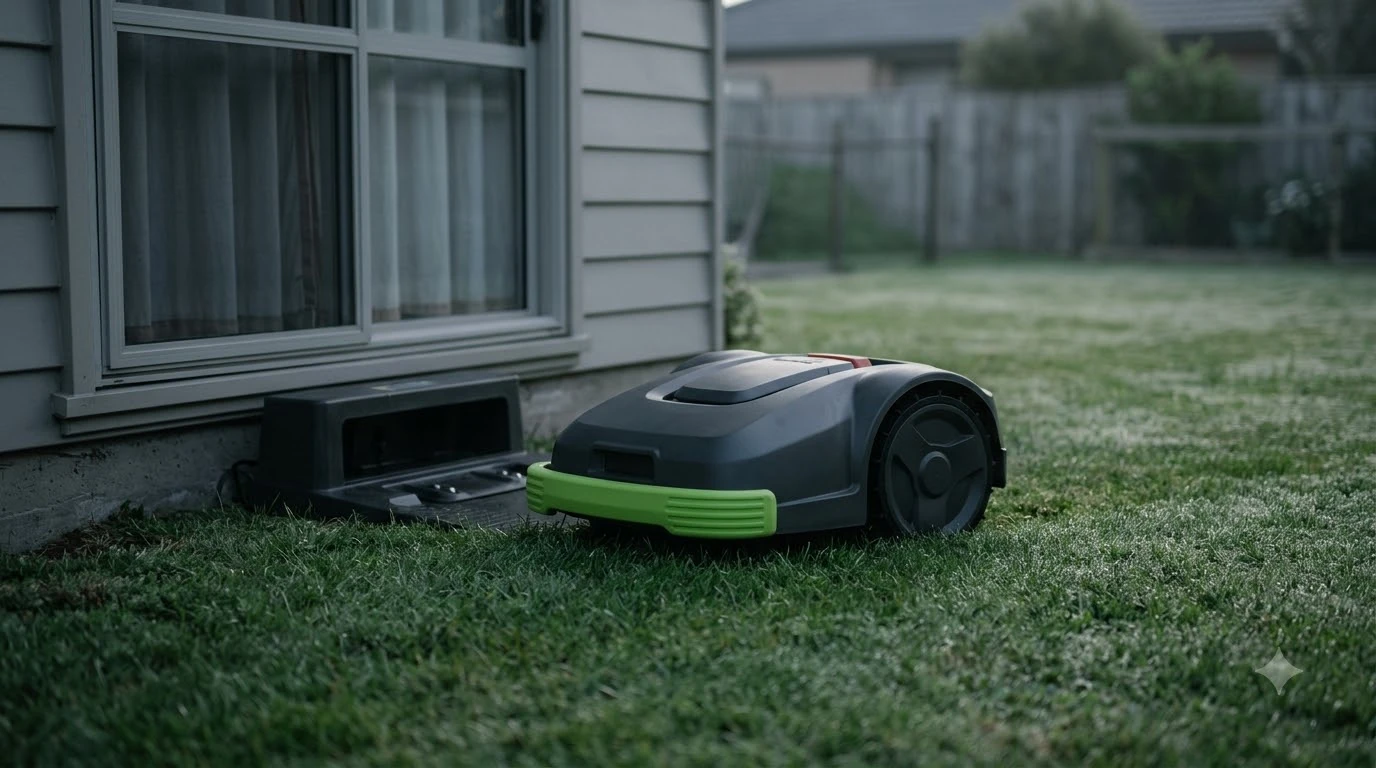

A robot mower for a lawn with a boat trailer needs the trailer’s footprint treated as a fixed obstacle, with the tongue, jack, and tires kept off the mowing path. A trailer that sits for weeks can sink into soft ground, leave ruts after rain, and shade the grass beneath it. Its low frame and tongue can also catch a mower’s housing if the layout leaves too little room. This guide covers how to plan the boundary around a trailer, the clearances installation guides describe, and the habits that keep the lawn and the mower working together.
The short answer
- Trailer footprint: keep the tongue, jack, and tires outside the mowing zone with a wire or map boundary.
- Parking pad: if the trailer sits on gravel or concrete, keep the wire about 25 to 30 cm from soft edges and about 10 cm from a flush hard surface.
- Soft ground: avoid mowing around the tires when the lawn is wet, because ruts are hard to fix.
- Clearance: check the mower’s ground clearance against the trailer frame before you set the boundary.
Why a robot mower for a lawn with a boat trailer is different
A boat trailer is large, heavy, and often parked for long periods. Unlike a bench or a flower bed, it has moving parts that can drop lower than the body suggests: the tongue, the jack foot, and the wheel hubs. A robot mower for a lawn with a boat trailer must work around all of these, and the boundary has to account for the full footprint, not just the trailer’s wheels. A trailer is a large stored item, and the mower guidance for yards with parked structures covers similar cases. A parked trailer can be handled by mapping it as a fixed object, and treating a stored object as an island shows how.
Robot mowers use a boundary wire, a virtual map, or a camera and GPS system to navigate. Each method tells the mower where it can and cannot go, but none of them is designed to inspect the underside of a trailer. The layout must do that job, so the mower never reaches the space beneath the frame.
Laying out the boundary around a trailer
Start by measuring the trailer’s length, width, and the swing of the tongue when it is hitched to a vehicle. Mark that footprint on the lawn with landscape paint, then add a buffer around it. Robomow’s installation guide describes keeping the wire a set distance from walls, beds, and hard edges, and the same logic applies here: the trailer is a fixed object the mower should not touch. A hard pad next to the grass is covered in RV pad edge boundary.
The lawnmowers.com setup guide suggests keeping the wire at least 30 cm from walls, fences, and tree trunks. A trailer’s frame and tongue are not solid like a wall, so a wider margin is sensible. Our reading is that 30 cm is a minimum, and a larger margin is safer where the tongue or jack foot sits low to the ground.
Heads up
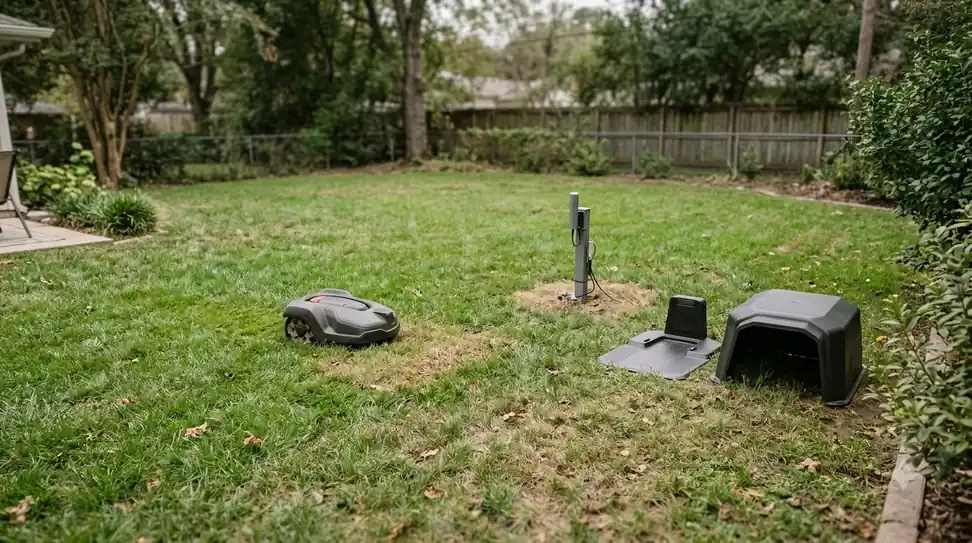
Do not rely on the mower to back out from under a low frame. Keep the mowing path open all the way to the trailer’s outer edge, and check the zone after any change to where the trailer parks.
Protecting the lawn under the trailer
Grass under a trailer grows slowly, or not at all, because it gets little light and air. When the trailer moves, the turf beneath it can come up in patches, and the ground can be compacted into a hard rut. A robot mower can keep the surrounding lawn even, but it cannot repair the bare patch under the frame, so it is better to keep the trailer on a stable surface. Paving beside the trailer takes the load of vehicles, and hard paving beside grass explains how the mower treats that edge.
If the trailer sits on the grass, lay a pad of gravel, pavers, or a concrete slab under the wheels and jack. Then set the boundary around that pad rather than around the bare turf. A pad keeps the trailer stable, reduces rutting after rain, and gives the mower a clear, hard edge to follow.
- Gravel or pavers under the wheels: keep the wire about 25 to 30 cm from the soft edge.
- Concrete slab flush with the lawn: keep the wire about 10 cm inside the lawn edge.
- Bare ground under the trailer: fence it off with a stay-out zone so the mower does not drive over it.
Clearance, the tongue, and the jack
Robot mowers have a limited ground clearance, and the cutting deck sits close to the lawn. A trailer’s tongue, jack foot, or safety chain can hang lower than the body suggests. Before you set the boundary, measure the height of each low part and compare it with the mower’s clearance in its manual. If a part sits lower than the mower can pass, the zone must keep the mower out completely. Covered storage raises similar height and access questions, as carport storage clearance shows for stored vehicles and trailers.
The jack foot is a common problem because it sits on a small plate that can sink into soft ground. Keep the jack and its plate inside the stay-out zone, and check the plate after heavy rain.

Wet ground, ruts, and the mowing schedule
Robot mowers are sensitive to soft and wet ground because the wheels can slip and dig in. A trailer makes this worse, because its weight can push tires into the turf and leave deep marks. Schedule the mower to skip the lawn beside the trailer after heavy rain, and check for ruts once the ground dries. A dry, firm surface is the safest time for a run. Pausing the mower after rain protects soft ground where the trailer stands, as rain delay schedule settings show for typical setups.
Frequent short runs also help. A mower that runs often removes only a little grass each time, which keeps the lawn even around the trailer and reduces the chance of uneven wear along the tire tracks.
Seasonal checks for a yard with a boat trailer
The trailer’s position changes through the year, so the mower setup should follow it. In spring, check that the boundary is still clear of the tongue and jack after the grass has grown, and look for ruts left over from winter. In summer, when the boat is used most, check the pad and the schedule after rain. In autumn, decide whether the trailer stays put or moves to storage, and recheck the boundary once the grass slows down.
Winter is a good time to inspect the wire and the pegs near the trailer. Frost can lift pegs, and a loose wire near a hard edge can fail without warning.
What to check before you set up or buy
Before you set up a robot mower for a lawn with a boat trailer, sketch the yard and mark the trailer footprint, the tongue swing, the jack position, and the pad, if there is one. Then match that layout to the mower’s setup method. A wire model needs a clear buffer around the footprint, while a map-based model needs a stay-out zone drawn over the trailer’s full area. Check the mower’s ground clearance, the lowest cutting height, and the slope of the lawn, because a slope under a heavy trailer can shift the parked position over time.
Related reads: Posts and fixtures near the driveway are another useful comparison, and driveway-side post handling covers how mowers treat them.
Frequently asked questions
Can a robot mower drive under a boat trailer?
Our reading is that it should not. The frame and tongue can sit lower than the mower’s clearance, so keep the mower out of the space beneath the trailer with a wire or a stay-out zone.
How far should the wire stay from the trailer?
The setup guides we read suggest at least 30 cm from solid fixed objects, with a wider margin where a low tongue or jack sits near the edge. Check the mower’s manual for the exact spacing.
Does a trailer on the grass damage the lawn?
It can. Grass under a parked trailer grows slowly and can become compacted into ruts. A gravel or paver pad under the wheels helps keep the ground stable.
Should the mower run after heavy rain?
It is better to wait until the ground dries. Wet soil makes the wheels slip and can deepen ruts left by the trailer’s tires.
Sources
- Robomow boundary wire guide (manufacturer): spacing from walls, beds, and hard edges.
- lawnmowers.com boundary wire setup guide (retailer guide): clearance from fences and trunks, and soft-edge spacing.
- Husqvarna islands guide (manufacturer): islanding obstacles that cannot take a bump.
 Up next6 min readBy YardRobot Mower for a Lawn With a FlagpoleUpdated Nov 13, 2026
 6 min readBy YardRobot Mower for a Lawn with a Croquet Court: What to ExpectUpdated Nov 13, 2026
 6 min readBy YardRobot Mower for a Lawn With a Mailbox PostUpdated Nov 13, 2026
 6 min readBy YardRobot Mower for a Lawn with Voles: Signs, Limits, ControlUpdated Nov 13, 2026
 7 min readBy YardRobot Mower for a Lawn With a Sundial or StatueUpdated Nov 13, 2026
 6 min readBy YardRobot Mower for a Lawn With Utility BoxesUpdated Nov 13, 2026