
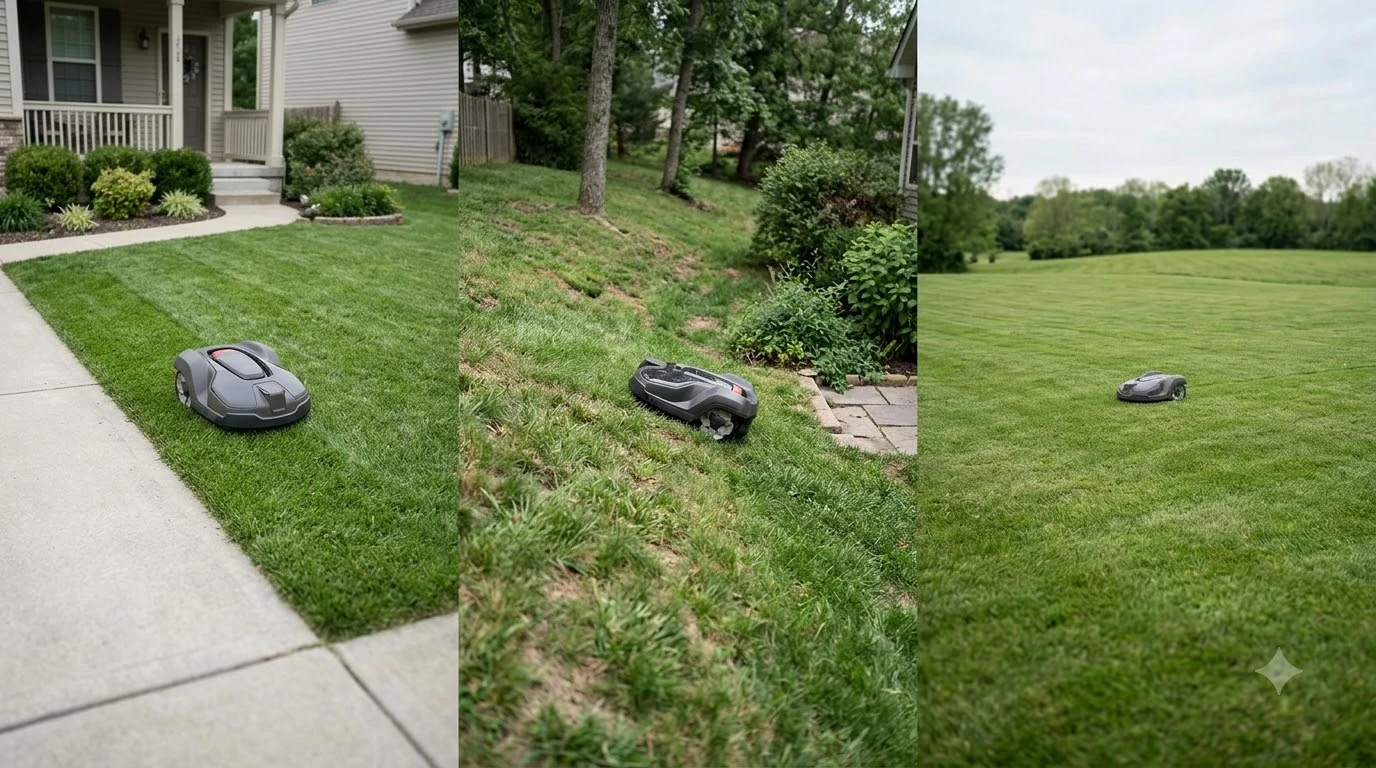

The best robot mower for Louisiana lawns is one that cuts St. Augustine at 2 to 3 inches and centipede at 1 to 2 inches, and that copes with the state’s heavy rain and humid summers. LSU AgCenter says St. Augustine should be mowed at 2 to 3 inches and centipede at 1 to 2 inches, so the two most common Louisiana lawn grasses need different settings. This guide explains what to check before you buy, how Louisiana’s rain, shade, and clay change the job, and why the grass type should set the cutting height.
The short answer
- St. Augustine: LSU AgCenter gives 2 to 3 inches, so the mower needs a range that reaches up to 3 inches.
- Centipede: LSU AgCenter gives 1 to 2 inches, so the mower needs a low setting that stays steady.
- Shade: LSU advises raising the blades to about 3 to 3.5 inches in shaded areas.
- Rain and clay: pick a model that pauses on saturated turf and handles soft, clay-heavy ground.
Why St. Augustine and centipede need different heights
St. Augustine and centipede are the two grasses most often grown in Louisiana home lawns, and LSU AgCenter’s publications are consistent that St. Augustine should be cut higher than centipede. The page LSU publishes on mowing at the correct height gives 2 to 3 inches for St. Augustine and 1 to 2 inches for centipede, and it warns against cutting too short. Louisiana belongs to the Gulf South, so the robot mower guide for Southeast states offers a broader regional view.
Scalping is the main risk. LSU’s guidance says cutting too short creates an open canopy that exposes the soil, which lets weeds in and thins the turf. A robot mower that defaults to its lowest setting can scalp a St. Augustine lawn quickly, so set the height to the grass before the first cut.
Heads up
LSU’s BMP table from 2010 gives St. Augustine a wider range of 2 to 4 inches and centipede 1 to 2 inches. Use the newer 2 to 3 inch figure as the starting point and adjust by how the lawn looks.
Heights by grass type in Louisiana
The table below uses the LSU AgCenter figures. Bermudagrass is common in Louisiana too, but the LSU page used for this guide did not give a height for it, so the table leaves it out rather than guessing. For another state with mixed warm-season turf, see the Tennessee robot mower picks for comparison.
| Grass in your lawn | Height guidance from LSU AgCenter | What it means for a robot mower |
|---|---|---|
| St. Augustine | 2 to 3 inches; in shade, about 3 to 3.5 inches | A mower that reaches at least 3.5 inches for shaded areas |
| Centipede | 1 to 2 inches | A low, steady setting in the 1 to 2 inch range |
The one-third rule also applies. LSU AgCenter advises that you never remove more than one-third of the leaf blade height in one mowing. A robot mower that runs often keeps each cut small and meets that rule without measuring.
Heavy rain, humidity, and summer growth
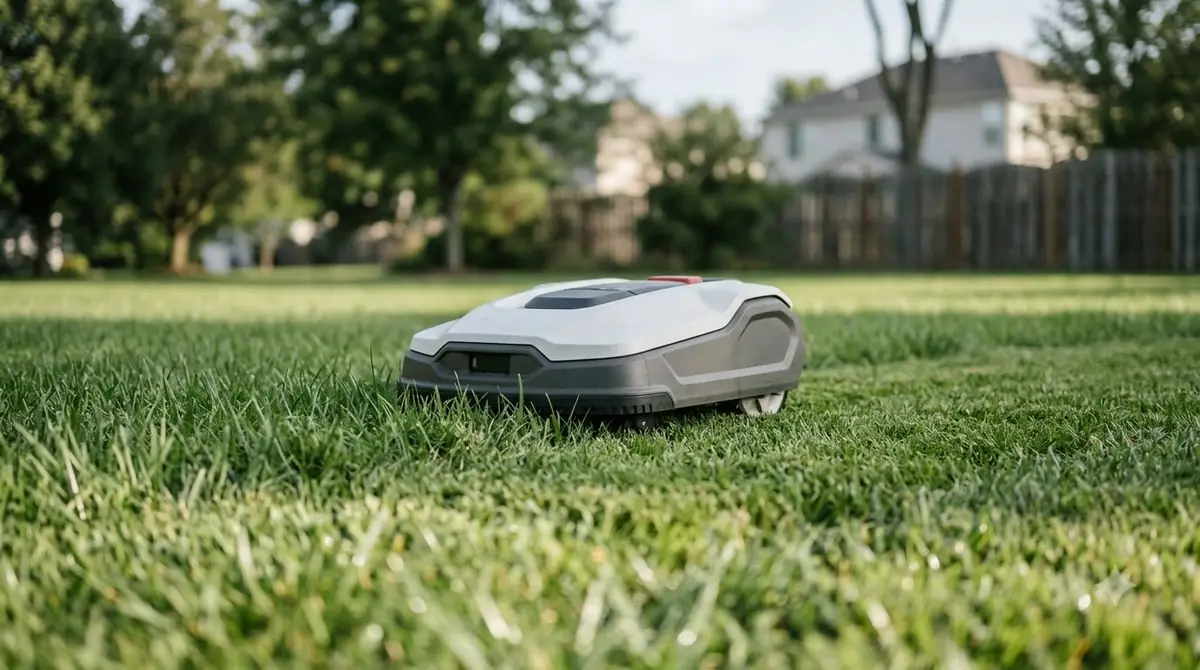
Louisiana gets heavy rain and humid summers, and warm-season grass grows fast in the heat. That makes frequent, short runs the practical choice. Run the mower often in peak growth and let it wait out storms, because a mower running on saturated, soft turf can rut the lawn and leave tracks that stay for weeks. Heavy rain and humidity shape the choice, so review robot mowers that handle heavy rain. Florida shares the same humid pattern, so compare robot lawn mower picks for Florida.
Check the rain behaviour before you buy. A model with a rain sensor and a stated way to pause in wet conditions will protect the lawn through a wet season. Our reading is that a model with a steady climb on soft ground will also handle the clay patches common in many Louisiana yards better than a light model made for dry lots.
Shade under trees and along fences
Many Louisiana yards have large trees that shade part of the lawn. LSU AgCenter advises raising the blades to about 3 to 3.5 inches in shade, so the mower needs to set a higher cut for shaded areas. If the model can only use one height for the whole lawn, the shaded grass may thin, so look for zone settings or a height range that covers both sunny and shaded areas. Shade changes how the grass grows, so look at robot mowers for tree-shaded lawns. Shade under trees and along fences affects the cut across the Southeast, and mowing Carolinas lawns with a robot is covered in a companion guide.
A mowing schedule for a Louisiana season
A robot mower works best with a schedule that matches the grass. For most of the growing season, run the mower often enough that no single cut removes more than a third of the blade height.
- Spring green-up. Start the mower when the lawn is growing well. For St. Augustine begin around 3 inches, and for centipede begin around 1.5 inches.
- Peak summer. Run the mower most days. In shaded areas, keep the blades at about 3 to 3.5 inches.
- Fall. Keep the schedule until growth slows, then stop when the grass goes dormant.
- Winter. Store the mower under cover, and bring the charging dock indoors or into a dry spot.
Best robot mower for Louisiana lawns: what to check before you buy
For a Louisiana lawn, start with the grass type and set the height range from it. Then check the wet-weather behaviour, the slope rating if the yard is uneven, and the boundary setup around trees and beds. Make sure the mower can handle soft clay ground and has a way to pause after heavy rain.
Think about the lowest setting too. A model that can reach 1 inch is useful for centipede, but a model that cannot hold a steady height may scalp a St. Augustine lawn. Choose one that does both well.
Related reads: Fast summer growth keeps blades busy, so read about replacement blades for robot mowers.
Frequently asked questions
What height should St. Augustine be cut at in Louisiana?
LSU AgCenter says St. Augustine should be mowed at 2 to 3 inches. In shade, LSU advises raising the blades to about 3 to 3.5 inches.
What height should centipede be cut at in Louisiana?
LSU AgCenter gives 1 to 2 inches for centipede. Keep the setting steady in that range rather than dropping to the lowest possible blade height.
How often should a robot mower run on a Louisiana lawn?
Run it often enough that each cut removes no more than one-third of the leaf blade height. In peak summer growth that usually means most days.
Can a robot mower run after heavy rain in Louisiana?
It should not run on saturated, soft ground, because it can rut the lawn. Choose a model with a rain sensor or a way to pause in wet weather, and check the boundary wire after storms.
Sources
- LSU AgCenter, Mowing Your Lawn at the Correct Height (university): 2 to 3 inches for St. Augustine and 1 to 2 inches for centipede, and the warning about cutting too short.
- LSU AgCenter, Three Common Lawncare Mistakes to Avoid this Summer (university): the one-third rule and the advice on scalping, as shown in its search summary.
- LSU AgCenter, Taking Care of St. Augustinegrass Lawns (university): the shade guidance of about 3 to 3.5 inches, as shown in its search summary.
 Up next7 min readBest Robot MowersBest Robot Mower for Alabama Lawns: Grass and Height GuideUpdated Nov 13, 2026
 7 min readBest Robot MowersBest Robot Mower for Missouri Lawns: Height Guide Before You BuyUpdated Nov 18, 2026
 8 min readBest Robot MowersBest Robot Mower for Arizona Desert Lawns: Heat, Dock and HeightUpdated Nov 14, 2026
 8 min readBest Robot MowersHow to Choose the Best Robot Lawn Mower with Automatic Height Adjustment in AppUpdated Nov 19, 2026
 8 min readBest Robot MowersBest Robot Mower With Adjustable Cutting HeightUpdated Nov 11, 2026
 7 min readBest Robot MowersBest Robot Mower for Utah Lawns: What to Check Before You BuyUpdated Nov 13, 2026