
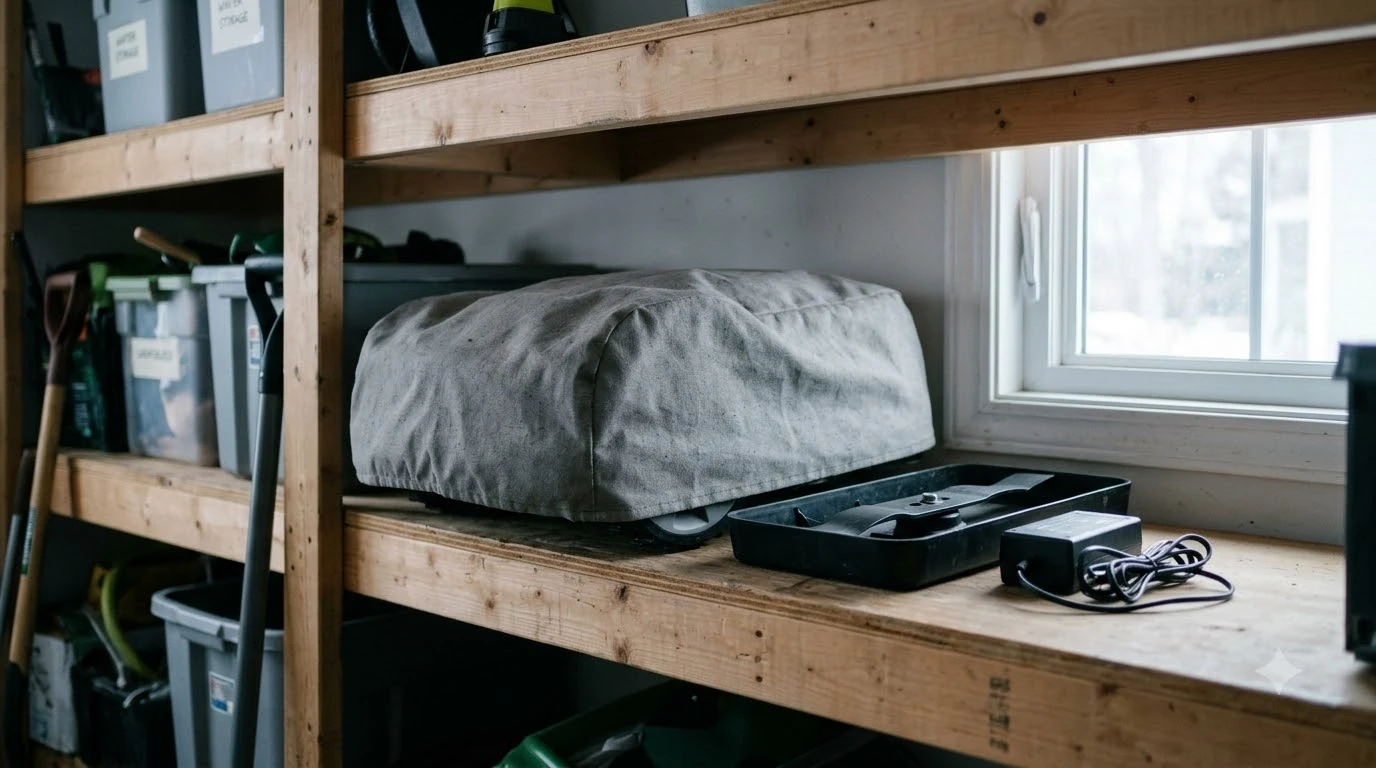

Here is how to store a robot mower for winter: charge it fully, clean the body and blades, look after the battery, and keep the mower in a dry place that stays above freezing. Husqvarna, STIHL and Mammotion publish similar core steps, as of 2026-11-09. Charge levels and temperature limits differ by brand, so your model’s manual has the final word.
The short answer
- Stop mowing before the first hard frost, leaving the grass at 6-8 cm (2.4-3.1 in).
- Clean the body, chassis and blades, and replace worn blades.
- Charge the battery fully, then switch the mower off.
- Store it indoors in a dry, frost-free place, and leave the boundary wire in the ground.
How to store a robot mower for winter: when to stop mowing
Stop mowing before the first hard frost. STIHL’s UK guide recommends a last cut before the first frost, when temperatures are regularly below 10°C, which in many areas means late October or early November. Husqvarna advises leaving the grass slightly longer, at 6-8 cm (2.4-3.1 in), so the turf has better protection through the cold months.
The timing depends on your climate. In a mild region the mower may keep working into December. Our reading is that the cut-off should follow the temperature trend in your yard rather than the calendar.
Before you put the mower away, turn off any automatic mowing plan so it does not try to start while in storage. STIHL recommends this step along with setting the highest safety level, covered in the locking section below.

Clean the mower and check the blades
Cleaning removes the grass and soil that hold moisture against metal parts. Mammotion suggests clearing clippings from the blades, wheels and underside with a soft brush or compressed air, then wiping the sensors and wheels with a damp cloth. STIHL recommends a damp cloth or dry brush for the housing and mowing deck, with no aggressive detergents.
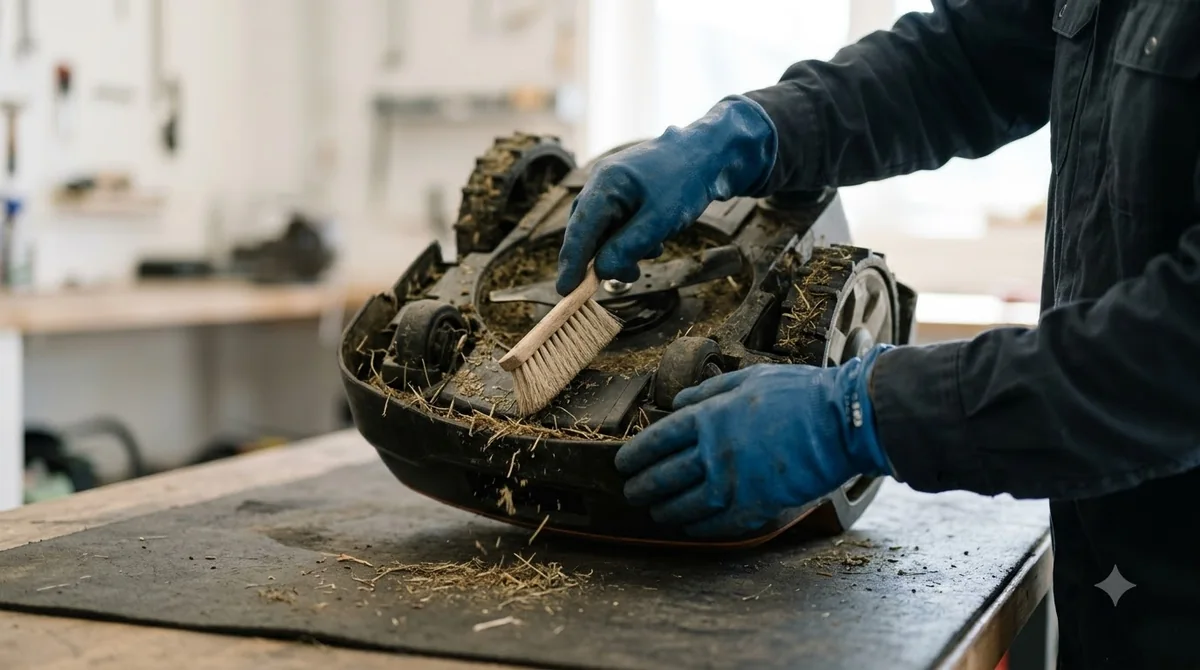
Avoid high-pressure hoses and running water. STIHL says not to clean its iMOW under running water or with a high-pressure cleaner, and Mammotion gives the same warning for its models. Water ratings are a separate question, covered in robot mower IP rating explained.
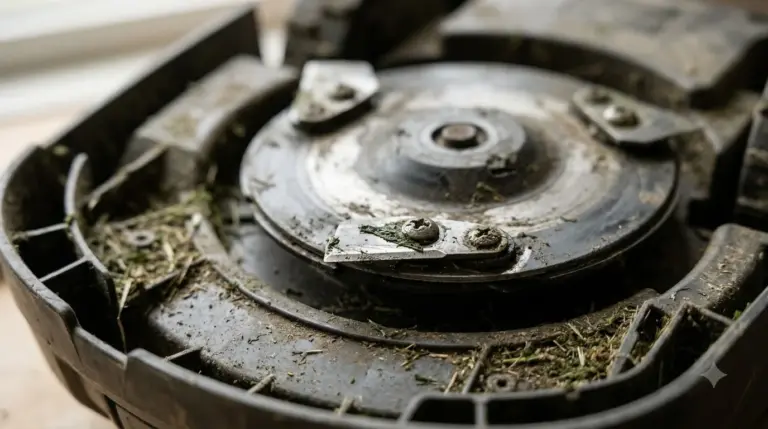
Husqvarna advises replacing the blades and screws before storage to prevent rust and keep the edges sharp. STIHL says a blade should be replaced after 200 operating hours. Check the lower front wheel bearings and body panels for wear, turn the wheels by hand, and listen for grinding or squeaking. Look at the charging contacts on both the mower and the station for corrosion or debris.
Charge the battery before storage
Charging is the step where the brands differ most. Husqvarna and STIHL both say to charge the battery fully after the last use of the season, then switch the mower off. A full charge helps prevent deep discharge over the winter, when the mower will not be used for months.
Mammotion takes a different view. Its winterizing guide says 40-60% is usually enough for storage, and it adds that some manufacturers, Mammotion among them, recommend 80%. Our reading is that a full charge is the safer default for most owners, and a partial charge only makes sense when your manual explicitly says so.
| Source | Recommended charge before storage |
|---|---|
| Husqvarna Automower | Fully charged, then switched off |
| STIHL iMOW | Fully charged after the last use |
| Mammotion | 40-60% usually enough; 80% for some models |
Two more points apply to most models. First, do not leave the battery fully empty for months, since Mammotion warns that a depleted battery can lose capacity. Second, if the battery is removable, take it out and store it separately in a cool, dry place above freezing. Husqvarna notes that most models need no charging during storage, but some older models need a top-up about every three months. Check the manual to see which group your model falls into. Over the long run, battery wear is a bigger issue than one winter, as our guide on how long robot lawn mowers last explains.
Pick a storage place that stays above freezing
The storage spot matters as much as the charge. Husqvarna says indoor storage should be dry and above freezing, meaning above 0°C (32°F). STIHL sets a higher floor and says the storage area should not drop below 5°C. Mammotion gives an ideal range of around 10-20°C (50-68°F) for the battery and says to keep the mower in a dry, temperature-controlled area.
| Source | Lowest safe temperature | Ideal range |
|---|---|---|
| Husqvarna Automower | Above 0°C (32°F) | Not stated |
| STIHL iMOW | Not below 5°C | Not stated |
| Mammotion | Above freezing | Around 10-20°C (50-68°F) |
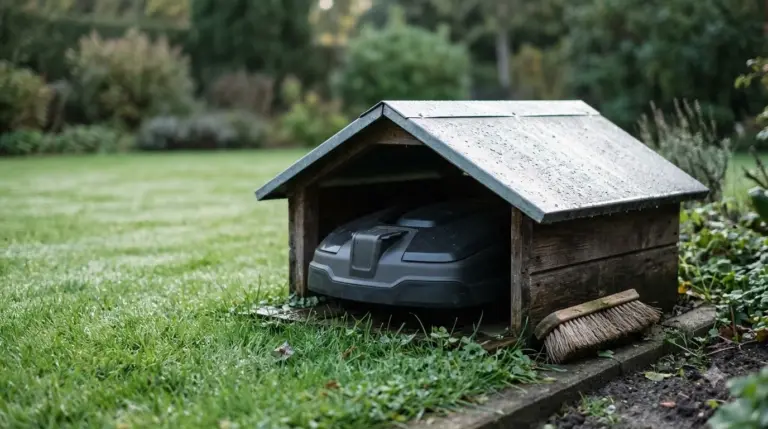
Where you store it matters as much as the number when you learn how to store a robot mower for winter. STIHL says a dry, lockable garage or basement works. Mammotion warns against damp garages and basements, because condensation can damage electronics and metal parts. Our reading is that a dry garage, shed or utility room with a stable temperature is the best fit, and that a basement only works if it stays dry all winter.
Husqvarna recommends resting the mower on all of its wheels on a flat surface, or hanging it on an Automower wall hanger. STIHL advises storing it in its normal upright position and placing nothing on top of it.
Charging station and boundary wire
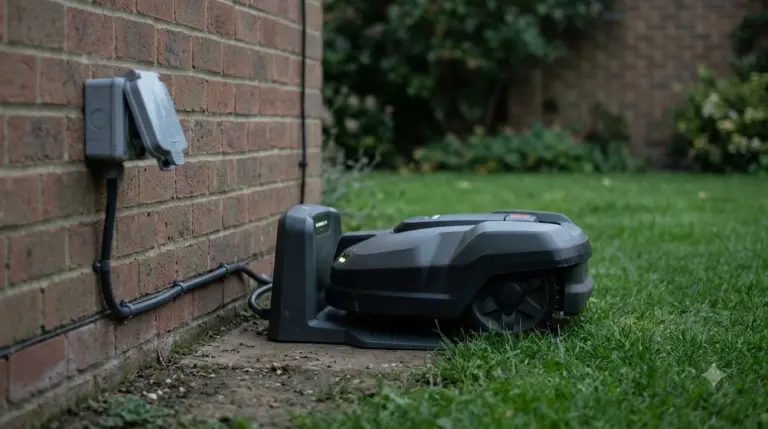
The charging station is the part of how to store a robot mower for winter that most often needs different handling, and the rule depends on the brand. Husqvarna says to store its charging station indoors, with one exception: the NERA baseplate is designed to stay outdoors, so only its top needs to come in. Mammotion says to move its base station indoors or into a sheltered, dry spot, and to cover it with a breathable, dust-proof cover.
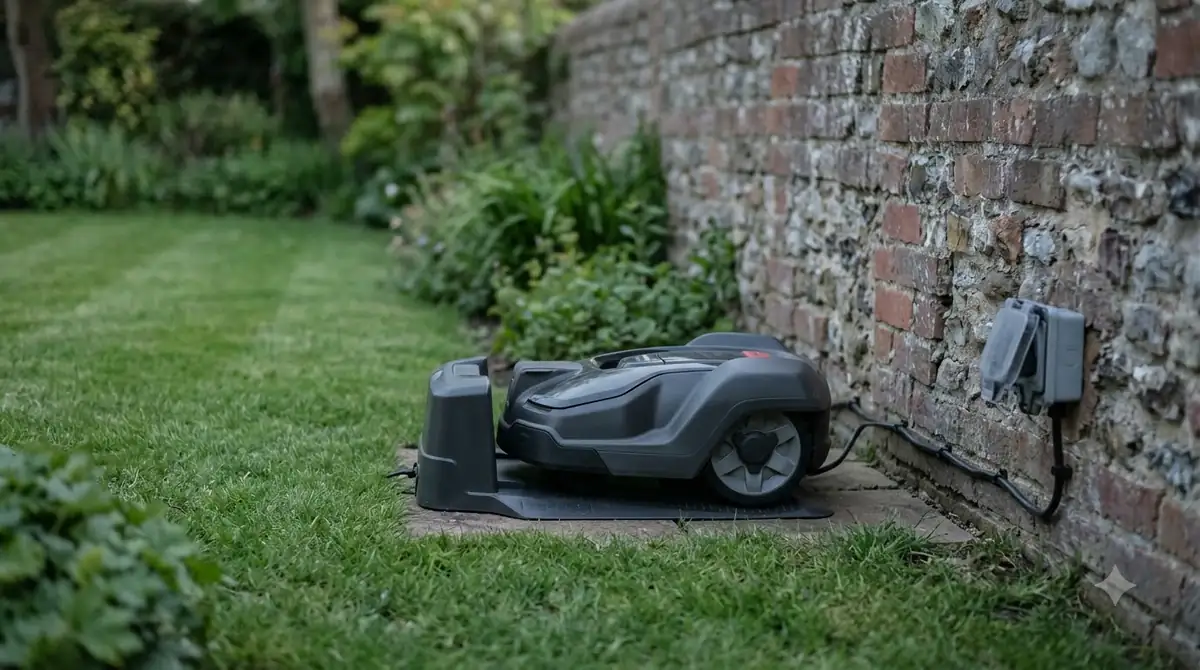
STIHL is more flexible. Its docking station can stay outdoors over winter if it is covered, the mains cable is disconnected and stored in a cable box, and a bucket or plastic crate is placed over the station. Whichever way you store it, keep the station protected from moisture and frost, which can corrode the contacts. If you want to understand how the dock and mower work together, read how robot mowers return to the charging station.
The boundary wire can usually stay in the ground. Husqvarna says it remains installed through winter, and Mammotion says it generally does not need to be removed, though its connectors should be protected from moisture and corrosion. If you do disconnect a wire, label each end so you can reconnect it correctly in spring. Wire-free models use a reference station instead; Husqvarna says its weatherproof reference station can stay outdoors year-round, but if you bring it inside, reinstall the mounting arm in its original position.
Update, lock and set the mower up
Before you power the mower down, install any firmware update. Mammotion recommends this before storage. Then set the mower up so it cannot start by accident.
- Turn off the mowing plan. STIHL says to turn off the automatic mowing plan and set the highest safety level.
- Lock the mower. Press and hold the STOP button, or choose Lock iMOW in the Commands menu and confirm with OK, as described in STIHL’s guide.
- Handle the GeoFence. Husqvarna says to keep the GeoFence active if the mower is stored inside its area. If you move it outside the area, disable the GeoFence before you power off, and disable it before you take the mower to a dealer.
- Check the ECO setting. On some STIHL C-models, ECO mode turns off wireless communication during idle periods, so app control works only during active hours. Check your manual before relying on remote control in winter.
- Power off. Disconnect the power supply, as Husqvarna advises, and store the mower in a dry, frost-free place.
Restart the mower in spring
A spring restart is simpler if you plan it, and once you know how to store a robot mower for winter, the steps back are short. STIHL says the first warm, sunny days in March or April usually signal that winter is over. Before you switch the mower on again, have an authorized dealer check the battery, electronics and software. STIHL recommends an annual check-up during winter for this reason.
Husqvarna says winter maintenance and storage may already be included if you have a Warranty Plus, Service Plus or Lease Plus contract. Its annual service typically covers wear parts, firmware updates, blade replacement and battery testing, although included services vary by country and dealer. Ask your dealer what your plan covers before the season ends, and compare it with the terms in our robot mower warranty guide.
When the weather turns, re-check the charging contacts, reconnect the station and the boundary wire, and re-enable any GeoFence settings you turned off before storage.
Frequently asked questions
Is a full charge the right way to store a robot mower for winter?
Husqvarna and STIHL both recommend a full charge before storage. Mammotion says 40-60% is usually enough and recommends 80% for some models, so check your manual before you decide.
Can a robot mower stay outside in winter?
Not ideally. Husqvarna strongly advises storing the mower indoors in a dry place above freezing. Only some docking and reference stations are designed to stay outdoors, and STIHL says its docking station can stay out only if it is covered and the mains cable is disconnected.
Do I need to remove the boundary wire?
Usually not. Husqvarna says the wire stays in the ground through winter, and Mammotion says it generally does not need to be removed. Protect the connectors from moisture and corrosion.
Should I take the battery out for winter?
If the battery is removable, Mammotion advises taking it out and storing it separately in a cool, dry place above freezing. If it cannot be removed, keep the whole mower above freezing and follow your manual.
Sources
- Complete winter storage guide for your Automower robotic lawn mower (Husqvarna): grass height, charging, storage temperature, boundary wire and charging station rules.
- How to prepare your robot lawn mower for winter storage (STIHL, UK): last-cut timing, 5°C storage floor, cleaning limits, docking station and spring restart.
- Winterize robotic lawn mower (Mammotion): battery charge range, cleaning, battery removal and storage location.
 Up next8 min readBest Robot MowersRobot Mower IP Rating Explained: What IPX4, IPX5 and IPX6 MeanUpdated Nov 11, 2026
 8 min readBest Robot MowersDo You Need a Grass Collector on a Robot Mower?Updated Nov 11, 2026
 8 min readBest Robot MowersHow Often to Replace Robot Mower BladesUpdated Nov 11, 2026
 8 min readBest Robot MowersDo Robot Mowers Work in the Rain? Sensors, Delays and LimitsUpdated Nov 11, 2026
 8 min readBest Robot MowersDo Solar Powered Robot Lawn Mowers Exist?Updated Nov 11, 2026
 8 min readBest Robot MowersHow Loud Are Robot Lawn Mowers? A Simple Guide to dB LevelsUpdated Nov 11, 2026