
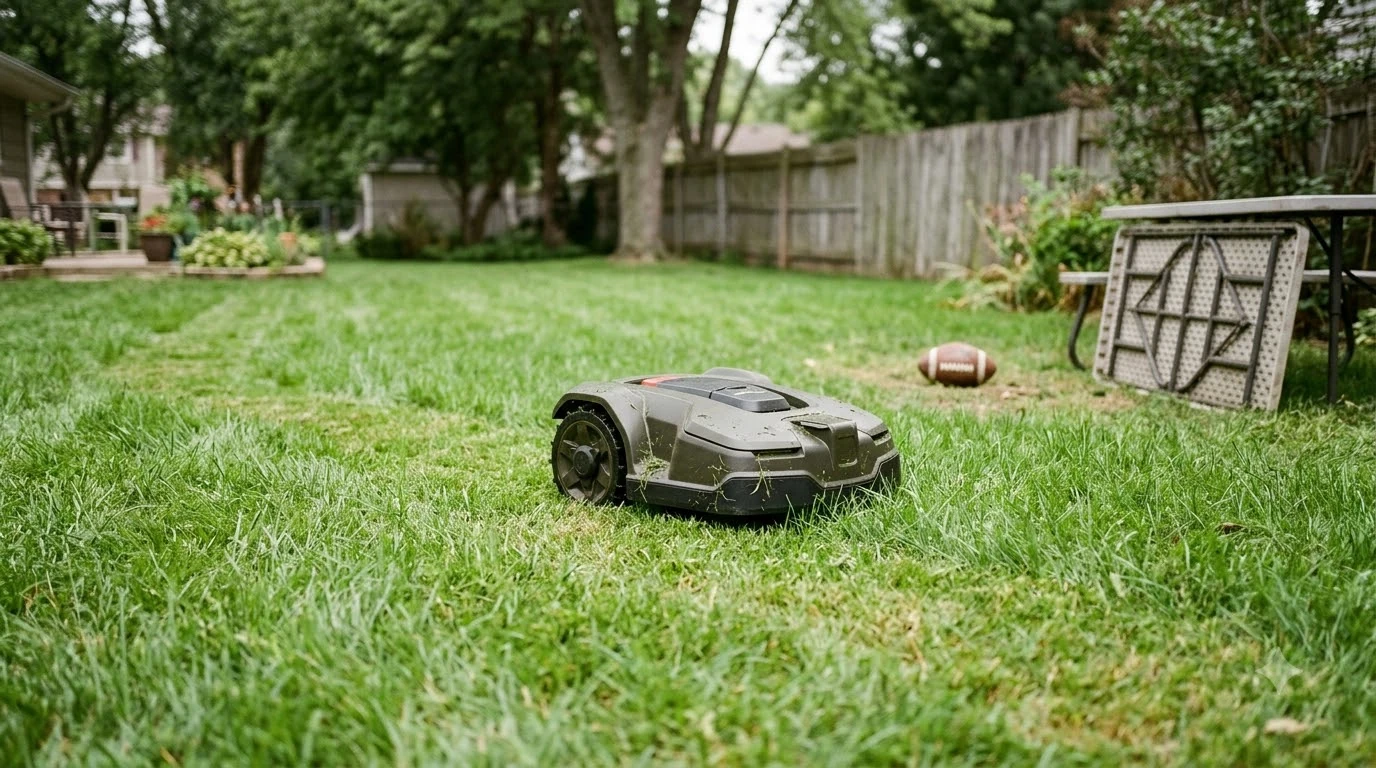

The best robot mower for a duplex yard is the one whose published specs cover your mowable area, your narrowest passage and your steepest slope. Duplex lots are often small, and many are split into front and back sections or share a side passage, so those three numbers usually decide fit before brand does. Check them against the manufacturer’s specs before you compare models.
The short answer
- Measure only the grass the mower will cut, then compare it with the size band on the spec sheet.
- Check the narrowest passage between lawn sections, since Husqvarna’s guidance starts at 2 m (6 ft 6 in) without a guide wire.
- Match the slope limit to your steepest area, which runs from 10% to 50% across Husqvarna models.
- Decide how the boundary wire will run around fences, planters and patios before you buy.
Start with the mowable area of a duplex lot
Our reading is that a duplex lot is often smaller than a standard suburban yard, so for the best robot mower for a duplex yard, area is the first filter. Manufacturer guidance on small lawns puts the typical range at about 1,000 to 10,000 square feet, as Ecovacs describes it for its small-lawn models. Mammotion’s size bands place up to 500 square meters, roughly 5,380 square feet by our conversion, in the category of small courtyards, townhouses and compact suburban lawns, where entry-level models are often enough. If your duplex feels closer to a townhouse lot, our page on robot lawn mowers for townhouses covers the same size question.
Measure only the grass the mower will actually cut. Subtract the driveway, the patio, the planting beds and any shed footprint, because those are not mowable. Our reading is that a duplex owner should use the cuttable number, not the full lot, when reading a spec sheet. If the lot is split into two sections, measure each section and check whether the mower supports multiple zones, as covered in our guide to mowing a front and back yard with one robot.
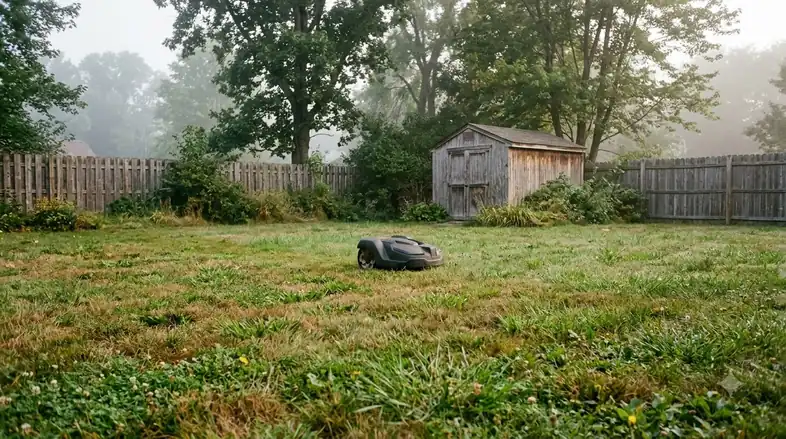
Rated coverage is best read as a ceiling. Slopes, obstacles and tight corners all reduce the area a mower covers in a given season, so leave headroom above your measured number instead of buying a model rated right at the edge of your lawn.
Check passages and separate lawn sections
On a duplex, the passage between the front and back lawn often matters more than the total area. Husqvarna’s installation guidance recommends that the boundary wires on each side of a passage without a guide wire sit at least 2 m (6 ft 6 in) apart. Robomow’s guidance for a passage to a separate zone is wider, at 70 cm, so the two figures should not be mixed up. For the full picture, see our explainer on the minimum passage width for a robot mower.
When a passage is narrower than the recommendation, Husqvarna says systematic passage mowing needs a guide wire, and it gives 60 cm (24 in) as the minimum spacing for passages that use one. Our reading is that a narrow side yard is a common reason a robot mower fails to reach a second section, so for the best robot mower for a duplex yard, measure the gap at its tightest point, not its average.
Husqvarna also notes that systematic passage mowing improves the cutting result in narrow passages, but only when a guide wire is installed for that function. Our reading is that a duplex owner who wants the mower to work the side passage evenly should plan for the guide wire from the start, rather than adding it after the first season of uneven strips.
Use this checklist for each passage:
- Width at the narrowest point, measured wall to wall or fence to fence.
- Obstacles such as hoses, downspouts, planters and bike racks that narrow the gap.
- Whether the model needs a guide wire to pass through, which adds installation work.
- Whether a second zone needs its own wire loop.
Understand boundary wire and what it defines
Boundary wire defines the mowing area for wired models (our primer explains what a boundary wire is), and Gardena describes the wire loop as the boundary of the work area, which can be extended by adding more wire. On a duplex lot, that means the wire has to run around shared fences, side gates, planters and patio edges, so the route is the part of the install that takes the longest.
Our reading is that a duplex lot with many corners, islands or a split layout is harder to wire than a single open rectangle, so the wire plan matters as much as the model when choosing the best robot mower for a duplex yard. If a model uses a different navigation method, check the manufacturer’s installation page, because the wire routing steps do not apply the same way.
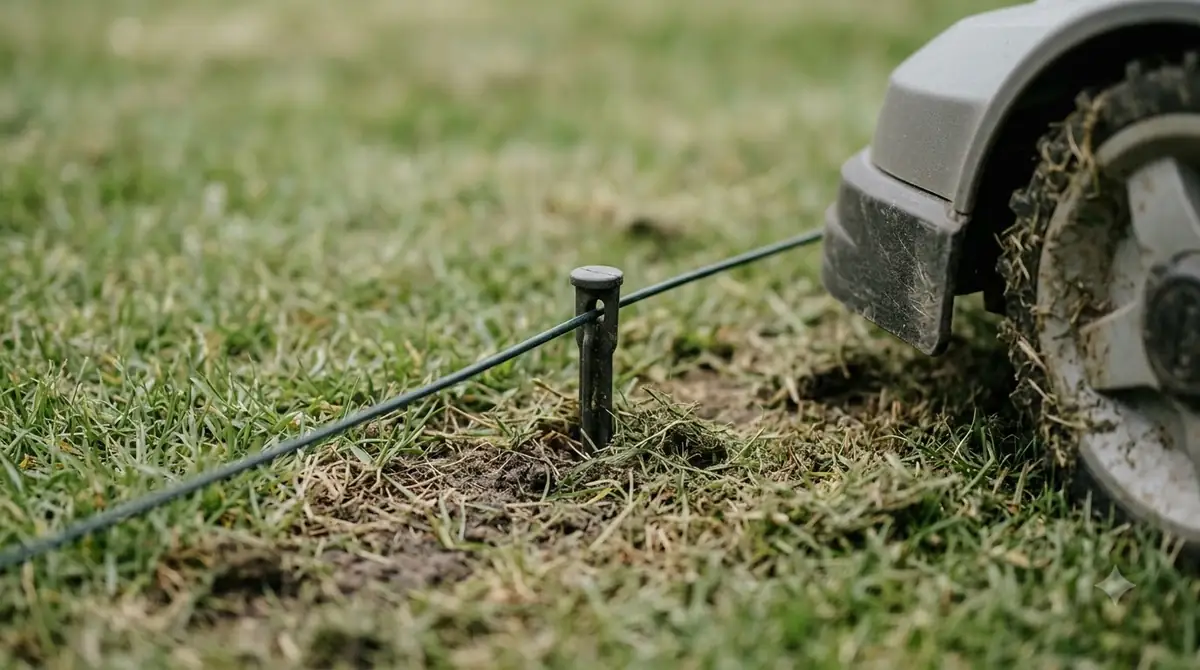
Before you buy, sketch the wire route on your measured sketch. Mark each fence, gate, bed and patio, then note where the wire must turn. A sketch like this also shows whether the passage width from the previous section still holds once the wire is placed.
Check slopes and how the wire behaves on them
Slope is the second limit on most duplex lots, especially where a back yard drops toward a fence line, and you can learn how to measure your yard slope before you read the limits below. Husqvarna’s steep-slope guidance gives boundary limits by model, from 10% for the Aspire R4 to 50% for the 435X AWD. For AWD models working on 50% to 70% slopes, Husqvarna asks for 1.5 m (5 ft) between the bottom of the slope and the boundary wire, and at least 50 cm (1.6 ft) of level ground between flat areas and steep sections.
| Check | What the manufacturer’s guidance says |
|---|---|
| Boundary limit, lowest model | 10% (Aspire R4) |
| Boundary limit, highest model | 50% (435X AWD) |
| AWD on 50% to 70% slopes | 1.5 m (5 ft) from slope bottom to boundary wire |
| AWD level ground before steep area | At least 50 cm (1.6 ft) |
Husqvarna’s steep-slope guidance also says to position the boundary further in on flat ground before the slope begins, rather than running the wire across the steep section itself. On a duplex back yard that sits above a neighbor’s fence or a patio, that setback can cost a strip of cuttable grass, so measure the strip before you count it toward the total.
On standard models, Husqvarna recommends laying the guide wire diagonally across the slope rather than parallel to the contour, for better traction and less grass wear. Our reading is that the best robot mower for a duplex yard on a slope is one whose boundary limit covers the steepest strip, so a sloped duplex back yard needs the model’s limit checked first, because a mower rated for a gentler slope may struggle on the steeper section even if the total area fits.
Best robot mower for a duplex yard: four checks before you buy
Before comparing models, run through four checks, in this order, because each one can rule out a model before you reach the next.
- Mowable area. Measure the cuttable grass and compare it with the size band, leaving headroom above your number.
- Narrowest passage. Measure the tightest gap between lawn sections and compare it with the 2 m or 70 cm guidance for the model.
- Steepest slope. Match the steepest area to the model’s boundary limit, using AWD where the slope needs it.
- Wire route. Sketch where the wire will run around fences, gates and beds, and decide whether you can install it yourself.
A model that passes all four checks on its spec sheet is a reasonable shortlist when you are looking for the best robot mower for a duplex yard. We recommend confirming the numbers on the current manufacturer page, because specs and model lineups change, and as of Nov 2026 the figures in this article are taken from the pages linked in Sources.
Frequently asked questions
How big a lawn can a robot mower handle on a duplex lot?
Use the mower’s rated coverage as an upper limit and leave headroom above your measured cuttable area. Manufacturer size bands, such as up to 500 square meters for compact lawns, give a starting point. Slopes and obstacles reduce real coverage, so choose a model with room to spare.
Do I need a guide wire for a narrow side passage?
Husqvarna’s passage guidance says a passage without a guide wire should have boundary wires at least 2 m (6 ft 6 in) apart. Systematic passage mowing needs a guide wire, with at least 60 cm (24 in) of spacing, so a narrower passage usually calls for one.
Can a robot mower work on a shared lawn with a neighbor?
The specs cover the mower and the lot, not the neighbor. A shared boundary is an agreement question between the owners, so confirm the wire route and the cutting area with the other side before installing anything.
What should I do if the back yard is steep?
Check the model’s boundary limit first, which Husqvarna lists from 10% to 50% depending on model. For AWD models on steeper ground, keep 1.5 m (5 ft) from the bottom of the slope to the boundary wire, and lay the guide wire diagonally.
Sources
- Creating a passage in an Automower boundary wire installation (Husqvarna): 2 m passage without guide wire, and 60 cm spacing with a guide wire.
- Optimising an Automower installation for steep slopes (Husqvarna): boundary limits by model, AWD setback, and guide wire direction.
- Laying the lawn boundary wire (Robomow): 70 cm passage to a separate zone.
- Robot lawn mower for small lawn (Ecovacs): small lawn range of 1,000 to 10,000 square feet.
- How to choose a robot lawn mower (Mammotion): size band up to 500 square meters for compact lawns.
 Up next8 min readBy YardBest Robot Mower for a Mobile Home Lot: What to Check Before You BuyUpdated Nov 11, 2026
 7 min readBy YardRobot Lawn Mower for 45 Percent Slope: What to Check Before You BuyUpdated Nov 11, 2026
 8 min readBy YardBest Robot Mower for a Coastal Yard With Salty Air: What to CheckUpdated Nov 11, 2026
 8 min readBy YardRobot Mower for Yard With Retaining Walls: What to CheckUpdated Nov 11, 2026
 9 min readBy YardRobot Mower for Terraced Yard: What to Check FirstUpdated Nov 11, 2026
 8 min readBy YardRobot Mower for Yard With Heavy Tree Canopy: What to CheckUpdated Nov 11, 2026