
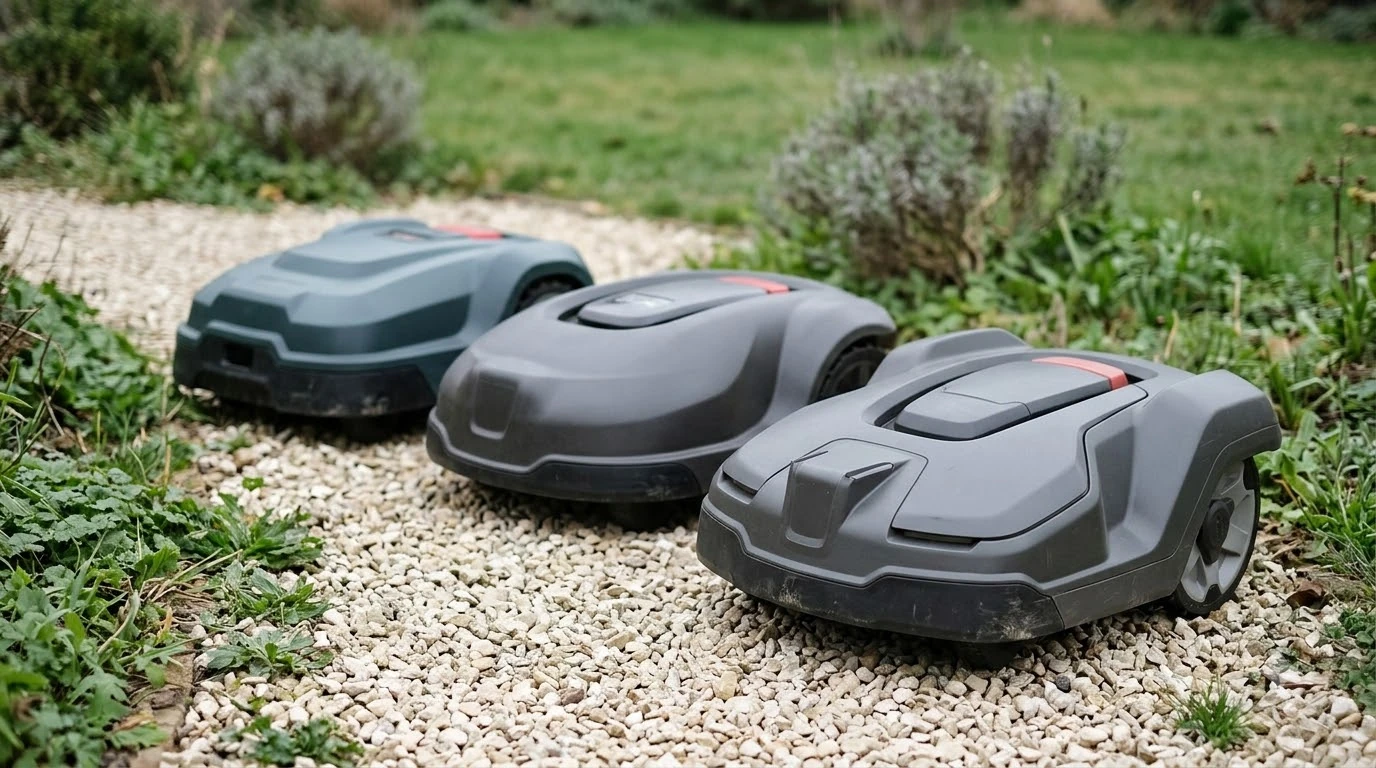

The best path pavers for robot mower gravel crossing are solid, level pavers laid in two flush rows, or a narrow bonded-gravel strip, so the wheels run on a firm track instead of loose stone. Anker’s setup guide says that if the existing path is loose, you should create one of these two surfaces for the wheels. Loose gravel is the part to fix first, because it is the part that can jam the blades or stall the mower.
The short answer
- Surface: two flush rows of solid pavers, or a narrow bonded-gravel strip for the wheels, per Anker.
- Loose gravel: not advisable. Robomow says gravel driving is possible but “not always advisable”, because loose stones can jam the blades.
- Width: Robomow says a passage should be at least one meter (about 100 cm) wide. Anker gives 80 to 100 cm as a starting point for clearance on a crossing.
- Wire: the boundary wire can run in the joints or under the stones, and Robomow’s guide puts the wire about 10 cm from slabs and paths that sit at or below lawn level.
Why loose gravel is the crossing problem
Gravel is the material most likely to cause trouble at a crossing. Anker says a mower may cross firmly compacted fine gravel, but loose stones can shift beneath the wheels. Deeper gravel and rounded pebbles are harder still, because the mower can dig in while it turns. Robomow adds that loose stones can jam the blades and leave the robot stuck, which is why it calls gravel driving possible but not always advisable.
Our reading is that the gravel path itself is not the failure point; the trouble starts when the wheels have to climb, turn or stop on stones that move. A firm track solves most of that, even when the rest of the path stays gravel, which is why the best path pavers for robot mower gravel crossing jobs are the ones that keep the wheels on a flush, solid surface. For the lawn side of the same problem, see a robot mower on a lawn with gravel edges.
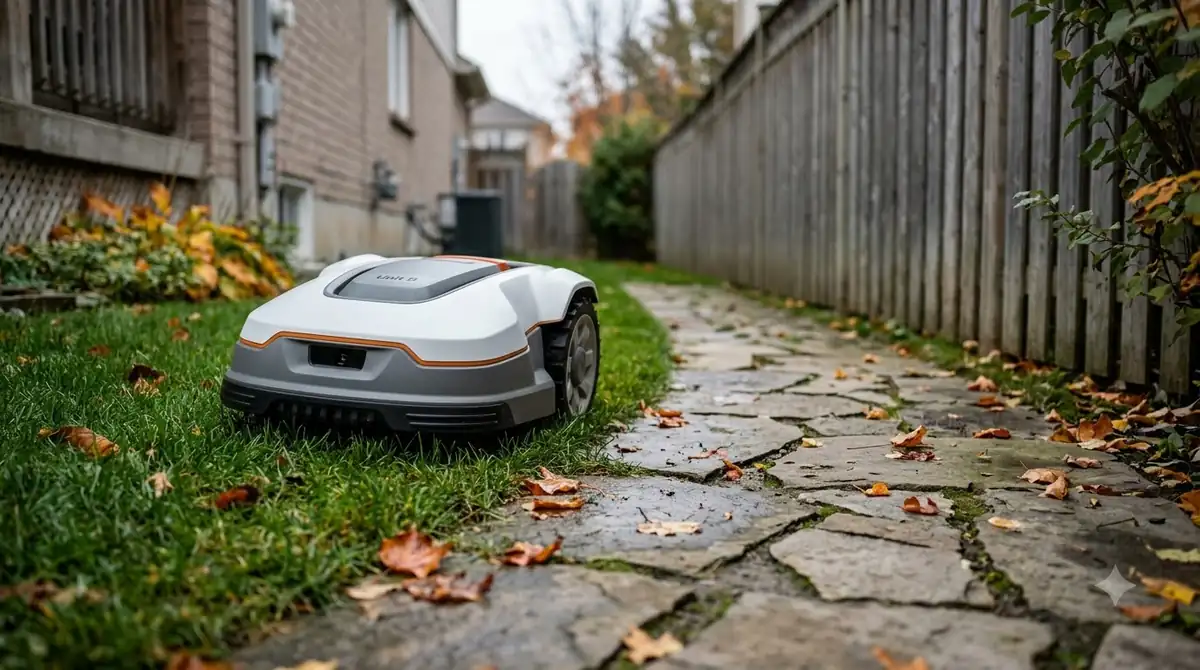
Best path pavers for robot mower gravel crossing: compare the surfaces
The table below sets out the four surfaces most yards end up with at a gravel crossing. Each row uses only what the sources say, and the last column is our reading.
| Surface at the crossing | What the sources say | Our reading |
|---|---|---|
| Flat paved path | Robomow calls flat paved areas unproblematic. | Easiest case. Check the surface sits level with the lawn. |
| Two flush rows of solid pavers | Anker recommends this for a loose path, so the wheels run on solid stone. | A reasonable choice when the path is loose, as long as the joints are tight. |
| Narrow bonded-gravel strip | Anker names it as the alternative to the paver rows, for the wheels. | Keeps a gravel look. Confirm the strip is bonded, not loose. |
| Loose gravel or pebbles | Anker: loose stones shift, and deep gravel and rounded pebbles are the hardest. Robomow: loose stones can jam blades. | The surface to avoid at a crossing, or to cover with one of the rows above. |
Lay two flush rows, not one stone
The two-row idea is about the wheels. Anker’s wording is two flush rows of solid pavers, which gives each drive wheel its own firm track across the crossing. Our reading is that two rows give the wheels a predictable track, though the sources do not compare a single wide stone against two rows directly.
The rows should be flush with each other and with the lawn. Robomow’s guidance on paths makes the same point about levelness: stones should sit level with the ground surface, or be backfilled with soil so the robot can climb onto them. A raised paver stands in the wheel’s way.
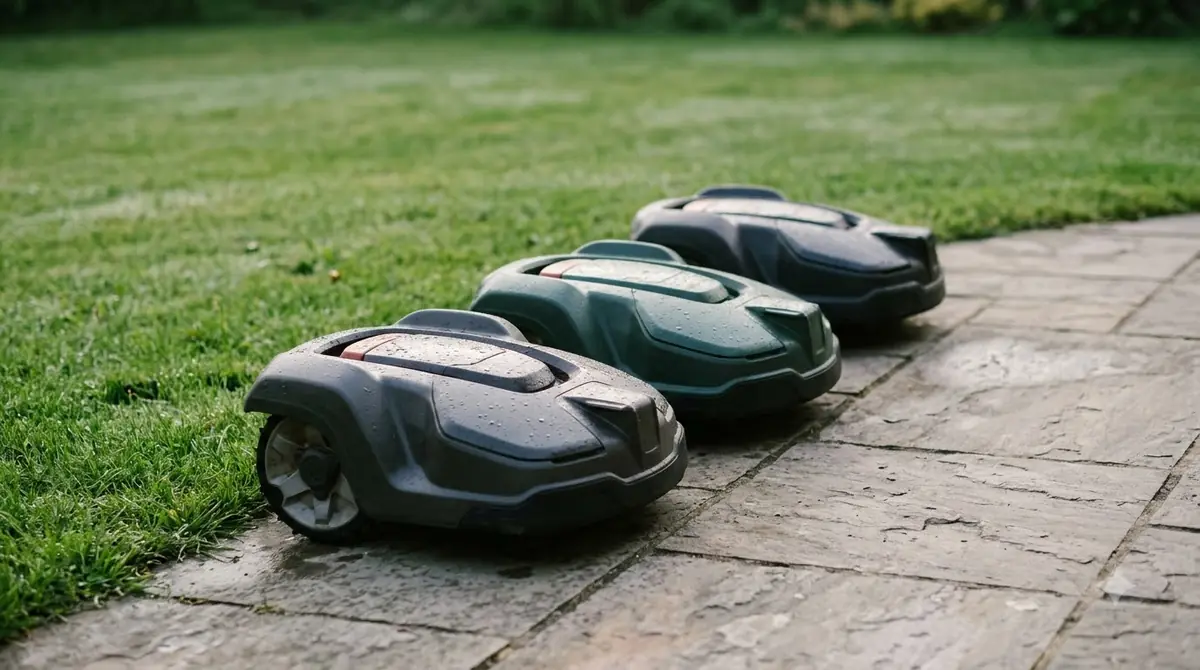
Heads up
Robomow says stones should be level with the lawn, or backfilled with soil into a slope the robot can climb. Our reading is that a raised step at the crossing is where a wheel is most likely to stall.
Keep the route straight and the stones off the blades
Anker advises making the route straight where possible, and keeping displaced stones away from the lawn edge and the blades. A straight crossing gives the mower one clear line to follow, while a bent route invites it to turn on loose material. Our reading is that stones pushed out of the crossing onto the lawn are the ones most likely to reach the blades, so keep the crossing edges clean.
Robomow also warns about bark mulch, which blades chop into chips. It causes faster wear and can damage the path, so it is not a substitute for pavers or a bonded strip. For the strip between the lawn and a hard edge, the guide to mowing strip pavers for robot mower edges covers a different job.
Width and the boundary wire
Robomow says a passage should be at least one meter wide, about 100 cm. Anker’s figure of 80 to 100 cm is a starting point for many gardens, not a rule for every mower. The yard guide on how robot mowers deal with narrow paths covers the narrow case. Where the crossing is narrower, Robomow’s guide says a tunnel circuit or a small loop on each side narrows the passage so the robot passes only when it approaches head-on. Robomow’s page gives no loop dimensions, so check the model’s own installation manual before you cut any wire.
Robomow’s boundary wire guide gives the wire positions that matter at a crossing. It advises a laying depth of 4 to 5 cm, and says the robot still receives the signal at up to 7 cm. It says the distance from the wire to slabs and paths is about 10 cm, if the surface sits at or below lawn level, and it says you can bury the wire under stones or patio slabs and mark passages even under paths. Anker adds that wire spacing and placement vary a lot between manufacturers, and that moving paving can mean repositioning the wire.
Our reading is that a paver crossing is a practical place to run the wire under the stones, because the joints give a route that does not disturb the surface. When you compare the best path pavers for robot mower gravel crossing options, Anker’s note that moving paving can mean repositioning the wire is a reason to plan the wire first, and burying or pegging boundary wire explains the trade-off.
What to check before you buy the pavers
Choosing the best path pavers for robot mower gravel crossing depends on the wheel track and the wire, not on how the stone looks.
- Measure the crossing. Aim for at least 100 cm of clear width, as Robomow describes for a passage.
- Check the height. Stones should sit level with the lawn, or be backfilled so the mower can climb.
- Pick the surface. Two flush rows of solid pavers, or a narrow bonded-gravel strip, for the wheels.
- Plan the wire. Keep the boundary wire about 10 cm from the path edge, laid 4 to 5 cm deep, and check your model’s manual for its own distances.
- Keep the route straight. Remove displaced stones from the lawn edge and blades.
Frequently asked questions
Can a robot mower drive over a gravel path?
It can, but Robomow says gravel driving is “not always advisable”. Anker says firmly compacted fine gravel may be crossed, while loose stones can shift under the wheels and deep gravel or pebbles are the hardest surfaces.
What are the best path pavers for robot mower gravel crossing?
Anker recommends two flush rows of solid pavers, or a narrow bonded-gravel strip, so the wheels have a firm track. This is advice for a loose path; a flat paved path needs no change.
How wide should a robot mower crossing be?
Robomow says a passage should be at least one meter wide, about 100 cm. Anker gives 80 to 100 cm as a starting point for clearance on a crossing in many gardens.
Can the boundary wire run under pavers?
Robomow says the wire can be buried under stones or patio slabs, and can mark passages under paths. Its guide gives a laying depth of 4 to 5 cm and about 10 cm from slabs and paths at or below lawn level. Check your model’s manual, because Anker notes that spacing varies between manufacturers.
Sources
- Can a robotic lawnmower cross paths? (Robomow): flat paved areas, gravel driving, passage width, wire under stones, tunnel and loop narrowing.
- Laying the lawn boundary wire (Robomow): laying depth of 4 to 5 cm, signal up to 7 cm, wire distance from slabs and paths.
- Can Robot Lawn Mower Cross Path? A Practical Setup Guide (Anker): gravel and pebble difficulty, two flush paver rows or bonded-gravel strip, route and clearance.
- How cleanly does a robotic mower cut the lawn edge (Robomow): edging stone widths, used only as a contrast with crossing surfaces.
 Up next8 min readGearBest Mowing Strip Pavers for Robot Mower Edges: What to CheckUpdated Nov 13, 2026
 8 min readGearBest Flush Stepping Stones for a Robot Mower PathUpdated Nov 11, 2026
 6 min readGearRobot Mower Garden Hose Guard: Keeping a Hose Out of the Mower PathUpdated Nov 13, 2026
 7 min readGearBest Topsoil for Filling Lawn Holes Before a Robot MowerUpdated Nov 14, 2026
 9 min readGearBest 4G IoT Module for Robot Mower: What to Check Before You BuyUpdated Nov 14, 2026
 10 min readGearRTK Antenna Extension Cable for Robot Mower: 6 ChecksUpdated Nov 19, 2026