
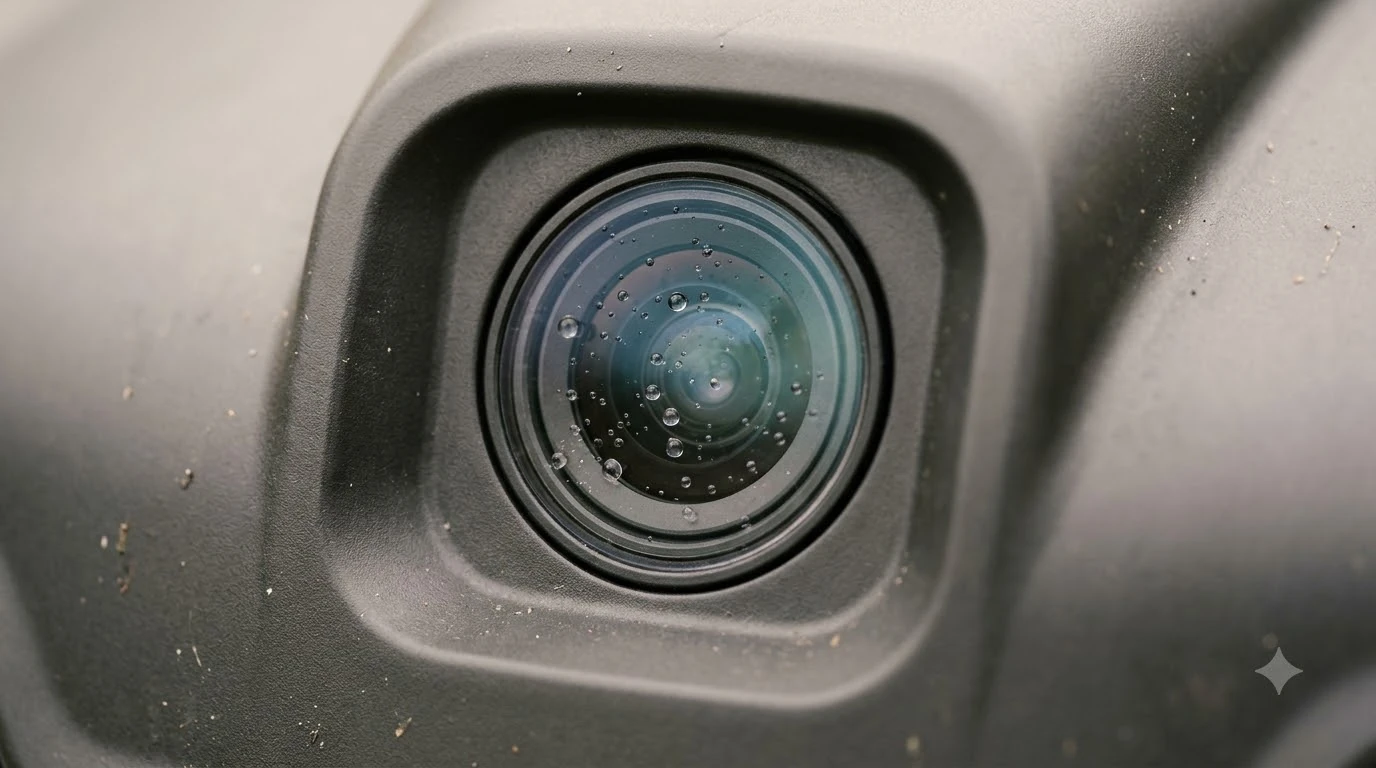

Which vision AI camera robot mower is the most accurate? No model has been shown to be the most accurate overall. The sources we read do not include an independent accuracy test that ranks camera-based models against each other. As of November 2026, accuracy depends on what you mean by it: how well the mower spots obstacles, how well it keeps its position, and how it behaves at night or in rain.
The short answer
- No single winner. Vendor specs describe obstacle detection and positioning, but not a shared accuracy score.
- Check night and rain first. Vendors document camera limits in darkness, in heavy rain, and with a dirty lens.
- Compare the fallback. When satellites are blocked, some systems rely on visual odometry and inertial data instead.
What a vision AI camera mower actually measures
A camera mower uses one or more cameras to recognise objects on the lawn and to help it keep track of where it is. Husqvarna describes its NERA models as using AI that classifies objects by risk level, with a separate group of Aspire models that keep one safety distance for all obstacle types. Worx lists its Landroid Vision Cloud 1 Acre with a stereo camera, V-SLAM and RTK Cloud positioning.
The key point is that a camera does not do the whole job. Most vendors describe the camera as one part of a sensor mix, alongside satellite positioning, bump sensors or both. For a look at that mix on a single feature, see our guide to the best robot mower with obstacle avoidance.
Which vision AI camera robot mower is the most accurate? It depends on the test
When you ask which vision AI camera robot mower is the most accurate, accuracy can mean at least two different things. Positioning accuracy describes whether the mower stays inside its boundary and mows the right area; our page on which satellite navigation robot mower is the most accurate covers that side. Obstacle accuracy describes whether it detects and avoids a toy, a hose or a pet. A mower can be strong on one and weaker on the other, and vendor pages usually report only the feature they sell.
Heads up
We did not find an independent test that measures obstacle detection rates across camera mowers under the same conditions. Treat any claim of “most accurate” as a vendor claim until you see test data from a neutral source.

Where vision mowers do well
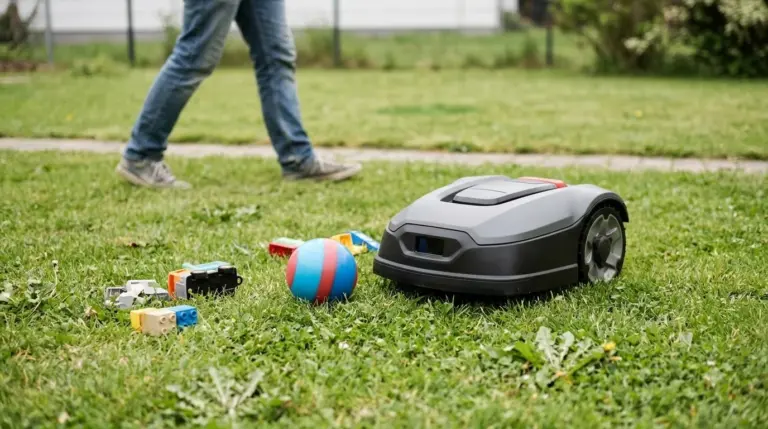
Daytime obstacle detection is the best-documented strength. Husqvarna’s object detection support page says its Aspire R6V, 308V and 312V detect objects during the day and keep one safety distance for every obstacle type, and its NERA models classify objects into higher and lower risk groups. That classification matters on a real lawn: a person, an animal or a garden hose is treated differently from a flowerpot or a piece of garden furniture.
- Higher-risk objects: people, animals and water hoses, per Husqvarna’s classification.
- Lower-risk objects: items such as toys or flowerpots, which the mower may approach more closely.
- Permanent objects: garden furniture or trampolines are handled with a stay-out zone rather than detection alone.
Where camera limits show up
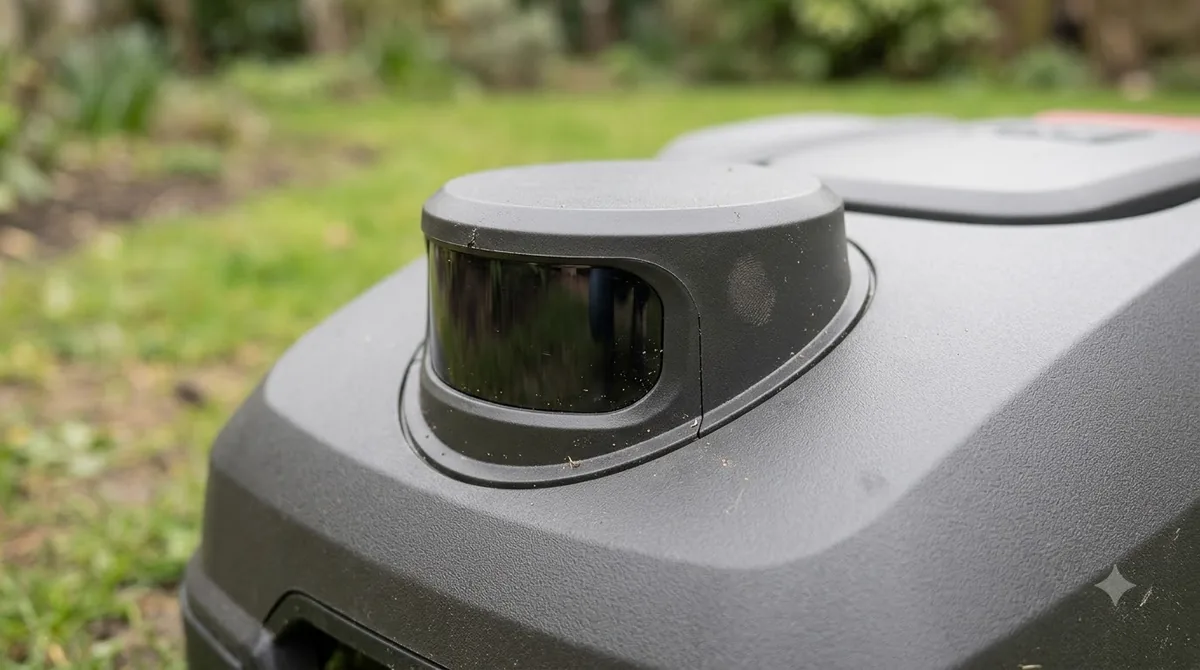
Three limits appear again and again in the manufacturer material we read: darkness, rain and a dirty lens, and blocked satellite signals. Each one has a different fix.
| Condition | What the vendor says | What to do |
|---|---|---|
| Night | Husqvarna’s Aspire R6V, 308V and 312V run “without vision support” at night and “may collide with objects on the lawn.” NERA models use infrared sensors to detect objects at night. | Confirm whether the model has infrared, or schedule mowing for daylight. |
| Rain or dirt | Husqvarna lets you choose “Keep mowing” or “Pause” when the camera cannot see clearly. Ecovacs says rain on the camera “will also interfere with the GOAT’s visual localization function to a certain extent.” | Choose the pause setting if you want a stop, and clean the lens regularly (a microfiber cloth for a robot mower camera lens is the usual tool). |
| Blocked satellites | Worx says that when trees or buildings block satellite signals, V-SLAM, inertial data and odometry take over until satellites return (background: what an RTK base station is). | Check the positioning fallback on the model page, not only the camera spec. |
Worx puts the darkness limit in one line: “In darkness, cameras become blind.” Its FiatLux module is meant to address this, but the page says it is standard on select models and optional across the rest of the lineup. Dark and wet conditions are where a camera mower is most likely to behave differently from its daytime demo. Ask the vendor how the mower reacts, not just whether it has a camera.
Specs to compare before you buy
Camera features do not change the basic limits of a robot mower, so compare those first when deciding which vision AI camera robot mower is the most accurate for your lawn. The Worx Landroid Vision Cloud 1 Acre is a useful reference: its spec page lists a recommended lawn size of 1 acre, a maximum slope of 30% (17°), a cutting height of 1.57 to 3.54 inches and a weight of 30.9 pounds with the battery, as of November 2026.
| Spec | Why it matters for accuracy |
|---|---|
| Recommended lawn size | A mower rated for a smaller lawn may be pushed to its limits on a larger one. |
| Maximum slope | Steep ground can affect traction and camera view at the same time. |
| Positioning method | RTK, V-SLAM or boundary wire each behave differently under trees and near buildings. |
| Night capability | Infrared or darkness rating determines how the mower reacts after sunset. |
Objects and safety
Stay-out zones are the practical fix for objects that a camera may not reliably handle. Husqvarna advises creating a stay-out zone for permanent objects such as children’s trampolines, and for objects hidden in high grass that could snag the mower.
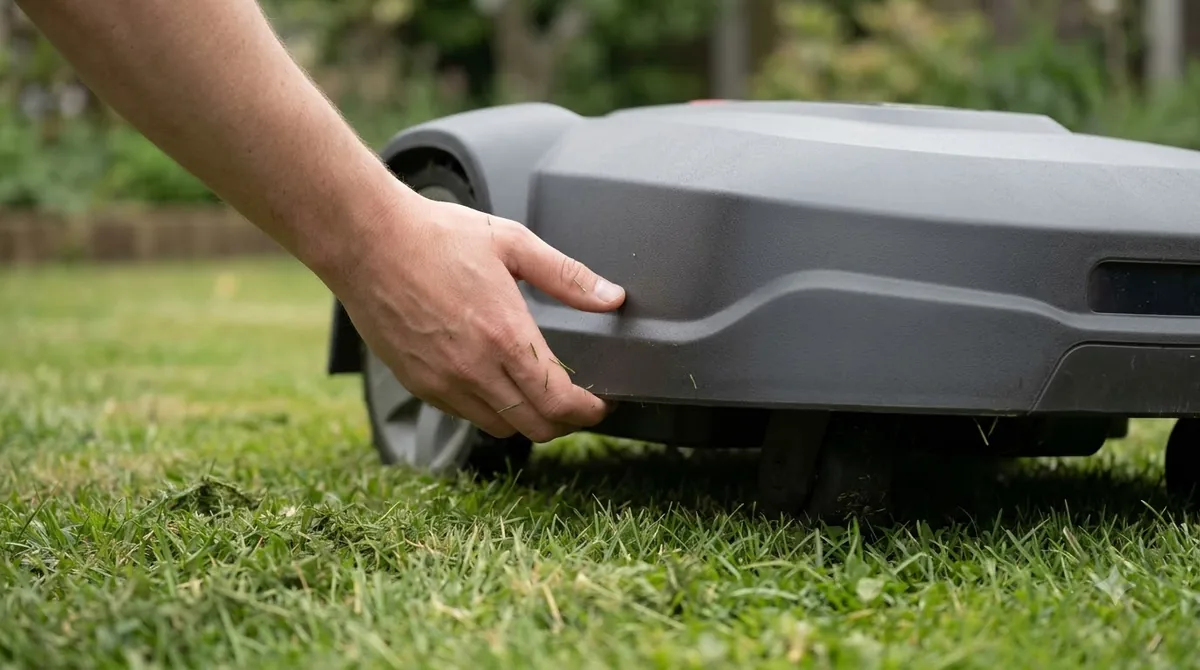
- Remove loose items such as balls, dog toys and hoses before each run.
- Mark permanent objects as stay-out zones in the app (see how to set up no-go zones on a robot mower).
- Keep children and pets indoors or behind a barrier while the mower runs.
Eufy’s safety guidance puts it plainly: “no camera or sensor system should be expected to recognise every small animal, toy or sudden movement under all conditions.” Treat a camera as a helper, not a guarantee.
What to check before you buy
Before you decide which vision AI camera robot mower is the most accurate for your own yard, run the five checks below against each model’s own support page. The answers decide how the mower behaves in the conditions that matter to you.
- Match the lawn. Confirm the rated lawn size, slope limit and cutting height against your yard.
- Check night behavior. Find out whether the model has infrared or runs without vision support after dark.
- Check rain behavior. Look for the pause setting and the lens-cleaning guidance in the manual.
- Check the fallback. Read how the mower positions itself when satellites are blocked by trees or buildings.
- Plan stay-out zones. List permanent objects and hidden hazards before setup.
If the vendor cannot show these answers on its own support page, that is a useful signal in itself.
Frequently asked questions
Is a vision AI camera robot mower more accurate than an RTK mower?
The sources we read do not show one ranking that covers both, so no one can say which vision AI camera robot mower is the most accurate against an RTK model. Vision handles obstacle detection well in daylight, while RTK is a positioning method. Compare them on the conditions that matter for your yard.
Do camera robot mowers work at night?
It depends on the model. Husqvarna says some NERA models use infrared at night, while some Aspire models operate without vision support in the dark.
Does rain affect the camera?
Yes. Ecovacs says rain on the camera can interfere with visual localization to a certain extent, and Husqvarna offers a Pause setting when visibility is limited.
What happens if satellite signals are blocked?
Worx says its Landroid Vision Cloud uses V-SLAM, inertial data and odometry until satellite signals return. Check the same fallback on any model you consider.
Sources
- Husqvarna object detection and avoidance with AI vision (manufacturer): AI classes, daytime detection, night limits, lens settings and stay-out zones.
- Ecovacs GOAT support FAQ (manufacturer): rain and visual localization.
- Worx Landroid Vision Cloud 1 Acre (manufacturer): lawn size, slope, cutting height, sensors and darkness limit.
- Eufy robot lawn mower safety guide (manufacturer): limits of camera and sensor detection.
 Up next8 min readBest Robot MowersBest Vision AI Camera Robot Lawn Mower 2026: What to CheckUpdated Nov 11, 2026
 6 min readBest Robot MowersWhich RTK and Vision Robot Mower Is the Most Accurate?Updated Nov 13, 2026
 8 min readBest Robot MowersWhich 4G Cellular Robot Mower Is the Most Accurate?Updated Nov 12, 2026
 8 min readBest Robot MowersWhich 3D LiDAR Robot Mower Is the Most Accurate? What the Numbers ShowUpdated Nov 16, 2026
 7 min readBest Robot MowersWhich 4-Wheel Drive Robot Mower Is the Most Accurate?Updated Nov 14, 2026
 7 min readBest Robot MowersWhich Satellite Navigation Robot Mower Is the Most Accurate?Updated Nov 13, 2026