
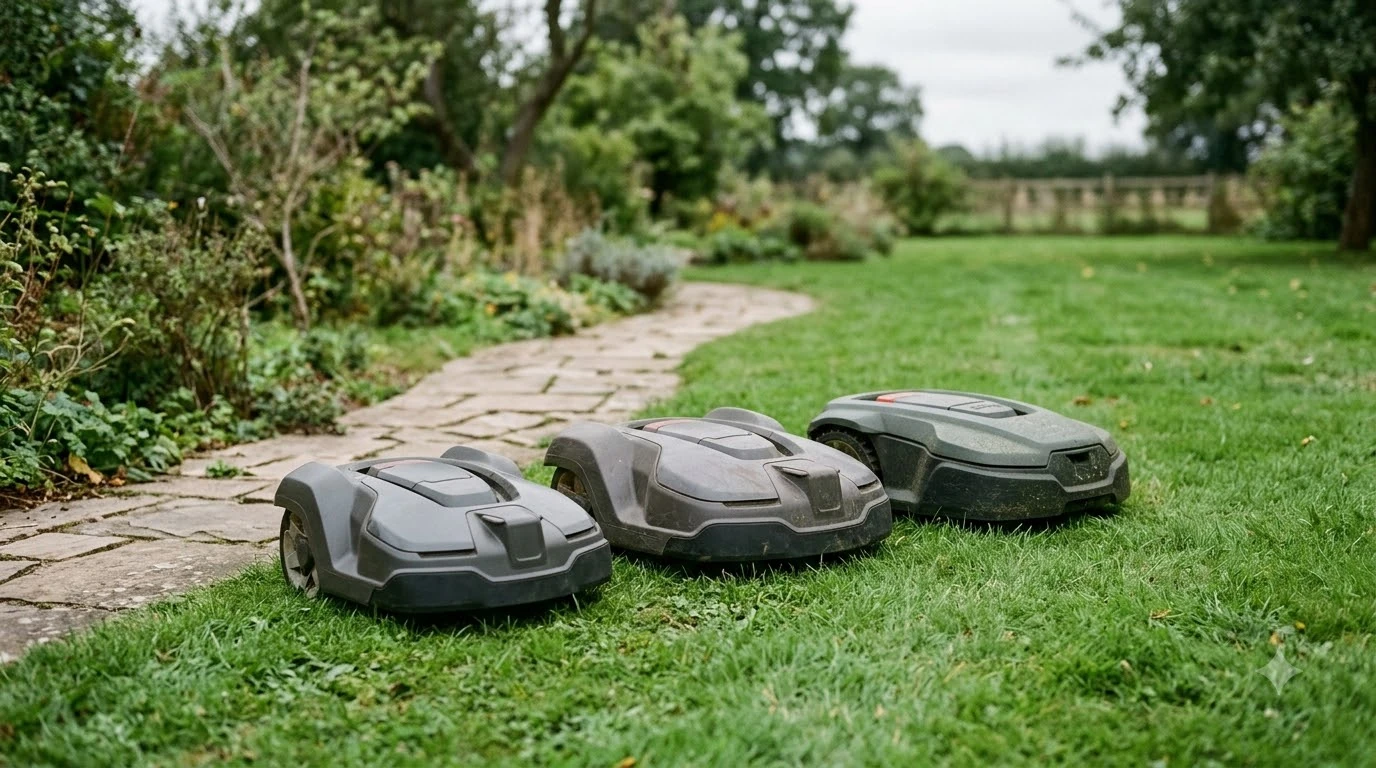

Is the Toro Turf Pro 200 robot mower worth it? It depends on the lawn. The official Toro manual for model 30927US rates the Turf Pro 200 for about 5.4 acres and slopes up to 30%, and says it navigates with RTK GPS. This guide shows what those figures mean in practice and what the manual does not cover. It is a research summary of manufacturer and extension sources, not a hands-on test.
The short answer
- Size: the recommended working area is 22,000 m2 (5.4 acres), with a 30,000 m2 (7.4 acres) maximum.
- Slope: the maximum slope is 30% (17 degrees).
- Setup: the robot uses RTK GPS positioning, so an RTK base must be installed. The working area is set by GPS way points or by a peripheral wire, and the charging station needs a loop wire.
- Height: cutting heights run from 10 mm (0.4 in) to 80 mm (3.2 in), depending on the disc fitted.
- Our reading: a good option for a large, open lawn with a strong GPS signal and moderate slopes, where an RTK base can be installed. Check the points below before you buy.
What the Toro manual lists
The Turf Pro 200 is covered by Toro operator’s manual 3479-589A, which applies to models 30927US and 30927EU with serial range 326000000 and up. The specifications section gives the figures below. Toro notes that specifications and design are subject to change without notice, so check the manual that ships with your unit.
| Item | Manual figure |
|---|---|
| Recommended working area | 22,000 m2 (5.4 acres) |
| Maximum working area | 30,000 m2 (7.4 acres) |
| Maximum slope | 30% (17 degrees) |
| Mowing width | 400 mm (15.75 in) |
| Cutting height, low disc | 10 mm (0.4 in) minimum |
| Cutting height, medium disc | 15 mm (0.6 in) minimum |
| Cutting height, standard disc | 20 mm (0.8 in) minimum; 80 mm (3.2 in) maximum |
| Maximum noise | 52 dB(A) measured at 5 m (16 ft) |
| Battery | 25.6 V nominal, 8.55 Ah |
| Average mowing time | 110 minutes |
| Average time to full charge | 55 minutes |
| Weight | 25 kg (55.1 lb) |
| Working temperature | -20 C (-4 F) to 60 C (140 F) |
These are the manufacturer’s rated figures. The manual does not describe the grass, terrain or test conditions behind the area, noise or runtime numbers, so treat them as starting points rather than guarantees.
Lawn size and slope limits
The area figures are the first thing to check when you ask if the Toro Turf Pro 200 robot mower is worth it for a given yard. The 22,000 m2 recommended area is the planning number, and 30,000 m2 is the outer limit the manual gives. A lawn above the recommended area is outside the figure Toro suggests, so ask the manufacturer before buying for a yard near the top of the range.
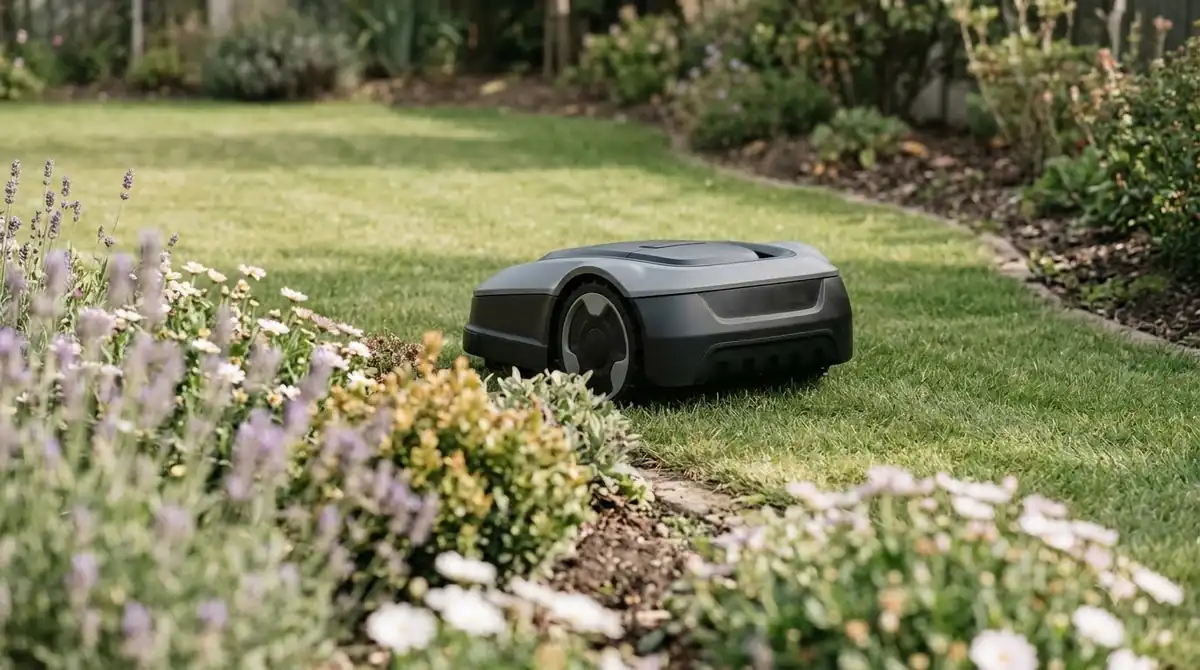
The manual rates the maximum slope at 30% (17 degrees). Inside the mower, a tilt sensor measures the slope angle and raises an alarm and stops the machine if the angle is exceeded. A rollover sensor detects if the machine is tipped upside down. For context, Penn State Extension’s riding-mower guidance uses a 15-degree line: on steeper slopes, drive up and down rather than across. That rule is written for riding mowers, so it is not a robot rating. Our reading is that the 17-degree rating sits above that 15-degree line, so measure the steepest section of your yard before you buy.
Cutting height and blade setup
The manual lists three disc options: standard (20 mm minimum), medium (15 mm minimum) and low (10 mm minimum), with a maximum cutting height of 80 mm (3.2 in). The specifications list 6 or 12 cutting blades but do not say which configuration applies to which model, so confirm this with your unit. Disc set screws are tightened to 1.7 N m (15 in-lb), and the manual says to wear cut-resistant gloves when handling the blades.
If you keep the lawn low, check which disc comes with your mower, because the minimum height depends on it.
How positioning, the boundary and the charging station work
The manual says the robot uses the RTK GPS positioning system, which lets it mow in straight lines in a pattern. Pattern mowing is only possible when the GPS signal quality is high enough. If the robot cannot communicate with the satellites well, it stops and scans to improve the connection, and it raises an alarm if the problem persists. An RTK base must be installed to pass exact position corrections to the robot, over 4G or Wi-Fi. For background, see our explainer on what an RTK base station is.
The robot can work in one of two configurations: within an area set by GPS way points that creates a safety border, or within an area set by a peripheral wire. With the wire, an induction coil reads the magnetic field of the peripheral wire, which is strongest on the wire and makes the robot stop, rotate and mow in a new direction. No-go zones are areas set by GPS points that the robot will not work in, often around permanent obstacles.
Either way, the manual says a station loop wire must be defined so the robot can return to and leave the charging station. The station’s single LED shows the status: green blinking means the loop wire is operating normally, red blinking means no wire is detected (cut or too long), and red continuous means a problem, such as a wire shorter than 200 m (656 ft) or an electronics fault.
Sensors and safety
Obstacle detection sonars slow the mower when they see an obstacle. Lift sensors at three points on the body stop the mower and move it backward if the body is pushed up. If the obstacle does not clear, the robot raises an alarm after 10 seconds and stays stationary until it is removed. A temperature sensor stops operation when ambient temperature falls below a minimum set as an operating parameter.
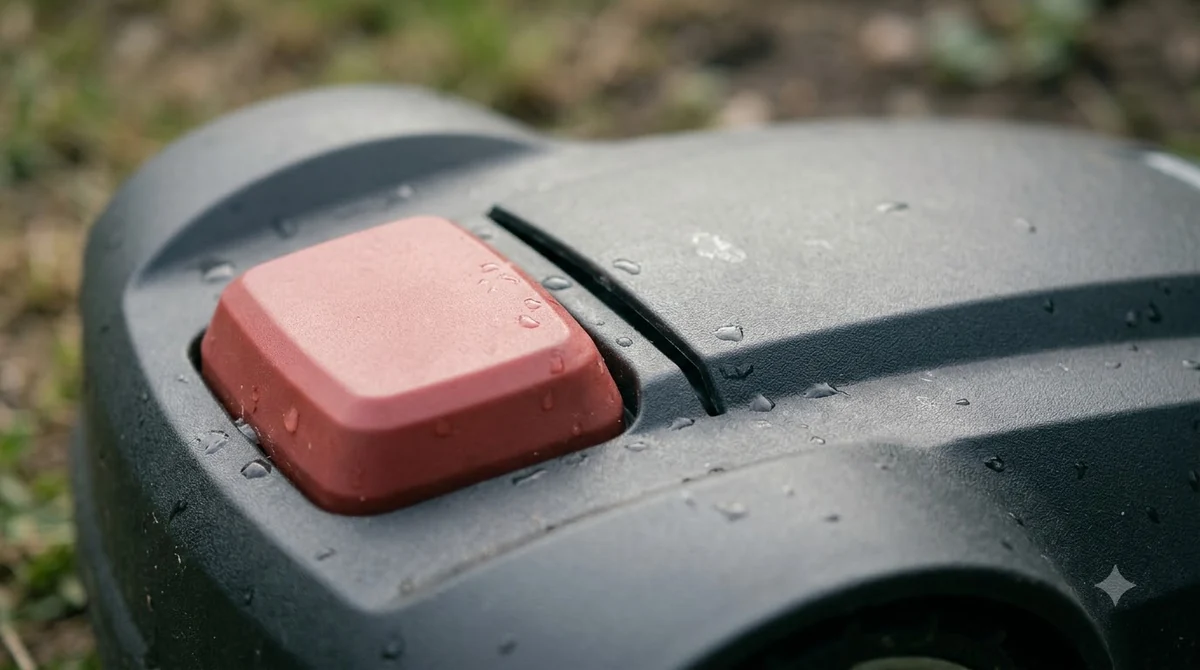
The manual also says to keep bystanders, children and pets away, not to spray the machine with water, and to avoid use in bad weather, especially when lightning is possible. It adds that before operating, there should be a physical barrier such as a low fence or boundary wire, or the operating-area boundary should be set at least 8 m (26 ft) from hazards. The machine has an access code and an anti-theft system.
Weather, noise and temperature
Maximum noise is rated at 52 dB(A), measured at 5 m (16 ft). That is a manufacturer figure without a stated schedule or comparison, so check it against your local noise rules and your neighbors’ expectations.
The rated working range is -20 C (-4 F) to 60 C (140 F). The manual tells owners to store the machine indoors in a dry, secure place when not in use. A covered shelter is one way to keep a mower out of weather between runs, but check the fit with your unit before buying one.
Weight, charging and run time
The mower weighs 25 kg (55.1 lb) and is 899 mm (35.4 in) long. The battery is 25.6 V nominal with 8.55 Ah. The manual gives an average mowing time of 110 minutes and an average time to full charge of 55 minutes. Those averages will change with grass, slope and the area covered. The manual also tells owners not to open or dismantle the battery, and to keep it clean and dry.
Is the Toro Turf Pro 200 robot mower worth it for your lawn?
Based on the manual, the Turf Pro 200 fits owners who have a lawn near the recommended 5.4 acres, slopes that stay below the rating, and a site where an RTK base and a station loop wire can be installed. So is the Toro Turf Pro 200 robot mower worth it? Only if your yard matches those conditions. For a wider look at another Toro model, see the Toro Turf Pro 500S vs Husqvarna Automower 435X AWD spec comparison.
- A stronger fit: an open yard near 5.4 acres with good GPS reception, mostly under 17 degrees, where a 52 dB(A) rating at 5 m is acceptable.
- A weaker fit: a yard above 7.4 acres, a site where an RTK base cannot be set up or the GPS signal is weak, or a lawn with steep sections at or above the rated slope.
What to check before you buy
Use this list to answer one question: is the Toro Turf Pro 200 robot mower worth it for your yard?
- Confirm the model and serial. The manual covers 30927US and 30927EU with serial 326000000 and up.
- Measure the lawn. Compare the area with 5.4 acres (recommended) and 7.4 acres (maximum).
- Measure the steepest section. Compare it with the 30% (17 degree) rating, and note the 15-degree riding-mower guidance.
- Plan the setup. Decide between GPS way points and a peripheral wire, choose a spot for the RTK base, and plan a station loop wire that is not shorter than 200 m (656 ft).
- Confirm the disc. Check which cutting disc comes with your unit, since the minimum height depends on it.
- Check the warranty. The manual pages read for this guide do not list a warranty period, so ask Toro or an authorized dealer.
Frequently asked questions
Is the Toro Turf Pro 200 robot mower worth it without a boundary wire?
The manual says the robot can work within an area set by GPS way points or by a peripheral wire, so a full perimeter wire is optional. The charging station still needs a loop wire, and an RTK base must be installed.
How big a lawn does the Turf Pro 200 handle?
The manual gives a recommended working area of 22,000 m2 (5.4 acres) and a maximum of 30,000 m2 (7.4 acres). For other large-lawn options, see our guide to a robot lawn mower for 5 acres.
What is the maximum slope?
The manual lists a maximum slope of 30% (17 degrees). See how robot mower slope ratings work for percent versus degrees.
How loud is the Turf Pro 200?
The manual lists a maximum noise level of 52 dB(A) measured at 5 m (16 ft). For context on other models, see how loud robot lawn mowers are.
Sources
- Toro, Operator’s Manual, Turf Pro 200 Robotic Mower (3479-589A) (manufacturer): specifications, product overview, sensors, RTK GPS, charging station and safety sections.
- Riding Lawnmower Safety Practices (Penn State Extension): 15-degree slope guidance for riding mowers.
 Up next8 min readReviews & CompareToro Turf Pro 500S vs Husqvarna Automower 435X AWD: Specs ComparedUpdated Nov 12, 2026
 7 min readReviews & CompareRobot Mower vs Artificial Turf: Heat, Upkeep, and CostUpdated Nov 14, 2026
 6 min readReviews & CompareIs the Dreame A1 Pro Worth It? Budget LiDAR Mower CheckUpdated Nov 17, 2026
 10 min readReviews & CompareIs the Sunseeker X7 Worth It? Verdict by Yard TypeUpdated Nov 16, 2026
 8 min readReviews & CompareIs the Worx Landroid Vision Worth It? Model Specs Compared (2026)Updated Nov 14, 2026
 8 min readReviews & CompareIs the Husqvarna Automower 415X Worth It? Specs and ChecksUpdated Nov 14, 2026