
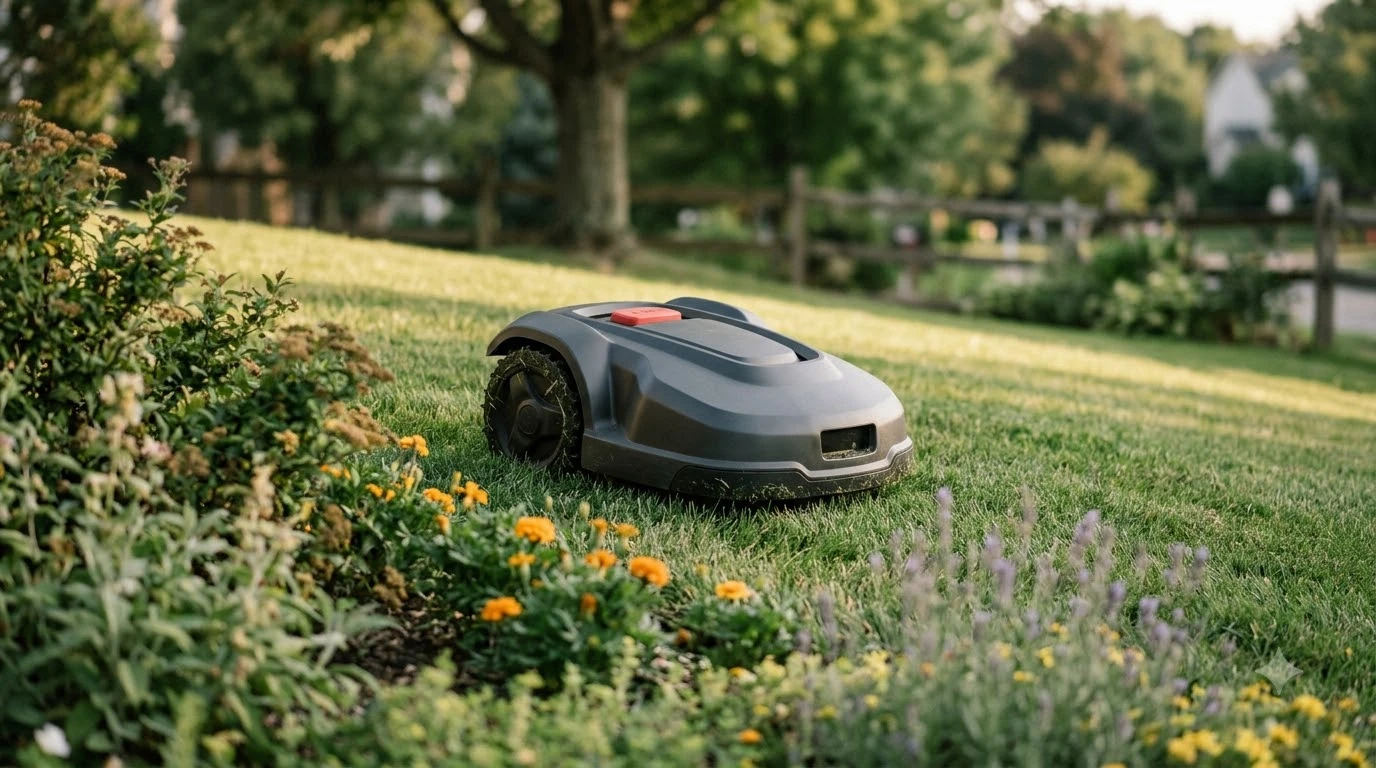

The short answer to how do robot lawn mowers work is that they stay inside a boundary, cut in a random pattern, and return to a charger when the battery runs low. They learn where the lawn ends from a buried wire or from satellite and sensor mapping, depending on the model.
The yard itself decides which system makes sense. Trees, slopes, and neighboring lawns all affect how well each navigation method works. This guide explains the parts, the wire and wire-free options, and the limits you should check before you buy.
The short answer
- Boundary: a buried or pegged wire, or satellite and sensor mapping on wire-free models.
- Cutting: small blades run often in a random pattern, a few millimeters at a time.
- Safety: lifting the mower shuts off the blades immediately.
- Charging: the mower heads back to its station by signal or guide wire when the battery is low.
The main parts of a robot mower
How do robot lawn mowers work? Start with the parts: a battery, cutting blades, sensors, a charging station, and a navigation method that keeps the mower inside the lawn. Each part does a separate job, and a fault in one part can stop the whole mower.
- Battery: powers the drive wheels and the blades, and runs down between charges.
- Blades: small blades that cut only the top of the grass.
- Sensors: lift, tilt, and collision sensors tell the mower when to stop or change course.
- Charging station: the home base where the mower recharges and waits between runs.
- Navigation: a boundary wire, onboard GPS, or grass sensing keeps the mower inside the lawn.

How do robot lawn mowers work with a boundary wire or wire-free navigation?
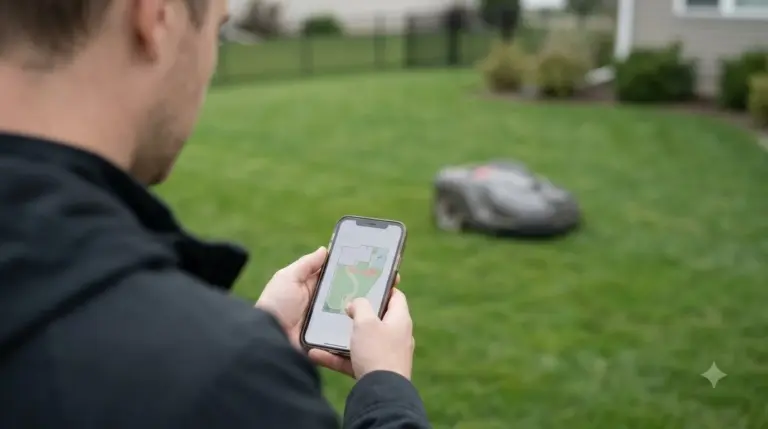
A boundary wire sends a signal the mower can detect, while wire-free models use GPS or grass sensing instead, each with trade-offs in setup and coverage. The right choice depends on how the yard is laid out and how much digging you are willing to do.
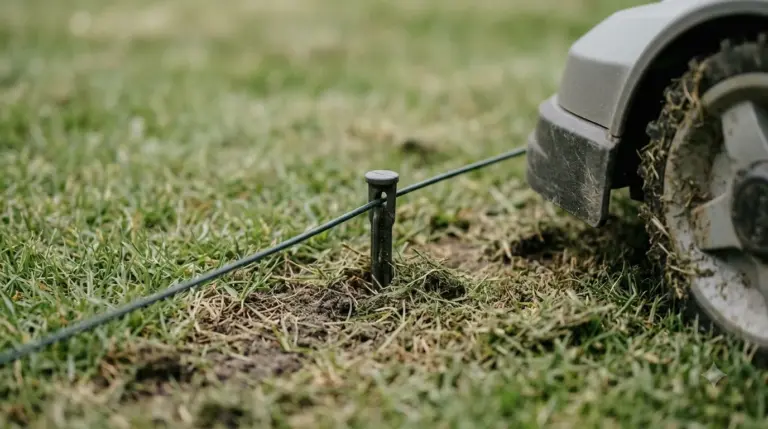
On wire models, the boundary wire forms a complete loop around the lawn and any obstacles. Robomow’s boundary wire comparison says the wire’s induction loop creates a magnetic field, which the mower detects as it nears the edge. The wire can be buried up to 20 centimeters deep, or laid above ground and fastened with lawn nails. It must never cross itself. Husqvarna’s AU guide says installation takes 2 to 5 hours depending on property size, and it recommends a qualified installer.
| Factor | Boundary wire | Wire-free (GPS or grass sensing) |
|---|---|---|
| Setup | Wire is laid around the lawn and any obstacles, then buried or pegged | No wire to bury; the mower maps the lawn or senses grass |
| Typical limit | The wire must form a complete loop with no crossings | May confuse neighboring lawns and leaves, so physical barriers can be needed |
| Returning to the charger | Follows the boundary or guide wire | Depends on the model; Robomow says its grass-sensor mowers cannot find the station alone |
Our reading is that boundary wire suits yards where you need a firm edge, while wire-free models suit owners who do not want to dig. Husqvarna’s US page says newer models can also use virtual boundaries set in an app, so check which system a specific model uses before you buy. For a closer look, see our wire-free vs boundary wire comparison and the explainer on RTK positioning on a robot lawn mower.
How the mower cuts the grass
A robot mower cuts in a random pattern, taking only a few millimeters off the grass each pass, so it runs often and never removes much at once. Husqvarna’s AU guide says the random pattern keeps the lawn evenly cut and avoids the tracks a systematic pattern can leave. The page lists a cutting height range of 20 mm to 60 mm.

Husqvarna’s US page says the mower cuts just a few millimeters at a time. So how do robot lawn mowers work day to day? They run in short, frequent sessions rather than one long weekly mow, which keeps each cut small. Cutting too much leaf at once stresses the grass. The clippings stay on the lawn, and Husqvarna’s AU guide says they return to the soil as mulch, so there is no bag to empty.
Blades wear out, and they need regular checks. Husqvarna’s US page says blades should be replaced every one to two months, depending on lawn size and grass type. Our reading is that owners of dense, fast-growing grass should check the blades more often than that. Our robot mower blade replacement guide covers the schedule in more detail.
Sensors that stop the blades
Lift and tilt sensors shut off the blades immediately, and a collision makes the mower stop, back off, and choose a new path. Husqvarna’s US page describes both behaviors, and the lift shutoff is the one that matters most for safety.
- Lift or tip: the blades stop at once when the mower is picked up or turned over.
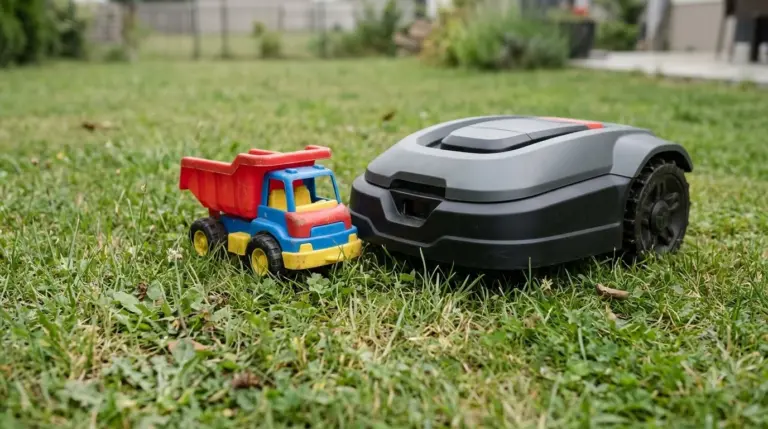
- Collision: the mower bumps, stops, reverses, and tries a new direction.
- Boundary: the edge signal turns the mower back before it leaves the lawn.
Heads up
Robot mowers have spinning blades and move without supervision. Keep children and pets clear when you lift, move, or service the mower, and follow the manufacturer’s safety instructions.
How the mower returns to its charger
When the battery runs low, the mower follows radio signals or a guide wire back to its charging station, then resumes the job after recharging. Husqvarna’s how-it-works page describes the guide wire as the fastest route home from a remote corner. The separate guide on how robot mowers dock and recharge goes deeper.
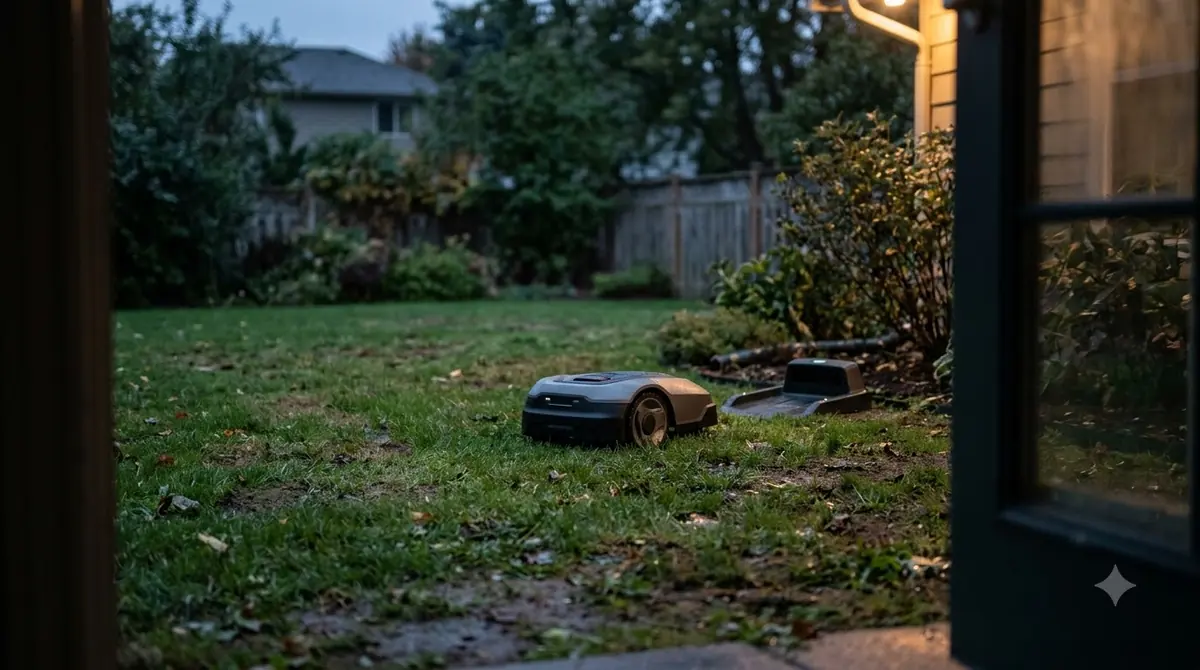
- The battery runs low. The mower leaves the grass and heads for its station.
- A signal or wire guides it. It follows a radio signal or the boundary wire, depending on the model.
- A guide wire helps from far away. For remote corners, the guide wire is the path Husqvarna calls the fastest route.
- It charges and resumes. After recharging, the mower picks up the job where it stopped.
Weather, slopes, and other limits
Robot mowers are designed to run in rain, and slope is the usual limit: standard Husqvarna models typically handle 20% to 40%, and AWD models reach about 70%. Those figures come from one manufacturer, so compare the spec sheet for your model before you buy.
Husqvarna’s US page says its mower is designed to work in rain, and its Weather Timer adjusts mowing frequency to grass growth. The page says the mower mows more often during wet, fast-growing periods. The AU page adds that extreme weather such as heavy wind and thunder could cause damage. How do robot lawn mowers work when the lawn is wet? See robot mower rain performance for the details, and how slope ratings are read before you trust any single percentage.
- Slope: standard models 20% to 40%, AWD models up to 70% (about 35 degrees), per the US page.
- Narrow gaps: guide wires help the mower pass spaces as narrow as 60 cm (24 inches).
- Grass-sensor limits: wire-free mowers may need physical barriers near neighboring lawns.
Frequently asked questions
How do robot lawn mowers work without a boundary wire?
Wire-free models navigate with onboard GPS or grass sensing, so no wire has to be buried. Robomow says grass-sensor mowers can confuse neighboring lawns and leaves, so they may need physical barriers. Wire models need the loop laid correctly, which is the main setup task.
How deep should boundary wire be buried?
Robomow says the wire can be buried up to 20 centimeters deep, or laid above ground and fastened with lawn nails. The wire must form a complete loop without crossing itself. Husqvarna’s AU guide says installation takes 2 to 5 hours, depending on property size.
How do robot lawn mowers work in the rain?
They are designed to run in rain, according to Husqvarna’s US page, which describes a Weather Timer that adjusts mowing to grass growth. Heavy wind and thunder can still cause damage, per the AU page. Check your model’s manual for any rain rules.
What happens if someone lifts the mower?
The blades shut off immediately, according to Husqvarna’s US page. Keep children and pets away when you lift or move the mower. Follow the manufacturer’s instructions before any maintenance or blade work.
Sources
- How do Automower robotic lawn mowers work? (Husqvarna): guide wire, charging, lift shutoff, Weather Timer, slope and passage figures.
- How do robotic lawn mowers actually work (Husqvarna): boundary wire installation time, random cutting pattern, cutting height, return to charger, mulching.
- Boundary wire vs. grass sensors for robotic mowers (Robomow): magnetic field detection, burial depth, wire-free limits.
 Up next8 min readBest Robot MowersDo Robot Mowers Work in the Rain? Sensors, Delays and LimitsUpdated Nov 11, 2026
 8 min readBest Robot MowersWire-Free vs Boundary Wire Robot Mowers: Which Setup Fits Your YardUpdated Nov 11, 2026
 8 min readBest Robot MowersDo Robot Lawn Mowers Need a Boundary Wire?Updated Nov 11, 2026
 8 min readBest Robot MowersWhat Is the Best Robot Mower Without a Boundary Wire?Updated Nov 11, 2026
 9 min readBest Robot MowersBest Robot Mower With Obstacle Avoidance: 5 Sensor TypesUpdated Nov 11, 2026
 8 min readBest Robot MowersBest Robot Mower With Ultrasonic Sensors: 5 Checks Before You BuyUpdated Nov 11, 2026