
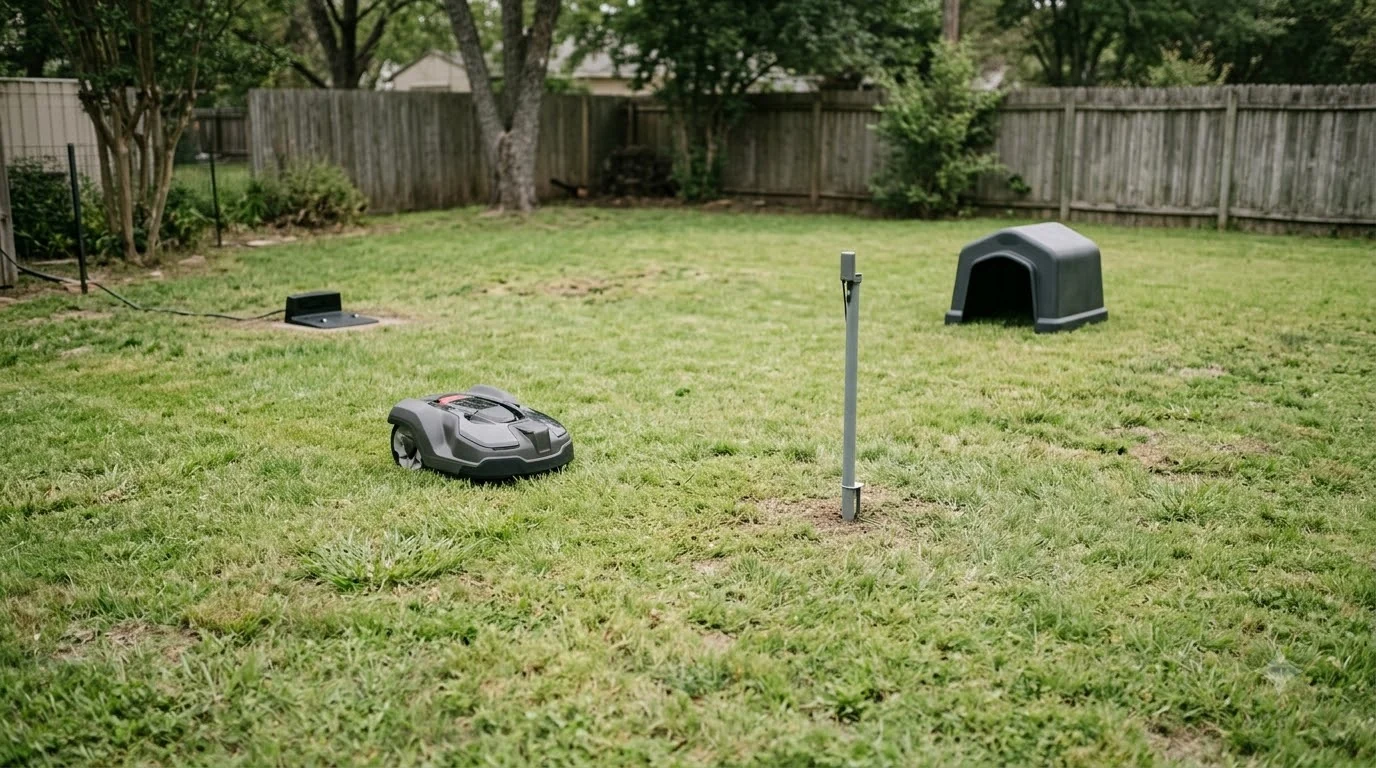

A robot mower for a lawn with a clothesline can work well, as long as the pole base and the hanging lines are treated as obstacles that the wire or the map must avoid. The main risks are a pole set in the middle of the grass, lines that sag close to the ground, and fallen laundry that the mower can drag or wrap around its wheels. This guide covers how to plan the layout, what clearances manufacturers and installers describe, and what to check before the first mow.
The short answer
- Pole base: give the post a clear buffer of roughly 30 cm (about 1 foot) on a wire-based mower, or fence it off as an island.
- Clothesline run: keep the mower’s path off the line’s footprint, and raise or tighten lines that sag low.
- Fallen laundry: pick up socks, towels, and clips before every scheduled run.
- Edges: if the line stands on a hard surface, such as a paved drying area, treat that edge as a hard boundary.
Why a clothesline is a special case in the yard
A clothesline is a small, fixed obstacle with three separate parts: the post, the anchor, and the line itself. Each one affects the robot mower differently. The post is solid and must not be hit, the anchor usually sits in concrete or a sleeve that sticks above the grass, and the line is thin and easy to miss. A clothesline is one of several fixed fixtures, and the mower guidance for fixed yard fixtures covers others. A pole with a wide base takes similar handling, as flagpole base fencing shows.
Most robot mowers navigate with a boundary wire, a virtual map, or a camera and GPS system, depending on the model. Each method handles a rigid post in its own way. With a wire system, the wire keeps the mower out of the area you fence off. With a map, you draw a stay-out zone. Neither method sees a low line hanging over the grass, so the line has to be kept clear of the mower’s path by layout, not by the mower’s sensors.
Laying out a robot mower for a lawn with a clothesline
Treat the pole as the first thing to plan, before any wire goes into the ground. The Robomow installation guide describes keeping the wire about 35 cm from walls and tall stones, and about 10 cm from beds or hedges. The lawnmowers.com setup guide advises keeping the wire at least 30 cm from walls, fences, and trunks, and about 25 to 30 cm from soft edges such as beds or mulch. A clothesline pole sits in the same category as these fixed objects, so a 30 cm buffer is a sensible starting point. Thin uprights are harder for sensors than boxes, which thin post island setup explains.
Where the pole stands in open grass, you have two practical choices. You can run the boundary wire around the whole pole so the mower never reaches it, or you can make the pole an island. Husqvarna describes islands for obstacles that cannot take a bump, such as flower beds and rockeries, and Worx lists 26 cm as the island clearance on its Landroid Classic. An island is the cleanest answer for a single pole because the mower simply cuts around it.
Lay the wire before you bury it. Mark the path first and check the loop once it is connected. A pole that looks clear on paper can still be inside the cutting path once the grass grows over the wire.
Heads up
Do not rely on a garden fence or a tall pole to stop the mower by appearance alone. Robot mowers use their own navigation logic, so a stay-out zone or wire is the reliable tool.
Managing the line when it sags
A clothesline that is tightened high is easy to ignore, but many lines droop once they are loaded with wet clothes. Low, sagging lines can reach the top of the grass, and a mower that brushes against them can pull the line or bend its anchor. Our reading is that the simplest fix is to keep the line taut and at a height that clears the mower’s body, then check it at the start of each season. Where a line sags, the overhead clearance under a pergola gives a useful comparison.
- Check the tension. Re-tighten the line after the first wash of the season and after any heavy load.
- Keep the anchor flush. A sleeve that stands above the grass is an edge the mower can bump into, so cut it level or move it inside the island.
- Move the line when you can. If you have a rotary line, lower it for mowing days and raise it again afterward.
Keeping laundry and clips off the grass
Fallen laundry is the most common issue with a clothesline, and it is not a sensor problem. A towel or a sock on the grass can be drawn under the mower or wrapped around the blade housing. Before a scheduled run, walk the lawn and clear any clothing and loose clips. Pegs and clips that have fallen into the grass should be collected too, because small metal parts can damage the blades. Clips and small items can jam a blade, so small debris on the lawn is a useful read.
If you hang laundry on days when the mower is scheduled, consider moving the schedule to a day when the line is empty. Many owners find that simply shifting the mowing time solves the problem without changing the layout.
Seasonal checks for a yard with a clothesline
A clothesline changes with the seasons, so the mower setup needs a short check at each change. In spring, confirm that the wire is still at the right height after the grass has grown and that the island is still clear. In summer, when lines are used most, check the tension and the laundry pickup routine. In autumn, lower or remove the line if you do not use it over winter, and check that the anchor has not shifted.
Winter is a good time to inspect the wire itself. Look for cuts or loose sections near the pole, because frost and lawn work can loosen the pegs that hold it. If the mower has a map, review the zones after any change to the line or the pole.
What to check before you buy or set up
For a robot mower for a lawn with a clothesline, the layout is most of the job. Before you start, sketch the yard and mark the pole, the anchor, and the path the line covers. Then match that layout to the mower’s setup method. A wire model needs room for the wire buffer, while a map-based model needs a clean, clear zone drawn in the app. Either way, the pole must not sit where the mower turns or where the lawn narrows. Keep the mowing path open, plan one stay-out zone for the post and its anchor, and recheck the layout after the first full season. Small low items sometimes hide in the grass, and low box fixtures on the lawn show how sensors treat them.
Related reads: A large object near the line is handled with an island, as the shed island plan shows.
Frequently asked questions
Can a robot mower run under a clothesline?
It can, provided the line is high enough to clear the mower’s body and no laundry hangs low enough to reach the grass. Our reading is that a taut, high line is safer than a sagging one.
How far should the boundary wire stay from a clothesline pole?
The setup guides we read suggest about 30 cm from a fixed object like a pole or trunk, and wider when the surface is soft. Check the exact figure in your mower’s manual.
Should I make the pole an island?
For a single pole in open grass, an island is often the cleanest option. Husqvarna and Worx both describe islands for obstacles the mower should not bump into.
What if laundry gets caught on the mower?
Stop the mower, lift the cover or housing as the manual shows, and remove the fabric. Then clear the lawn before the next scheduled run so it does not happen again.
Sources
- Robomow boundary wire guide (manufacturer): distances from walls, beds, and paths when laying the wire.
- lawnmowers.com boundary wire setup guide (retailer guide): clearance from trunks and fences, and soft-edge spacing.
- Husqvarna islands guide (manufacturer): when to island an obstacle that cannot take a bump.
- Worx Landroid Classic island setup (manufacturer): island clearance from an obstacle.
 Up next7 min readBy YardRobot Mower for a Lawn with a Sandbox: Keep Sand OutUpdated Nov 13, 2026
 7 min readBy YardRobot Mower for a Lawn with Fairy Rings: What to ExpectUpdated Nov 13, 2026
 7 min readBy YardRobot Mower for a Lawn with Grubs: What Actually HelpsUpdated Nov 13, 2026
 7 min readBy YardRobot Mower for a Lawn with a French Drain: What to KnowUpdated Nov 13, 2026
 6 min readBy YardRobot Mower for a Lawn with a Kiddie Pool: Barrier FirstUpdated Nov 13, 2026
 7 min readBy YardRobot Mower for a Lawn With Tall Ornamental GrassesUpdated Nov 14, 2026