
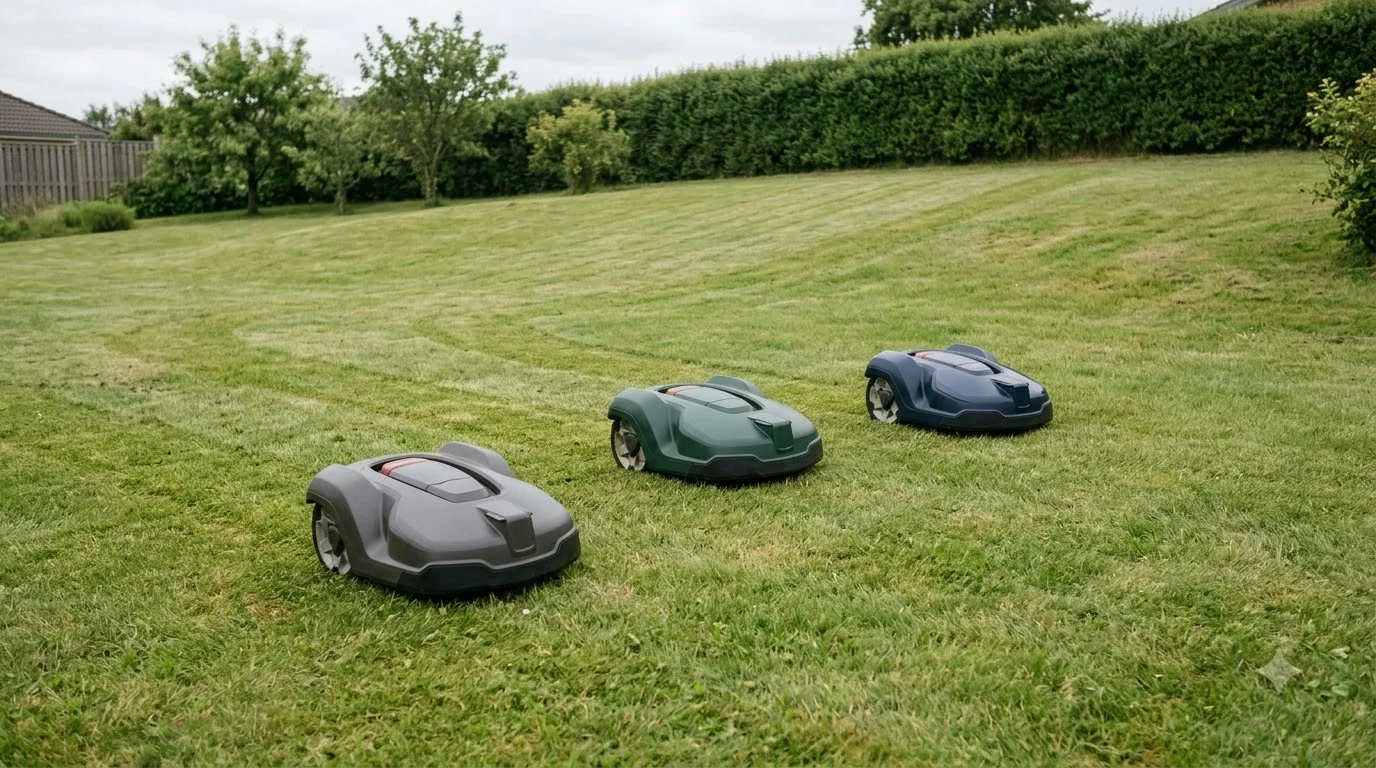

Robot mower vs robot vacuum technology: the sensors overlap, but a mower has to find its way without walls. PCWorld notes that robot mowers operate much like robot vacuum cleaners but with higher stakes, and both use similar sensors. The difference is the edge of the work area, which a mower must locate by other means.
The short answer
- Shared ideas: bump, obstacle and similar sensing carry over from vacuums to mowers.
- Main gap: a vacuum uses walls to define its space, and a mower has none.
- Three ways to fill the gap: a buried boundary wire, satellite positioning (GPS or RTK), or cameras and LiDAR.
- Biggest tradeoff: wire-free designs cost more and depend on sky view or line of sight.
Robot mower vs robot vacuum technology: how they compare
Robot vacuums and robot mowers both move across a surface, avoid obstacles and return to a charger. Many of the sensing ideas are the same, which is why the two product types often get compared. PCWorld’s reading is that mowers operate much like robot vacuums, with the same kinds of sensors, but a mower works outdoors where a mistake costs more.
| Question | Robot vacuum | Robot mower |
|---|---|---|
| Sensors | Bump and obstacle sensing | Similar obstacle sensing, plus a way to locate the lawn edge |
| Work boundary | Walls help define and map the space | No walls, so a wire, GPS or vision sets the edge |
| Environment | Indoors | Outdoors, with changing light, weather and satellite conditions |
The table is a simplified summary. In any robotic mower vs robot vacuum comparison, the indoor and outdoor rows are our reading of the PCWorld comparison, not a measured test.
Why a mower cannot use the vacuum’s walls
According to PCWorld, walls help a robot vacuum define and map its space. A robot mower has no equivalent. The grass simply continues into the flower bed, the driveway or the neighbor’s yard, so the mower needs an outside reference to stay inside the lawn.
In practice that means one of three things: a physical wire marks the perimeter, satellites establish where the mower is, or cameras and laser sensors read the scene around it. PCWorld also describes hybrid designs, such as Segway Navimow’s, that pair a stationary antenna with a second GPS antenna inside the mower.
Boundary wire: the older method
A boundary wire is a loop around the lawn that the mower senses and stays inside. Wire circuits are typically limited to about 2,600 feet, and many base stations cannot power more than about 1,000 feet of wire, according to PCWorld.
- Buried wire is the tidy option, but the installation takes time or professional help.
- Staked wire is easier to lay, but it is exposed to weather and animals and can trip people.
- Wire-free models remove the installation step, but they add cost and depend on the signals discussed below.
For a longer look at the trade-off, read our guide to wire-free versus boundary-wire mowers.
Satellite positioning: RTK and GPS
RTK uses satellite signals together with a base station to reach centimeter-level accuracy, according to Ecovacs. Mammotion gives a general figure of within 1 to 2 centimeters, though that is vendor marketing rather than an independent test. PCWorld says most wire-free mowers use GPS to establish location, often with a front camera and grass sensors added.
The weak point is the sky. Ecovacs says the base station must sit in an open, unobstructed area, and dense trees and buildings can interfere with satellite connectivity. Mammotion adds that RTK performance can degrade under dense trees or near tall structures. PCWorld says wire-free GPS mowers need a clear view of the southern sky in the Northern Hemisphere.
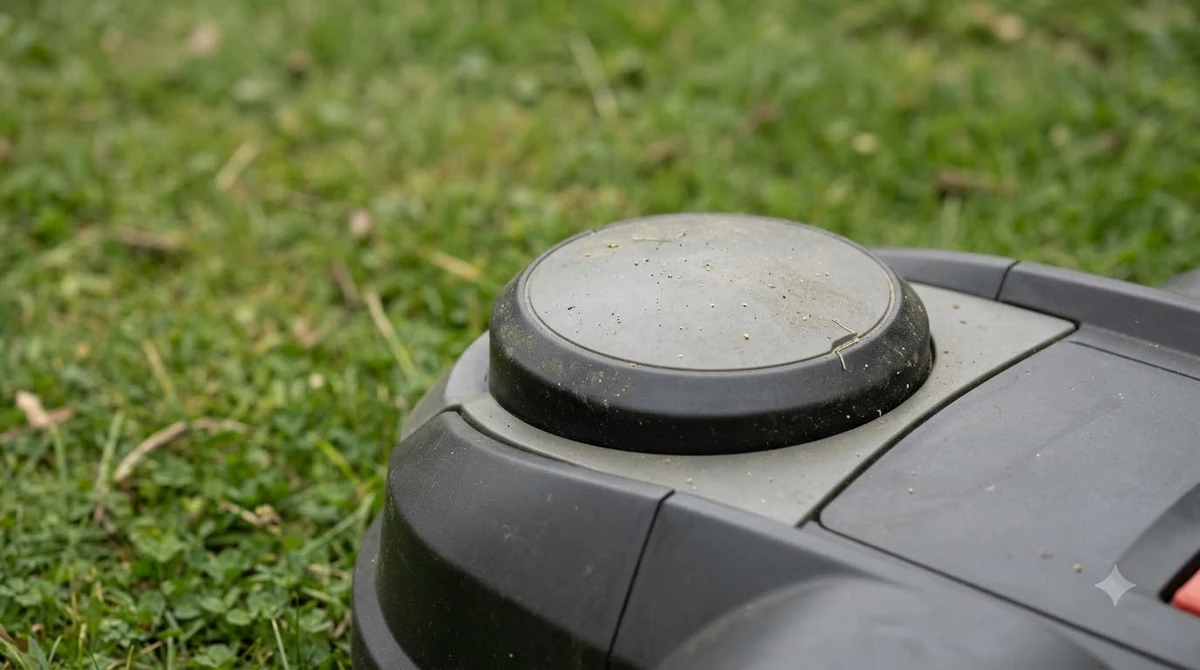
Some brands use an antenna on the mower or on a stationary unit. Husqvarna claims its EPOS system works up to 500 meters, a figure from the vendor, not an independent measurement.
Before buying an RTK or GPS mower, check where the base station or antenna would sit and whether the lawn has a clear sky view for most of the day. Our guide on where to mount an RTK base station covers the placement question.
LiDAR and cameras: what each one tolerates
LiDAR scans the surroundings with lasers to build a 3D map, and it needs no base station or special placement, according to Ecovacs. Fog and heavy rain can scatter and absorb the laser beams, and LiDAR is generally the more expensive option.
Cameras with computer vision depend on lighting. Mammotion says vision is sensitive to lighting, shadows and weather, and that vision-only mowers are still uncommon.
| Method | Needs a base station | Main limit | Cost tier (vendor wording) |
|---|---|---|---|
| Boundary wire | No satellite base station; the wire loop connects to the charging station | Wire installation, exposed wire, about 2,600 ft per circuit | Not covered by these sources |
| RTK | Yes, in an open area | Trees, buildings and blocked satellites | Generally more budget-friendly than LiDAR |
| LiDAR | No | Fog and heavy rain; cannot position on its own | Usually more expensive |
| Camera vision | No | Lighting, shadows and weather | Not covered by these sources |
Mammotion adds that LiDAR is reliable in shaded or low-light areas, because it does not depend on light or color. It also says LiDAR detects shapes but does not understand what they are, and it lacks global positioning on its own. For that reason, many mowers combine LiDAR with RTK or another positioning method. Our RTK, LiDAR and vision comparison sets the three side by side.

Obstacle handling: bump sensors and early detection
A bump sensor works by contact. The device taps an obstacle and adjusts its path, according to PCWorld. The author says the Husqvarna Automower 435X avoids obstacles by bumping into them, and points to scuff marks after years of use as evidence.
Ultrasonic and infrared sensors detect obstacles before contact, so the device does not have to bump into them, per PCWorld. That early warning matters most for objects a mower should not touch at all, such as toys or fragile plants. See how robot mowers avoid obstacles for more on this.
The biggest difference in robot mower vs robot vacuum technology is what happens if something goes wrong. PCWorld notes that a mower has sharp cutting blades that can injure people and damage hoses, sprinklers, toys and plants, while a vacuum running over a foot “might tickle.” For that reason mowers add lift and tilt sensors, which detect when the mower is caught on an object or tipped at an unsafe angle. PCWorld also describes rain sensors that can stop a mower from starting in wet conditions or send it back to its base when rain begins.
What to compare on a mower spec sheet
Use this checklist to judge robot mower vs robot vacuum technology on a real product page.
- Positioning method: wire, RTK, GPS, LiDAR or vision, and what each one needs.
- Base station or antenna: where it must sit and how much open sky it needs.
- Tree and building tolerance: whether the vendor says it works under canopy.
- Low-light behavior: relevant if the mower runs at dusk or in shade.
- Drive system: some wire-free models omit all-wheel drive, which matters on slopes.
- Price tier: wire-free mowers generally cost more, and the sources give no fixed dollar figures.
Frequently asked questions
Do robot mowers use the same sensors as robot vacuums?
Partly. In robot mower vs robot vacuum technology, PCWorld says both use similar sensors, but a mower must also handle grass, weather and open ground. The biggest difference is that a mower has no walls to define its work area.
Does RTK work under trees?
Usually less well. Mammotion says RTK performance can degrade under dense trees and near tall structures. Ecovacs says dense trees can interfere with satellite connectivity, so a yard with heavy canopy may need a wire or another method.
Is LiDAR better than RTK for a mower?
Neither is better in every yard. LiDAR needs no base station and works in low light, while RTK is generally cheaper, according to Ecovacs. Fog and heavy rain affect LiDAR, and blocked satellites affect RTK.
Do wire-free mowers need a clear sky?
Satellite-based wire-free mowers do. PCWorld says they need a clear view of the southern sky in the Northern Hemisphere, and that GPS can be lost after equipment failure, plant growth or solar storms.
Sources
- How robot lawn mowers cut grass without whacking off your toes (PCWorld, Ed Oswald, 2024): wire limits, wire-free navigation, and the robot vacuum comparison.
- RTK vs LiDAR robot lawn mowers (Ecovacs, vendor blog): RTK placement, LiDAR tradeoffs and cost tiers.
- AI vision vs RTK vs LiDAR of robot lawn mower (Mammotion, vendor blog): RTK signal limits, camera lighting sensitivity and LiDAR behavior in shade.
 Up next8 min readReviews & CompareRobot Lawn Mower vs Riding Mower: Cost Over 5 YearsUpdated Nov 11, 2026
 8 min readReviews & CompareChinese Robot Mower Brands vs Husqvarna: What the Specs ShowUpdated Nov 11, 2026
 9 min readReviews & CompareGardena vs Husqvarna Robot Mower: What the Spec Sheets ShowUpdated Nov 11, 2026
 8 min readReviews & CompareRobot Lawn Mower vs Zero Turn Mower: Which Fits Your LawnUpdated Nov 11, 2026
 8 min readReviews & CompareWhich Robot Mower Brand Has the Best Customer Service?Updated Nov 11, 2026
 9 min readReviews & CompareRobot Mower Spec Comparison: Coverage, Slope and NoiseUpdated Nov 11, 2026