
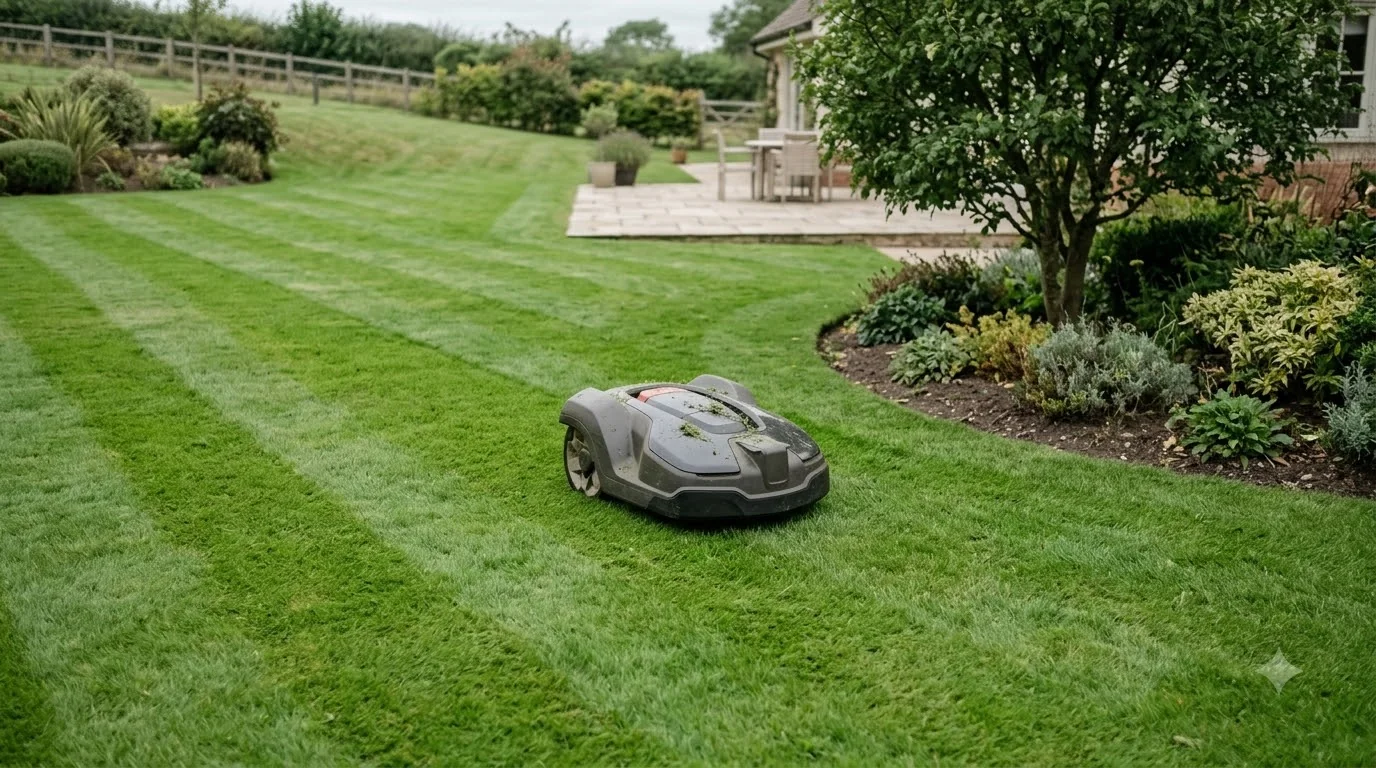

The best robot lawn mower under $5000 is the one whose rated lawn size, slope limit and navigation match your yard, not the one with the highest price. Prices change often, so confirm the current price on each manufacturer site as of November 2026 before you decide.
At this budget most models can cut a typical suburban lawn, so choosing the best robot lawn mower under $5000 comes down to drive type, navigation method and the lawn size each maker rates. This guide explains what to check first, using figures from manufacturer and university extension pages rather than rankings.
The short answer
- Area: choose a model whose rated lawn size is comfortably above your mowing area, and allow margin for narrow passages.
- Slope: standard models handle 25 to 50 percent slopes, while Husqvarna’s AWD 435 iQ is rated for slopes up to 70 percent.
- Navigation: boundary wire, RTK GPS or LiDAR each define the mowing zone differently, and RTK needs an open sky view.
- Price: no fixed price is quoted here, because manufacturer pages show none and retail prices move, so check the current listing.
Best robot lawn mower under $5000: what the budget buys
A budget around $5,000 is a filter, not a verdict. It limits the models you should consider, but it does not guarantee a larger lawn, a steeper slope limit or a better navigation system. Two mowers at the same price can cover very different yards, so start with three facts about your own property: the mowing area, the steepest slope, and how much of the sky is blocked by trees or walls. To judge when paying more makes sense, see when a premium robot lawn mower is worth the price.
- Measure the mowing area. Leave out beds, patios and the house footprint, since the mower will skip them.
- Measure the steepest slope. Use the rise over run method explained below.
- Check the sky view. Trees and walls affect satellite navigation more than an open lawn does.
- Check the grass type. UF/IFAS notes that most autonomous mowers are designed mainly for cool-season grasses.
Our reading is that the top of this price band mainly buys extra convenience, such as app features, larger rated areas and AWD drive. It does not replace checking the specifications for your own lawn, which is what settles the best robot lawn mower under $5000 for you.
Match the rated lawn size to your yard
Manufacturers rate each robot mower for a maximum lawn area. Husqvarna’s US robotic mower page lists each model with a lawn size marked plus or minus 20 percent, including 0.5 acre for the 410 iQ, 1 acre for the 420 iQ, 1.3 acres for the 435 iQ AWD, 1.5 acres for the 560 EPOS, 2 acres for the 440 iQ and 580 EPOS, and 6 acres for the CEORA, as shown on its robotic lawn mowers page.
The tolerance matters. A rating of 1 acre with a plus or minus 20 percent band means a model can be asked to cover roughly 0.8 to 1.2 acres, so a lawn at the top of the rating leaves little room. Our reading is that you should compare the rated area of each model with your mowing area, then add a margin for irregular shapes, islands and narrow side passages.
Price is not a reliable guide to lawn size. The Husqvarna page shows no prices for any model, so a higher budget does not automatically move you into a larger rating band. For a method, see sizing a robot mower to your lawn.
Check slope and drive type before you buy
Slope is measured as vertical rise divided by horizontal distance, multiplied by 100. A rise of 15 cm over 100 cm is a 15 percent slope. Husqvarna’s UK support says standard models manage 25 to 50 percent depending on the model, while the AWD model reaches up to 70 percent, as explained in its steep slope installation guide.
Drive type matters most on steep ground. The same guide advises placing the boundary further in on flat ground before a slope begins, with at least 50 cm of level ground between the boundary and the slope. That setup step is easy to skip and can decide whether a model struggles on a bank.
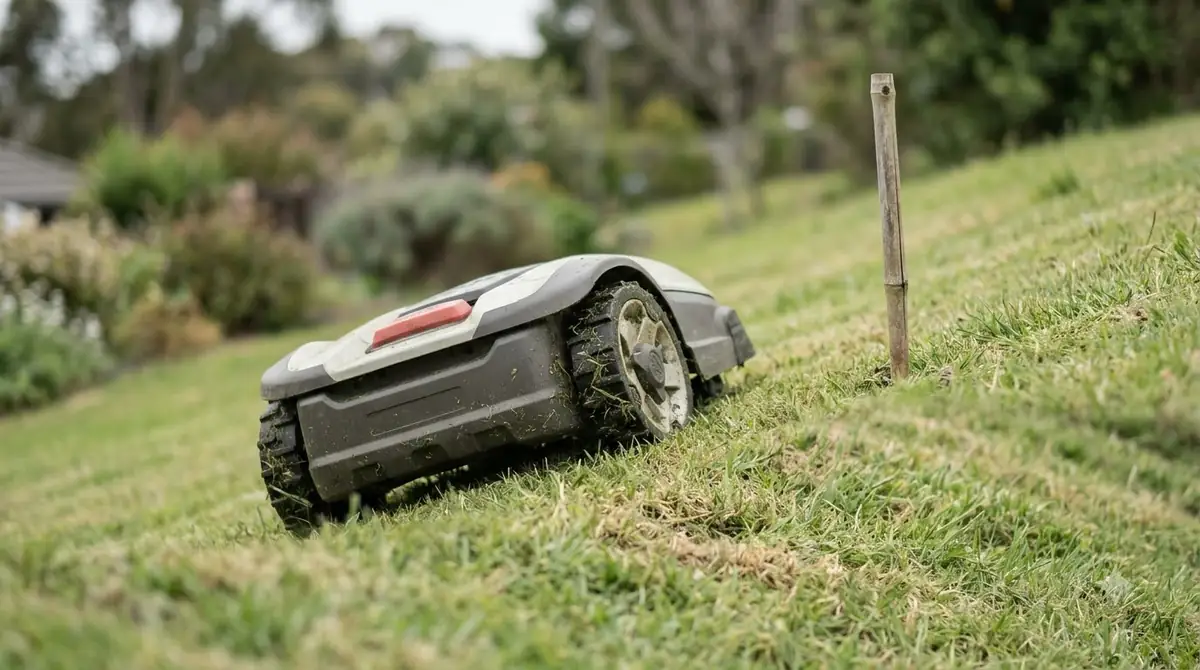
Husqvarna’s own page states the 70 percent figure only for the 435 iQ AWD, and it does not give a slope limit for every model. So a budget near $5,000 does not guarantee steep-slope performance. Check the stated maximum for the exact model you are comparing, and treat a general “handles slopes” claim without a percentage as incomplete. Our explainer on percent and degree slope ratings shows how to convert them.
Compare navigation: wire, RTK and LiDAR
Navigation decides how the mower knows where its area ends. UF/IFAS explains that boundary wire, or GPS with RTK, defines the mowing area, so the choice changes installation work and the places the mower can reliably run.
| Option | What it needs | Weak point |
|---|---|---|
| Boundary wire | Buried or pegged wire around the zone | Installation work and wire breaks |
| RTK GPS | A base station in an open, unobstructed area | Dense trees and buildings reduce accuracy |
| LiDAR | No base station | Behavior varies by model, so check the spec page |
Ecovacs, a manufacturer, states that an RTK base station must sit in an open area, that RTK struggles under dense trees and buildings, and that LiDAR needs no base station. Ecovacs is a vendor, so treat that as the company’s own description rather than an independent test, as set out in its LiDAR versus RTK article.
If your yard has heavy shade, our reading is that a LiDAR or wire-based model deserves a closer look than an RTK-only model, and that the base station location is worth planning before you buy. Our comparison of RTK, LiDAR and vision navigation goes further.
Blades, grass height and upkeep
Blade condition and grass height affect cut quality more than most buyers expect. UF/IFAS says most autonomous mowers are designed for cool-season grasses and are typically mowed below 2.5 inches, so check that the mower’s cutting range covers the height you want for your grass type.
The same UF/IFAS publication advises replacing robot mower blades every 6 to 8 weeks in the growing season, because dull blades tear the grass. Budget models and premium models share this maintenance need, so the upkeep cost should be part of your comparison, and blade replacement timing for robot mowers covers the schedule.
At the upper end of this price band, some models use larger decks. Mammotion’s LUBA 3 AWD page lists a dual-disc deck of 400 mm (15.7 in), which is a useful example of a spec to confirm on the maker’s own page rather than in a retailer roundup.

What to verify on the manufacturer page
Retailer roundups for the best robot lawn mower under $5000 often mix old listings with current ones, so the manufacturer page is the safer source for specifications. Husqvarna’s US page, read on November 12, 2026, lists lawn size and one slope figure, but it shows no prices, so the price must come from the retailer or a current listing.
- Rated area. Confirm the lawn size rating for the exact model and its tolerance.
- Maximum slope. Look for a percentage rating, not only the word “slopes”.
- Navigation. Confirm whether the model uses wire, RTK, LiDAR or vision.
- Drive. Check whether the model is AWD or rear-wheel drive.
- Price. Record the price with the date, since it changes often.
Our reading is that a model meeting these five checks is a better fit than one chosen on a price band or a feature list alone, and that is how to pick the best robot lawn mower under $5000.
Frequently asked questions
Does a higher budget give a bigger lawn?
Not automatically. Husqvarna’s US page shows its models by rated lawn size, and the rating is set per model, not per price. Compare the rating for each model against your own mowing area, with the plus or minus 20 percent tolerance in mind.
Is AWD worth paying for under $5,000?
It depends on the slope. Husqvarna’s UK guide lists 25 to 50 percent for standard models and up to 70 percent for the AWD 435 iQ. If your lawn is mostly flat, a non-AWD model may meet your needs, so check the stated slope rating for your yard.
Is LiDAR or RTK better under trees?
Ecovacs says RTK struggles under dense trees and buildings, and that LiDAR needs no base station. These are manufacturer statements, not independent test results, so check how the specific model navigates in a yard like yours before you buy.
Do I need the most expensive model in this price band?
Not necessarily. The right model is the one whose rated area, slope limit and navigation match your lawn. Spending more on features does not change those specifications, so start with the checks above before comparing prices.
Sources
- Husqvarna US robotic lawn mowers (manufacturer): rated lawn size per model with plus or minus 20 percent tolerance, the 70 percent slope figure for the 435 iQ AWD, and the absence of prices.
- Husqvarna UK steep slope installation guide (manufacturer): standard versus AWD slope ranges, the 50 cm level-ground advice and the slope calculation.
- UF/IFAS EP667 (ENH1402), autonomous mowers (university extension): boundary wire or GPS and RTK defining the area, cool-season grass design, mowing height and blade replacement interval.
- Ecovacs LiDAR versus RTK article (manufacturer): RTK base station placement and the effect of trees and buildings on RTK.
- Mammotion LUBA 3 AWD (manufacturer): dual-disc deck width of 400 mm.
 Up next8 min readBest Robot MowersBest Wire-Free Robot Mower Under $5000: What to CheckUpdated Nov 17, 2026
 9 min readBest Robot MowersBest Robot Lawn Mower Under $700: What to Check Before You BuyUpdated Nov 12, 2026
 7 min readBest Robot MowersBest Robot Lawn Mower Under $3000: What to Check Before You BuyUpdated Nov 14, 2026
 10 min readBest Robot MowersBest Robot Lawn Mower Under $1000: What to Check Before You BuyUpdated Nov 12, 2026
 7 min readBest Robot MowersBest Wire-Free Robot Mower Under $1200: What to Check Before You BuyUpdated Nov 16, 2026
 7 min readBest Robot MowersBest Robot Lawn Mower Under $2,000: What the Budget Buys and What to CheckUpdated Nov 13, 2026