
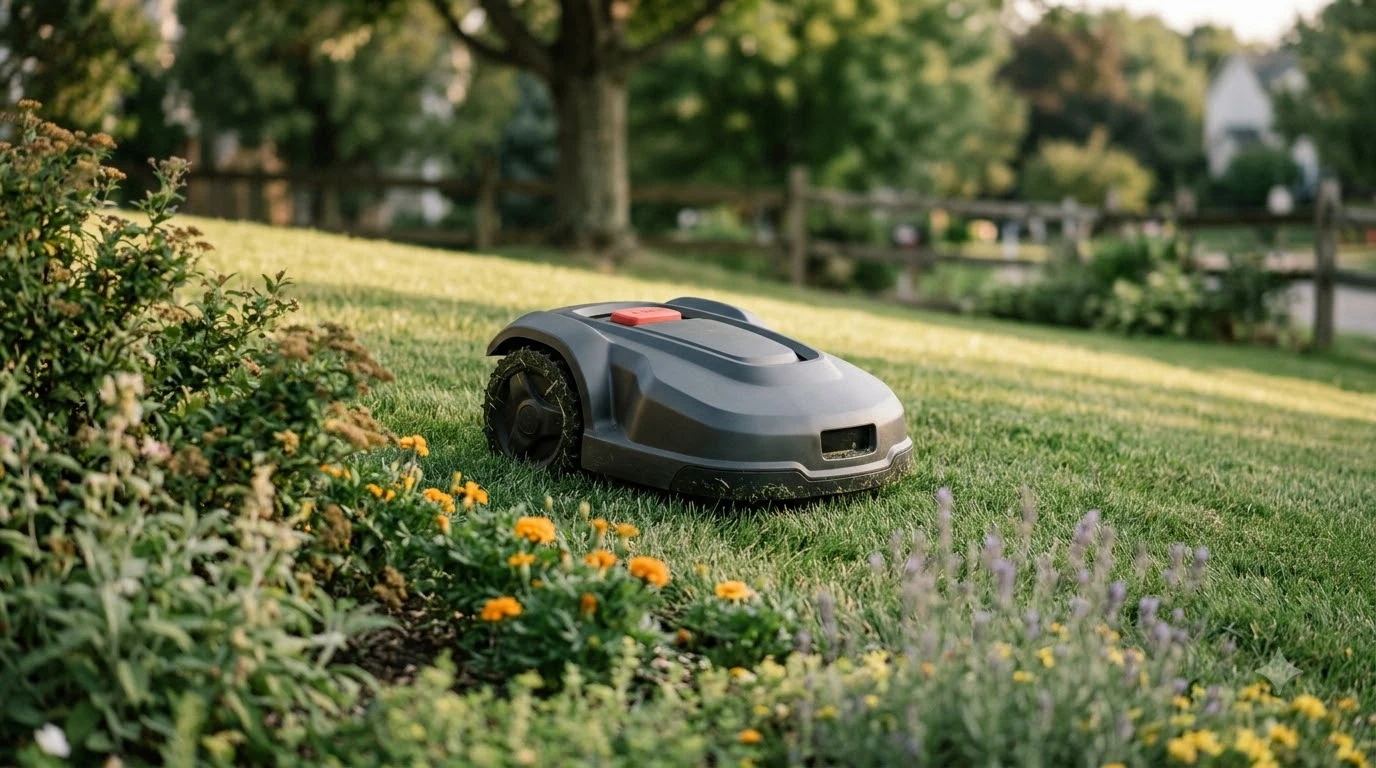

Asking what is the best robot lawn mower for the money has no single answer. The right value depends on your lawn’s area, its steepest slope, and whether you choose a wired boundary or a wire-free system. Brand-published ranges, checked as of 2026-11-10, put wired models at about $800 to $1,500 and wire-free models at about $1,800 to $3,500 or more.
The short answer
- Price by type: wired systems start lower; wire-free systems usually cost more, and published ranges vary by source.
- Fit first: match the rated area and slope to your yard before comparing prices.
- Navigation: wire-free systems need a clear view of the sky for satellite positioning.
- Value claims: a publisher naming a “best value” model is giving an opinion for certain yards, not a universal ranking.
What is the best robot lawn mower for the money? It depends on fit
The answer to what is the best robot lawn mower for the money changes with every yard. A mower that suits a small, flat lawn can struggle on a steep one with trees. Review roundups also disagree on picks, because their lists differ in models, ratings and prices. Use the criteria below to answer what is the best robot lawn mower for the money for your own lawn, rather than following one winner.

How much a robot lawn mower costs by type
Price ranges differ by publisher and by date, so treat them as starting points, not quotes (our guide to typical robot lawn mower costs covers the wider picture). Lawnlove, updated March 23, 2026, gives a typical range of $900 to $2,200 with an average of $1,550. Mammotion, a brand, publishes different tiers on two pages: $800 to $1,500 for wired and $1,800 to $3,500 or more for wire-free on its boundary-wire guide, but $700 to $1,500 for budget wire-free models on its wire-free guide.
| Type | Published range (varies by source) | Main tradeoff |
|---|---|---|
| Wired boundary | About $800 to $1,500 (Mammotion) | Cheaper upfront, but the wire takes time to lay and must move if the layout changes |
| Wire-free (GPS, RTK or vision) | About $1,800 to $3,500 or more (Mammotion) | No wire to install, but still needs initial setup and depends on sky view |
Even a wire-free model needs setup. Mammotion says wire-free mowers still require an initial process in which you map the area in an app, calibrate RTK if needed, and tune obstacle avoidance. Budget that time when you compare a cheaper wired mower with a pricier wire-free one.
Wired or wire-free: which gives more value
A wired system is usually the lower-cost route, and its navigation does not depend on satellite signal. Wire-free systems skip the buried wire, which helps if you expect to change the layout; wired and wire-free mowers compared lays out the tradeoffs in full. Mammotion’s guide on boundary wire says wire-free performance depends on clear satellite visibility, and that dense trees and tall buildings can block satellite signals.
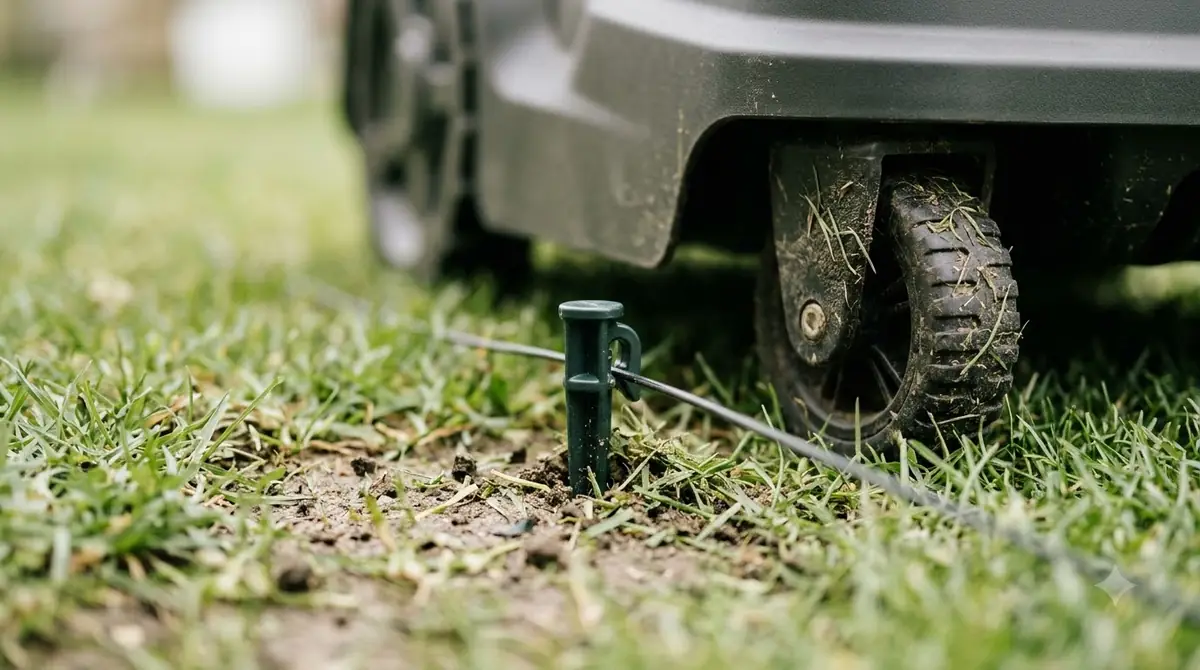
- Wired: lower upfront cost, and the installation work pays off in a fixed yard.
- Wire-free: no wire to lay, but the value falls if the yard is shaded or close to tall structures.
- Weather: Mammotion notes heavy rain or fog can affect vision-based navigation.
- Accuracy claims: brands quote different figures, from sub-inch to centimeter-level. Neither claim comes with a published test method, so treat them as brand claims.
Our reading is that a yard with heavy tree cover is where a wired boundary is the safer value, even at a higher installed cost.
Lawn size: measure grass area, not the lot
Measure the grass you will mow, not the whole property; choosing a robot mower by lawn size walks through it. Bob Vila’s buying guide, dated July 20, 2026, says to measure “the lawn’s square footage, not the size of the lot,” and notes that manufacturer coverage claims assume ideal conditions. Its size guide puts light-duty models at lawns up to a quarter acre, midsize models at up to a half acre, and large machines at an acre or more.
Lawnlove gives a sharper warning for big yards. It says large lawns of half an acre to one acre cost 50 to 60 percent more than small and medium models, and that yards over one acre may be better served by riding mowers. Our reading is that the cost gap widens fast once a lawn passes half an acre, so the value case gets weaker.
Slope decides the fit more than price does
Check the steepest part of your lawn against the rated slope, not the average. Bob Vila says basic robot mowers work on flat yards and slopes up to 15 percent, and that steeper yards need a more capable model. Lawnlove gives an average maximum incline of 24 degrees, with a typical range of 16 to 33 degrees.
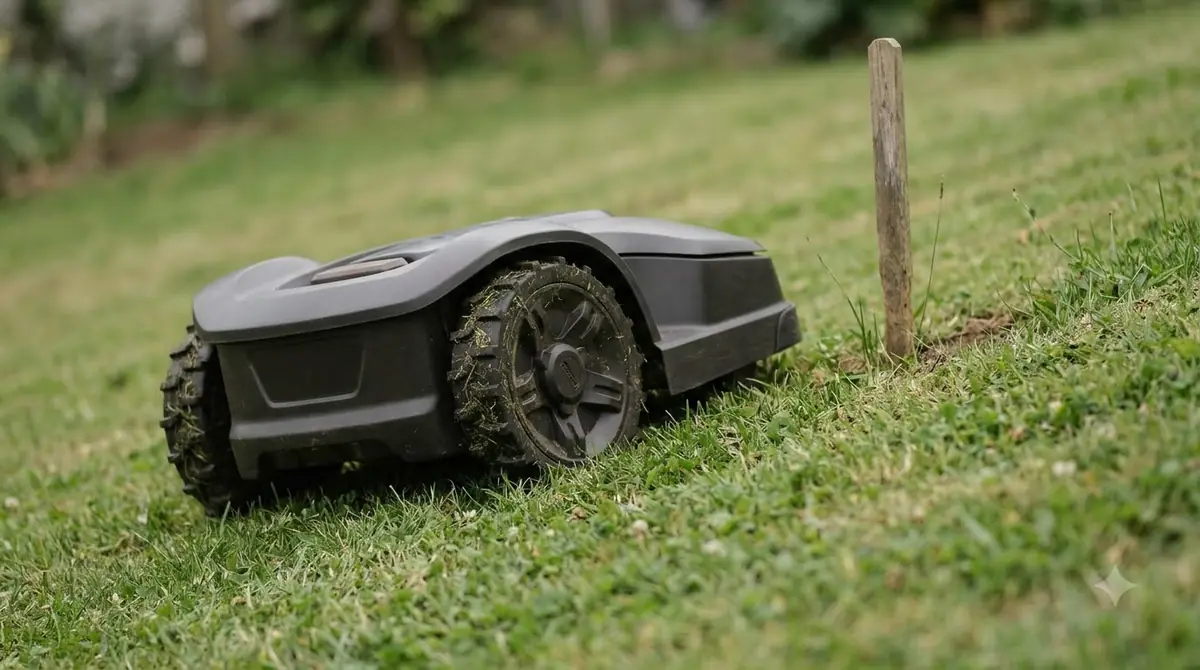
Brands also rate slope differently. Segway’s buying guide lists a 45% (24 degree) slope rating for its i2 AWD and 84% (40 degree) for its X4 series, and gives coverage per charge for each. Segway’s own spec figures are a good place to start.
| Brand model group | Slope rating (brand spec) | Coverage per charge (brand spec) |
|---|---|---|
| Segway i2 AWD (i205 and i208) | 45% (24 degrees) | 125 m2 (i205 AWD) and 250 m2 (i208 AWD) |
| Segway X4 series (X420 and X450) | 84% (40 degrees) | 675 m2 (X420) and 1,300 m2 (X450) |
Compare slope ratings in matching units (see reading a robot mower slope rating for the conversion). Some brands list percent and others list degrees, so convert before you compare. Lawnlove suggests using an online calculator for that step. Use the coverage figure as a ceiling, and leave margin for growth and corners.
Navigation and site conditions
Navigation affects value as much as the price tag. Bob Vila notes that satellite antennas can be hard to stake in hard ground, and that patchy 4G coverage can force some US models to use an external RTK reference station. Wi-Fi range can also be limited; one budget model it reviewed is limited to about 50 feet.
Our reading is that a mower with a higher price but better navigation for your site can outperform a cheaper model that struggles to find its position. Check the site conditions before you assume a lower price is the better deal for your yard.
What the best value claims mean
Reviewed states that “the best robot lawn mower for the money is the Segway Navimow” and names the i105N as its best value pick, with a 29% (16 degree) slope rating and coverage up to one-eighth of an acre. The same page warns that prices may change and that readers should check current listings.
Our reading is that a value pick answers what is the best robot lawn mower for the money only when its slope and area ratings fit your yard. A low-priced model that cannot handle your slope or lawn size is poor value, whatever the list says.
Heads up
Reviewed’s table lists MSRP figures, and retailer listings can differ. Compare current prices directly with the seller before you decide.
Ownership costs to plan for
The purchase price is only part of the cost. Bob Vila says blades cannot be easily sharpened and must be replaced. Its buying guide puts battery life at about three years on average. Its 2026 review says a well-maintained mower should last 5 to 10 years, so the battery replacement is the cost to budget for. For more on wear, see how long robot lawn mowers last.
Mammotion lists dirt on cameras and sensors, firmware updates and battery wear as the main upkeep items. Keep the mower and dock indoors over winter, since Bob Vila says long damp, subfreezing periods shorten lifespan.
What to check before you buy
Work through these checks in order to answer what is the best robot lawn mower for the money for your yard, because area and slope rule out more models than price does.
- Measure the grass area. Compare your real lawn size with the rated coverage, and leave margin for growth and awkward corners.
- Find the steepest section. Check it against the slope rating in matching units, not against the average slope.
- Choose the navigation. Wired suits yards where trees or buildings block the sky. Wire-free suits open yards where you want no wire.
- Compare price against type. Check your candidate against the published ranges above, then confirm the current price at the seller.
- Plan for ownership. Budget for blade replacement and a battery swap, and confirm the warranty terms for the model you consider.
Frequently asked questions
Is a cheaper robot lawn mower worth it?
It can be, if its rated area and slope fit your yard. Wired systems start lower in published ranges, but installation time and any later layout change add real effort. Check fit first, then compare price across the same type.
Do I need RTK navigation?
Only if your yard has a clear view of the sky. Mammotion says dense trees and tall buildings can block satellite signals, and brand accuracy claims differ. Check the navigation type on the spec sheet before you pay extra for an RTK base or reference station.
How long do robot lawn mowers last?
Bob Vila’s 2026 review says a well-maintained mower should last 5 to 10 years, while its buying guide puts battery life at about three years. These are publisher figures, not a warranty, so check the warranty terms for the model you consider.
Why do prices in reviews differ from what I see?
Reviewed notes that its prices were accurate when published but may change. Its table lists MSRP figures, so the retailer price you see can differ. Compare the current price at the seller before deciding.
Sources
- Reviewed, best robot lawn mowers (publisher, updated July 22, 2026): best value claim, listed slope and area ratings, price caveat.
- Mammotion, “Do All Robot Lawn Mowers Need a Boundary Wire?” (brand blog): wired and wire-free price ranges, and conditions that affect GPS and RTK.
- Mammotion, wire-free robot mowers guide (brand blog, May 24, 2026): wire-free price tiers, setup, navigation conditions.
- Segway Navimow buying guide (manufacturer): slope ratings and coverage per charge.
- Bob Vila, robot lawn mower buying guide (publisher, July 20, 2026): lawn size, slope, navigation, ownership costs.
- Bob Vila, best robotic mowers of 2026 (publisher, July 16, 2026): slope range and lifespan claim.
- Lawnlove, best robot lawn mowers (publisher, updated March 23, 2026): typical price range, lawn size and incline guidance.
 Up next9 min readBest Robot MowersWhat Is the Best Robot Lawn Mower for a Large Yard?Updated Nov 11, 2026
 9 min readBest Robot MowersWhich Robot Lawn Mower Is Best for Complex Yards?Updated Nov 11, 2026
 8 min readBest Robot MowersWhat Is the Best Robot Mower for a Corner Lot?Updated Nov 11, 2026
 8 min readBest Robot MowersWhich Wireless Robot Mower Is the Most Reliable? How to Judge ItUpdated Nov 11, 2026
 8 min readBest Robot MowersWhat Size Robot Mower Do I Need for 1/4 Acre?Updated Nov 11, 2026
 8 min readBest Robot MowersWhat Is the Best Robot Mower Without a Boundary Wire?Updated Nov 11, 2026