
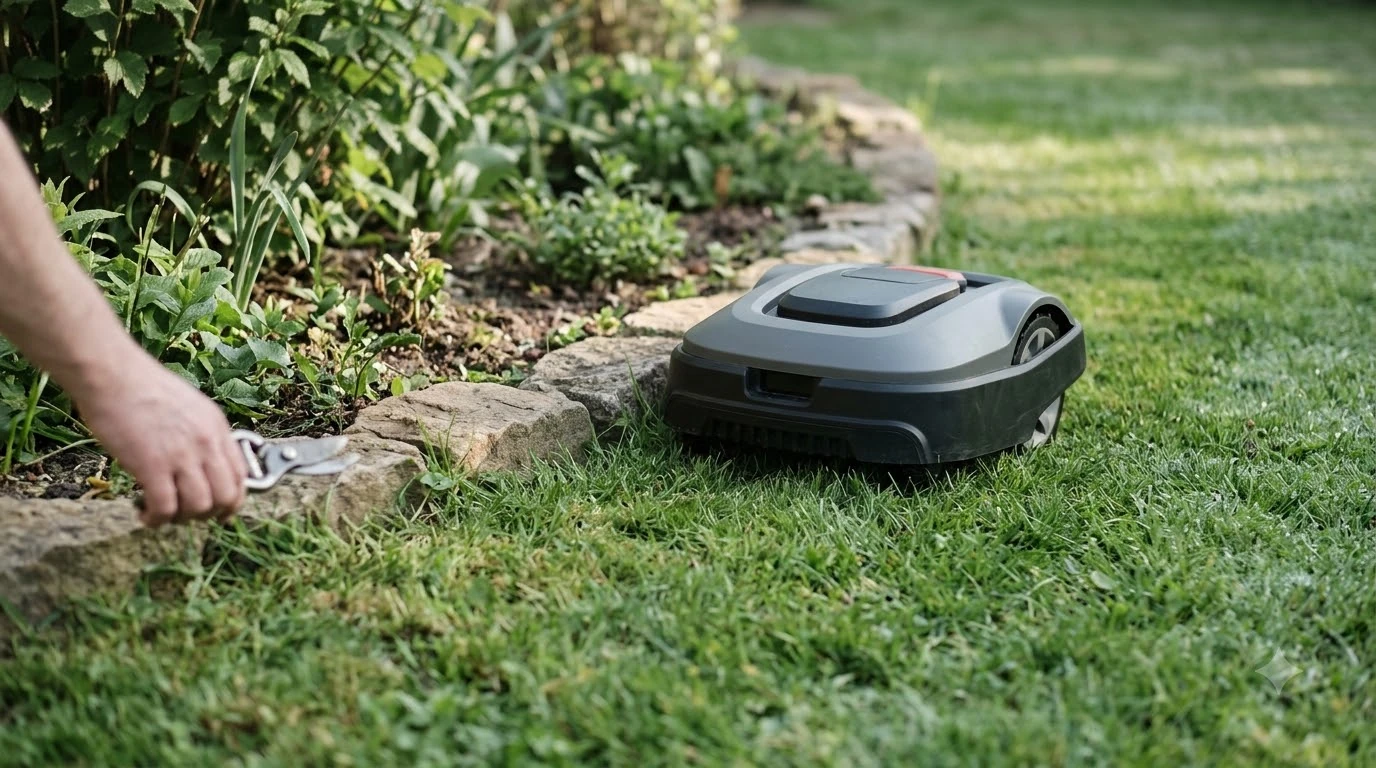

The best landscape edging for robot mower borders is flat, ground-level stone or concrete, because the mower can drive over it. Robomow’s edging guidance says these borders can be crossed, while raised, sloped, plastic and metal edging usually leaves a strip that needs trimming or a barrier. Where the boundary wire sits also changes the result.
The short answer
- Pick ground-level stone or concrete. Robomow says these borders can simply be driven over.
- Keep the surface level. Plastic, sloped and raised edging usually needs hand trimming or a physical stop.
- Avoid metal near the signal. Robomow says metal can severely interfere with the robot’s signal.
- Place the wire by the obstacle. Robomow’s wire guidance gives about 10 cm for beds and paths at lawn level and about 35 cm for walls and tall stone.
Why the border material matters for a robot mower
A center-mounted blade leaves an uncut strip of about 10 to 20 cm along the border, so the edging material decides how much trimming remains. Robomow’s edge-cut article puts that strip at about 10 to 20 cm for center-blade models and about 5 to 6 cm for its edge-cut function, using vendor figures. Ecovacs describes the same gap along borders as “greens creep” that needs manual trimming.
The edging sits inside that gap. A border the mower can roll over lets its wheels reach the lawn edge. A raised or uneven border keeps the blade back and leaves grass to cut by hand. Robomow lists the blade distance from the housing edge at between 6 cm on the edge-cut model and 20 cm on others, so the mower type matters as well as the material. Ecovacs says offset blades can cut nearer to the edge than center blades, though it gives no measurement.
Why ground-level stone is the best landscape edging for robot mower borders
Ground-level stone or concrete edging is the border material robot mower makers describe as drivable, and smooth, level stones give the cleanest result. Robomow lists smooth stones, concrete stones and dovetails as suitable, and says granite is a popular choice. In its guidance, rough-hewn stones give the mower a bumpy ride, which can cause bouncing and an uneven cut.
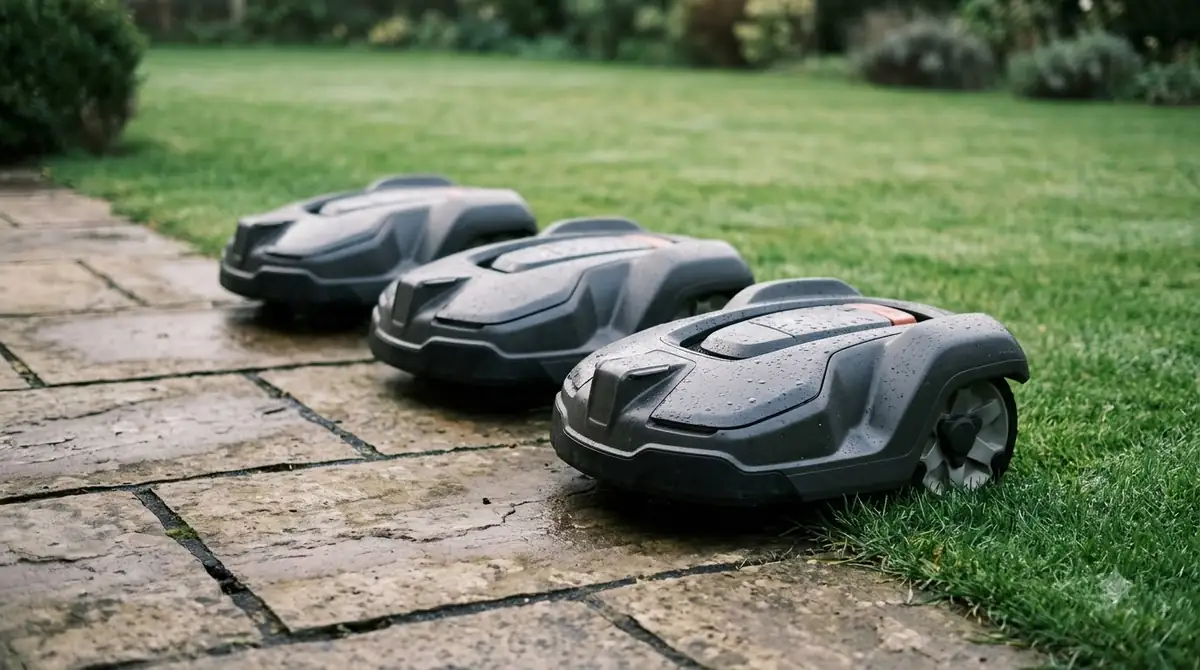
Robomow’s lawn edging guidance gives a short build sequence for this type of border:
- Dig a trench and add a sand layer so the stones sit flat.
- Lay the stones in two staggered rows, which the source says helps deter weeds.
- Use a stone width of often 10 cm for ground-level stones with a gap from a barrier, and 20 cm or more where a stone butts against a wall.
- If the wire runs in the trench, stay within the manufacturer’s maximum depth.
Raised, sloped, plastic and metal borders
Raised, sloped, plastic and metal borders usually fail the drive-over test, so plan for trimming, a barrier or a signal check. Robomow treats raised borders as barriers rather than surfaces to cross, and recommends them where a mower must be stopped, such as near pond embankments.
| Border type | Robomow guidance | What it means for you |
|---|---|---|
| Raised border, a few cm high | A barrier near hazards such as pond embankments, not a surface to cross | Useful as a stop, not as a drive-over edge |
| Sloped (English) edging | Not optimal; the slope can make the mower stick or cut unevenly | Keep the wire clear of the height change |
| Plastic or rubber | Usually not level, so the robot cannot drive over it | Expect a strip that needs hand trimming |
| Metal | Not recommended; can severely interfere with the signal | Avoid where the mower must cross |
Metal edging matters for a second reason. Husqvarna’s charging station placement guide says to keep metal edging, rebar and coiled low-voltage cable away from the charging station. Our reading is that the dock area needs the same check as the border.
Mulch, wood chips and wood edging
Mulch and wood chips can work as a border when backfilled in a small trench, but Robomow flags soil effects and a smaller wire offset. Treat mulch as a second-choice option for the best landscape edging for robot mower borders, not a default. The guidance says the mulch method is similar to stone edging. Wood chips draw nitrogen out of the soil, and lava stone raises acidity, so the source recommends countermeasures.
A mulch bed also needs a smaller wire offset than a bed planted right to the lawn edge. The source does not give a figure for that offset, so test the wire position before you bury it. Wood edging is possible when planks lie parallel to the edge and are secured so they do not sink or slip. Robomow notes that wood is less weather-resistant and warps, so expect to repair it over time.
Where to lay the boundary wire next to edging
Keep the boundary wire slightly inside the lawn edge rather than exactly on it, since the wire placement decides how close the mower gets to the best landscape edging for robot mower borders you choose. Robomow’s boundary wire guidance gives about 10 cm for beds, hedges, slabs and paths at or below lawn level, and about 35 cm for walls and tall stone. The exact offset depends on whether the mower has edge cutting and what borders the lawn.

Heads up
Robomow advises that runs of wire well under a metre apart can confuse navigation, so keep parallel runs clear of each other, and see how to lay boundary wire around obstacles. Husqvarna’s EdgeCut uses a fixed edge disc 45 mm (1.77 in) from the housing, which can reach a border that a center-blade model leaves uncut. The boundary wire still sets where the mower stops.
What to check before you buy or install
Check the edging height, width, surface level and material before you buy, because these decide whether the mower can cross the border. When you pick the best landscape edging for robot mower borders, those four points matter more than the brand name. Our reading is that a raised or metal border calls for a planned hand-trimmed strip rather than an expectation that the mower reaches the edge.
- Surface level: stones or concrete laid flat with the lawn, not sloped or raised.
- Material: avoid metal and plastic where the mower must cross.
- Stone width: about 10 cm for ground-level gaps, 20 cm or more against a wall.
- Wire offset: about 10 cm from lawn-level beds, about 35 cm from walls and tall stone.
- Charging station: keep metal edging, rebar and coiled cable away from the dock.
Frequently asked questions
Can a robot mower drive over stone edging?
Yes, if the stones sit at ground level. Robomow says ground-level stone or concrete borders can be driven over. Smooth, level stones give the cleanest result, while rough-hewn stones can make the ride bumpy and the cut uneven.
Is metal edging safe to use with a robot mower?
Robomow does not recommend metal edging because it can severely interfere with the robot’s signal. Husqvarna also advises keeping metal edging away from the charging station, so check both the border and the dock before you install a metal border.
Do I still need to trim after installing edging?
Often yes. Center-blade mowers leave an uncut strip of about 10 to 20 cm along borders, which Ecovacs calls greens creep. Edge-cut models narrow that strip, but Robomow notes that manual trimming can still be needed near walls and fences.
Can I use mulch as a border instead of stone?
Mulch can work as a border when it is backfilled in a small trench. Robomow notes that wood chips draw nitrogen from the soil and that a mulch bed needs a smaller wire offset than a bed planted to the lawn edge, though it gives no figure for that offset.
Sources
- Which lawn edging is suitable for robotic mowers (Robomow): stone, metal, plastic, wood, mulch and wire placement guidance.
- How cleanly does a robotic lawnmower mow the lawn edge (Robomow): uncut strip widths and edge-cut figures.
- Laying the lawn boundary wire (Robomow): wire distances from walls, beds and paths.
- What is edge cut and how to use it (Husqvarna): the 45 mm edge disc offset.
- Automower charging station optimal placement and mower house guide (Husqvarna): keeping metal away from the dock.
- Robot lawn mower for edge cutting (Ecovacs): the greens creep description.
 Up next8 min readGearBest Garden Fence for Robot Mower No-Go Zone: What Works and What Doesn’tUpdated Nov 11, 2026
 8 min readGearGPS Tracker for Robot Mower Theft: What Works and What to CheckUpdated Nov 11, 2026
 8 min readGearRobot Mower Wheel Brushes: What to Use and What to AvoidUpdated Nov 11, 2026
 9 min readGearBest Compressed Air Duster for Robot Mower Sensors: What to Use and What to AvoidUpdated Nov 11, 2026
 8 min readGearBest Robot Mower Cleaning Brush: What to Use and What to AvoidUpdated Nov 11, 2026
 8 min readGearBest Mowing Strip Pavers for Robot Mower Edges: What to CheckUpdated Nov 11, 2026