
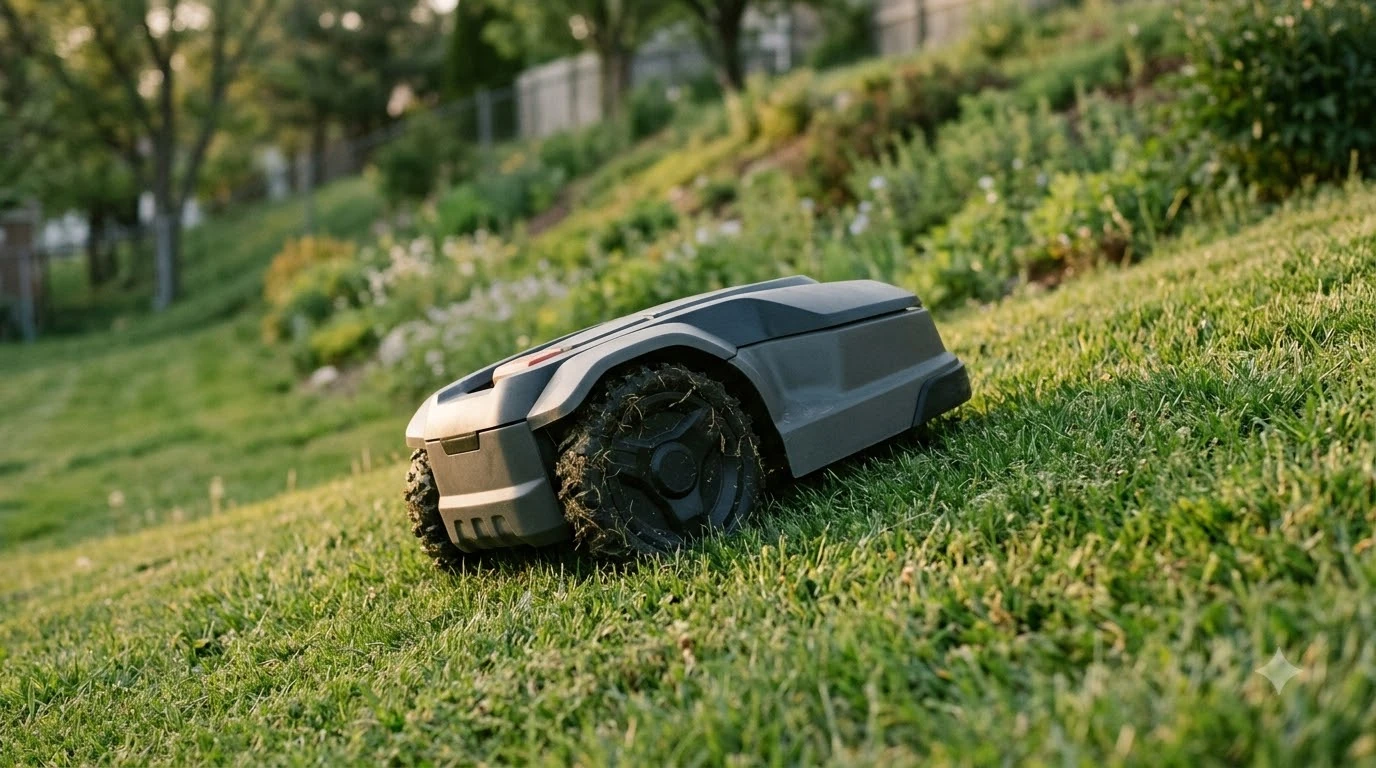

What does AWD mean on a robot mower? It means all-wheel drive, with power sent to every wheel rather than only the front or rear pair. The extra grip helps on slopes and uneven ground, and Husqvarna lists slope limits that differ by model. Because AWD also adds cost and parts, the useful question is whether your yard needs that grip, not just whether the label is there.
The short answer
- AWD: all four wheels receive drive power.
- 2WD: only two wheels, usually the front or rear pair, are driven.
- Grip: AWD generally helps on slopes, rough ground, and damp turf.
- Check the spec: read the number of driven wheels and the slope rating, not just the name.
- Trade-off: AWD usually costs more and has more drivetrain parts to maintain.
What does AWD mean on a robot mower?
All-wheel drive, or AWD, means every wheel on the mower is driven by the drive system. A standard robot mower usually drives two wheels and lets the others follow. An AWD mower uses more drive power to pull through grass, soft soil, and slopes, so each wheel contributes traction. Drive type matters most on hills, so choosing a mower for sloped lawns is the natural next step after learning what AWD stands for.
Some vendors call the same design 4WD, so the label alone is not enough. Mammotion’s own explainer describes AWD as powering “all four wheels instead of just the front or rear,” which matches the plain meaning. The number of driven wheels is the detail that matters when you compare models.
How AWD differs from 2WD on a robot mower
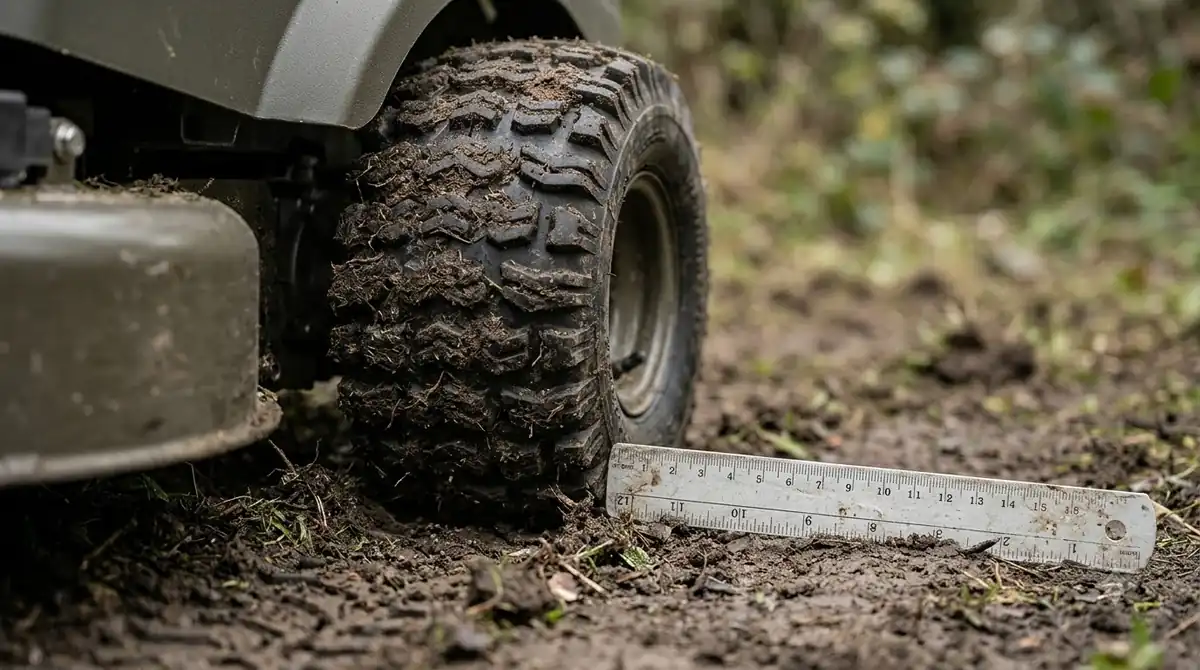
A 2WD mower sends power to two wheels. In a front-wheel-drive design, a central motor drives the front wheels and the rear wheels follow. In a rear-wheel-drive design, the rear wheels do the work and the front wheels steer. Either layout can handle a flat, dry lawn well, because the drive load is light. For a concrete look at AWD generations, Luba 3 AWD versus Luba 2 AWD compares two models from the same brand.
An AWD design spreads the load across four wheels. That matters most when one pair of wheels starts to slip. On a slope, a 2WD mower may lose grip on the driven pair, while an AWD mower keeps pulling through the other two. The difference is most noticeable on steep banks, wet grass, and ground with roots or ruts.
| Question | 2WD (front or rear drive) | AWD (all four wheels) |
|---|---|---|
| Wheels driven | Two | Four |
| Grip on slopes | Good on gentle slopes | Better on steeper, uneven ground |
| Typical cost | Lower | Higher |
| Parts to maintain | Fewer | More drivetrain parts |
| Best fit | Flat, dry, simple yards | Slopes, rough ground, damp turf |
The table is a general guide. The specifics depend on the model, so the spec sheet is the final word for any particular mower.
What the slope rating tells you
AWD is most useful when it shows up in the slope rating. Husqvarna’s support guidance puts standard models at about 25 to 50 percent slope, depending on the model. Its 435X AWD is rated up to 70 percent, or 35 degrees, and its boundary rating is lower than the work-area rating. The two numbers are different, so check both. A published slope rating is easier to judge with an example, such as Anthbot M5 slope limit explained. Slope ratings interact with safety sensors, a point covered in tilt sensor behavior on steep ground.
Husqvarna also explains how to measure a slope. Divide the vertical height by the horizontal distance and multiply by 100. A rise of 15 cm over 100 cm is a 15 percent slope. Measure your steepest area before you compare ratings, because a yard that looks steep can be gentler than it seems.
Heads up
Mammotion’s AWD article claims its LUBA 2 AWD is rated for slopes up to 80 percent. That is a vendor claim from a company selling the model, so compare it with the manufacturer’s official spec sheet and the installation guidance before you rely on it.
What AWD does not fix
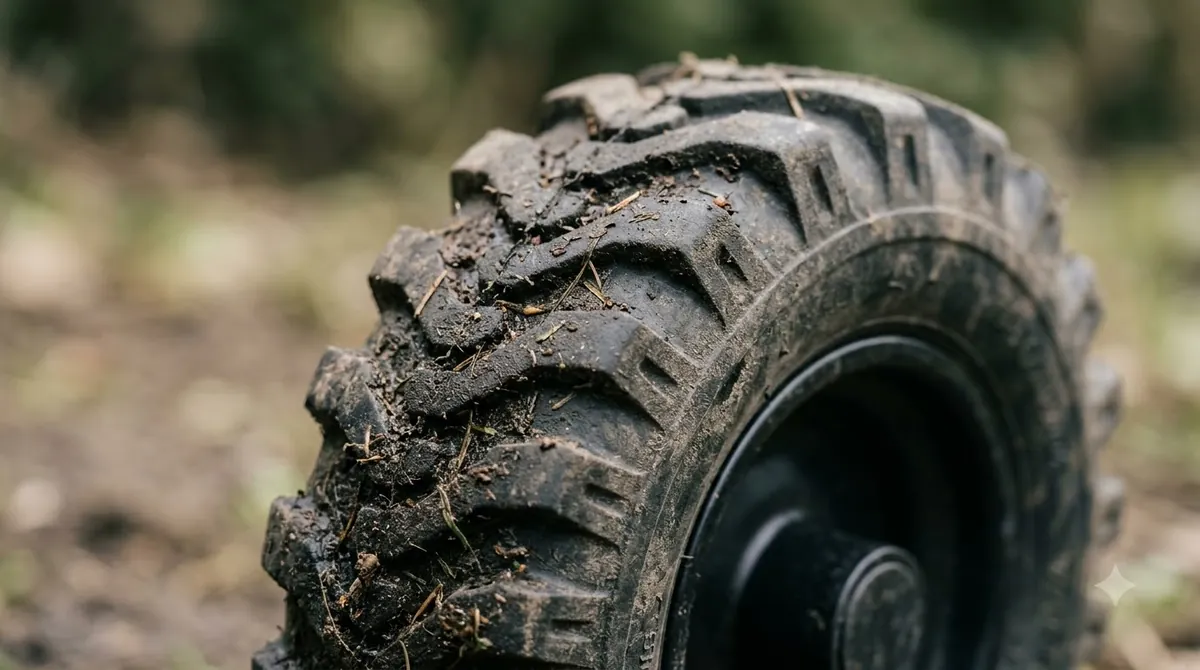
AWD does not remove every slope problem. Husqvarna notes that grass clogging the wheels makes slopes harder to manage, and that wet conditions raise the risk of slipping, especially when the mower turns on a slope. Keep the wheels clean, and use an optional wheel kit or brushes if the manual offers them. Even an AWD model needs sensible settings on a hill, which slope setup steps for robot mowers walks through. AWD does not make every yard suitable, and flat lawn requirements for robot mowers explains what terrain still causes trouble.
The boundary wire also matters. Slopes need to stay inside the model’s limit both in the work area and near the boundary, and steep edges may need to be excluded. A powerful drive system cannot make up for a boundary laid too close to a drop.
When AWD is worth the extra cost
AWD is worth considering when the yard has steep banks, several wet areas, or ground that tends to rut or slip. It is also a reasonable choice when the lawn is large, uneven, and has many obstacles that the mower must climb around. In these cases the extra grip reduces the chance of getting stuck. To see how the extra cost plays out on one model, read is the Luba 3 AWD worth it for a verdict.
AWD is harder to justify on a small, flat, dry lawn. Mammotion’s own guidance says an AWD mower may be unnecessary for a small, mostly flat yard with clean edges. Our reading is that a 2WD model with good boundary setup often does the job on a simple yard, and the money is better spent on a reliable boundary and charging station.
How to check AWD before you buy
Read the drive description on the spec sheet and confirm the number of driven wheels. Then check the slope rating for the work area and for the boundary, and compare it with your measured slope. Look for the maintenance schedule too, since AWD models can have more parts to inspect over time. Once you know whether you need AWD, a complete robot mower buying guide helps place that feature among the other specs.
Finally, ask whether the local dealer can service the model. Some AWD machines have fewer service points near home, so a model you can get repaired locally may be worth more than a few extra percentage points of slope rating.
Frequently asked questions
What does AWD mean on a robot mower?
AWD means all-wheel drive. The mower sends drive power to all four wheels instead of only the front or rear pair. That gives more grip on slopes and uneven ground, and it usually costs more.
Is AWD the same as 4WD on a robot mower?
Usually, the two terms describe the same idea, but vendors do not always use them the same way. Read the spec sheet for the number of driven wheels and the drive layout.
Do I need AWD for a flat lawn?
Probably not. A flat, dry, simple lawn usually works well with a 2WD mower. Mammotion’s own guidance says AWD may be overkill for a small, mostly flat yard with clean edges.
Does AWD make a robot mower safer on slopes?
It can improve grip, but it does not remove the need to respect the slope rating and boundary setup. Check the work-area and boundary limits in the manual, and keep the wheels clean on slopes.
Sources
- Husqvarna, Optimising an Automower installation for steep slopes (manufacturer): standard slope range, 435X AWD rating, slope measurement, traction and boundary guidance.
- Mammotion, All-wheel drive robot lawn mowers: pros and cons (vendor, read with caution): AWD meaning, cost and maintenance trade-offs, and the note that AWD may be overkill for small, flat yards.
 Up next6 min readLearnWhat Does an RTK Fixed Solution Mean on a Robot Mower?Updated Nov 13, 2026
 6 min readLearnWhat Does RTK Float Mean on a Robot Mower?Updated Nov 14, 2026
 7 min readLearnWhat Do Robot Mower Charging Station Lights Mean?Updated Nov 12, 2026
 8 min readLearnWhat Do Robot Mower Error Codes Mean? Causes and First FixesUpdated Nov 12, 2026
 7 min readLearnRobot Mower Blade Motor Error: What It Means and What to Check FirstUpdated Nov 12, 2026
 7 min readLearnDreame Robot Mower LiDAR Error: What It Means and How to Fix ItUpdated Nov 11, 2026